AI Chatbot for Leads: What It Is and How It Works

AI Chatbot for Leads: What It Is and How It Works
An AI chatbot for leads is a conversational software tool that engages website visitors in real time, asks targeted questions, and captures contact and intent data for sales follow-up. Unlike a static contact form, a lead generation chatbot, the standard industry term for this technology, holds a two-way conversation that mirrors talking to a real person. Platforms like Salesforce and tools like Kommunicate have built entire frameworks around this approach. The result is a faster, smarter way to fill your sales pipeline without adding headcount.
What is an AI chatbot for leads and how does it work?
An AI chatbot for leads is defined as a real-time conversational AI tool that engages visitors, asks discovery questions, and pushes captured data directly into CRM systems for follow-up. The key word is “real time.” When a visitor lands on your site at 11 p.m. on a Sunday, the chatbot is already there, ready to respond. No one on your team needs to be awake.
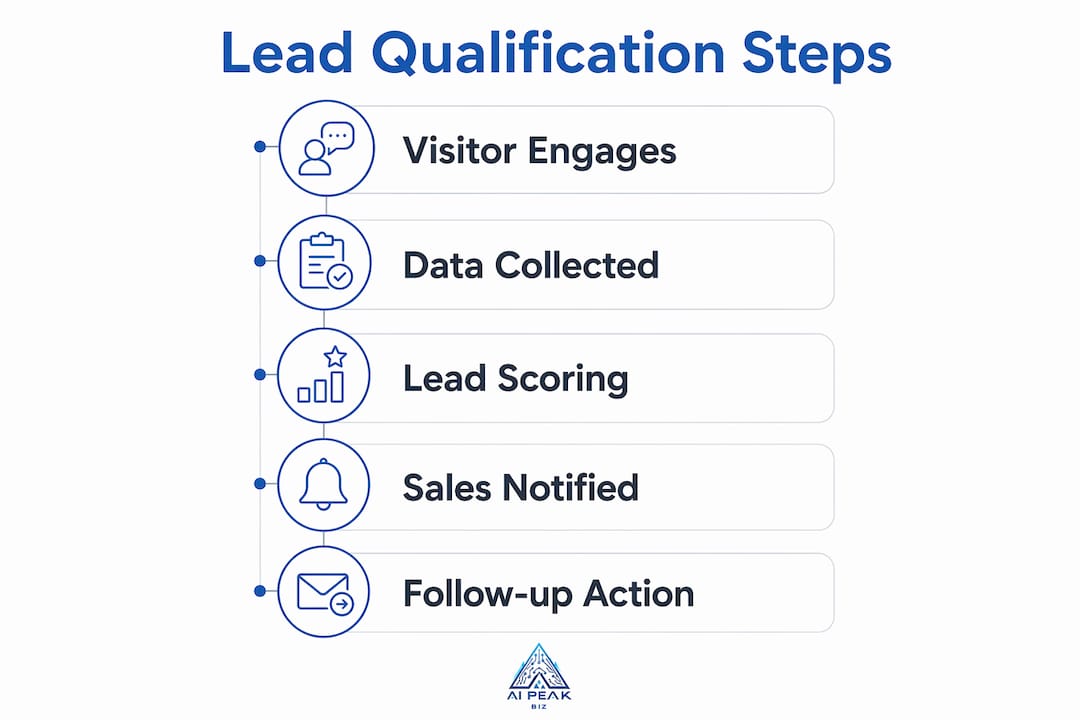
The chatbot collects name, email, phone number, and stated preferences through natural conversation. It then interprets those responses to score the lead and decide what happens next. A highly qualified lead gets routed to your sales team immediately. A less qualified visitor enters a nurture sequence or gets pointed to a self-serve resource. This kind of automated lead routing removes the guesswork from your sales process and keeps your pipeline moving.

Modern AI chatbots use natural language processing, meaning they understand loosely worded or informal answers. A visitor who types “I’m not sure about my budget yet” gives the bot enough signal to classify that lead as early stage. The bot adjusts its next question accordingly. That level of nuance is impossible with a standard web form.
How do AI chatbots generate and qualify leads effectively?
Lead qualification is the process of determining whether a prospect is worth a sales team’s time. AI chatbots do this through a structured conversation designed around four core questions: What do you need? What is your budget? When do you need it? Who makes the decision? These map directly to the classic BANT framework used by sales teams worldwide.
The chatbot does not ask all four questions at once. It sequences them based on the visitor’s previous answers. If someone says they need a service urgently, the bot prioritizes timeline and budget questions next. Conversational intent signals gathered this way produce better qualification data than static demographic fields alone. A form cannot adapt. A chatbot can.
Here is what a well-built qualification sequence covers:
- Needs: What problem is the visitor trying to solve?
- Budget: Do they have funds allocated, or are they still researching?
- Timeline: Are they ready to buy now, or planning for next quarter?
- Authority: Are they the decision maker, or do they need to consult someone?
- Contact details: Name, email, and phone number for follow-up.
Once the bot collects this data, it assigns a lead score. High-scoring leads trigger an immediate sales notification. Lower-scoring leads enter an automated email sequence. Structured lead data with fit, urgency, and value scores routed to CRM pipelines close deals faster than unstructured chat transcripts sitting in an inbox.
Pro Tip: Set your chatbot to ask the disqualifying question early. If budget is your biggest filter, ask about it second, not last. You save the visitor’s time and yours.
What are the key benefits of AI chatbots for marketing and sales?
AI chatbots increase landing page conversion by 2–4x and reduce cost per lead by 30–50% compared to static forms. Those numbers represent a fundamental shift in how marketing budgets perform. Getting more leads at lower cost from the same traffic is the goal of every marketing team.
The benefits extend well beyond conversion rates:
- 24/7 availability: Chatbots capture and qualify leads outside normal business hours, so you never miss an opportunity because your office was closed.
- Lower friction: Visitors are more likely to answer a conversational question than fill out a multi-field form. Conversation feels natural. Forms feel like work.
- Personalized engagement: The chatbot tailors its responses based on what the visitor says, creating a more relevant experience that builds trust faster.
- Faster sales handoff: Qualified leads reach your sales team within minutes of the conversation ending, not hours or days later.
- Consistent data quality: Every lead arrives in your CRM with the same structured fields, making it easier to prioritize and act.
The 24/7 benefit deserves special attention. A significant portion of web traffic arrives outside the 9-to-5 window. Without a chatbot, those visitors leave without engaging. With one, they get answers, share their needs, and enter your pipeline while you sleep. For service businesses, that is revenue that would otherwise leak quietly away.
What best practices make AI chatbot lead generation succeed?
The design of your chatbot conversation matters as much as the technology behind it. Keeping qualification questions short and well-ordered reduces visitor drop-offs and improves lead quality. Every additional question you add increases the chance a visitor abandons the conversation. Aim for five questions or fewer in your core qualification flow.
Follow this sequence when building your chatbot:
- Open with a warm greeting. State what the bot can help with. Set expectations immediately.
- Ask about the visitor’s primary need. This is the most natural first question and gets the conversation moving.
- Introduce a disqualifying question early. Budget or timeline works well here. Filter out poor fits before investing more of the visitor’s time.
- Collect contact details mid-conversation. Asking for an email after the visitor is already engaged produces higher completion rates than asking upfront.
- Confirm and close. Tell the visitor what happens next. “A team member will reach out within one business day” sets a clear expectation and builds trust.
Beyond conversation design, data handling is where most businesses fall short. Fast CRM sync and sales notifications after lead capture increase conversion by reducing lost opportunities from delayed follow-up. Mapping chatbot answers to specific CRM fields, not just saving a chat transcript, is what makes the data usable for your sales team.
Compliance is non-negotiable. GDPR requires affirmative consent with a timestamp and mechanisms for data deletion upon user request. Even if you operate primarily in the United States, many of your website visitors may be subject to GDPR or state-level privacy laws like the California Consumer Privacy Act. Build consent into your chatbot flow from day one.
Pro Tip: Deploy your chatbot across multiple channels, not just your website. WhatsApp, Facebook Messenger, and SMS reach prospects where they already spend time, and the same qualification logic applies.
Additional best practices worth noting:
- Map every chatbot answer to a named CRM field, not a free-text note.
- Set up instant email or SMS alerts to your sales team when a high-scoring lead completes the flow.
- Review drop-off points monthly and rewrite questions where visitors consistently abandon.
- Test your chatbot on mobile. Most visitors use a phone, and long questions look terrible on a small screen.
AI chatbots vs. traditional lead capture: which performs better?
The performance gap between AI chatbots and traditional methods is not marginal. It is structural. Static forms ask the same questions to every visitor regardless of context. Manual outreach relies on a human being available at the right moment. Chatbots do neither.
| Factor | AI chatbot | Static form / manual outreach |
|---|---|---|
| Availability | 24 hours a day, 7 days a week | Business hours only |
| Conversion rate | 2–4x higher than static forms | Baseline |
| Cost per lead | 30–50% lower | Baseline |
| Lead qualification | Real-time, adaptive questioning | Fixed fields, no adaptation |
| CRM integration | Instant, structured data sync | Manual entry or delayed import |
| Visitor experience | Conversational, low friction | Form fatigue, high drop-off |
| Response to visitor intent | Adjusts based on answers | Cannot adjust |
Manual outreach adds another layer of delay. A sales rep who calls a lead four hours after they submitted a form is competing against every other vendor that lead has already contacted. Speed matters enormously in lead conversion. A chatbot that routes leads immediately to your CRM and notifies your team within seconds of conversation completion gives you a real advantage.
The one area where forms still hold value is for highly technical or regulated industries where the visitor needs to upload documents or provide complex specifications. For most service businesses, a chatbot outperforms a form on every metric that matters.
Key Takeaways
An AI chatbot for leads outperforms static forms and manual outreach by qualifying prospects in real time, syncing structured data to your CRM instantly, and capturing leads around the clock.
| Point | Details |
|---|---|
| Core function | A lead generation chatbot engages visitors, qualifies them, and pushes data to your CRM automatically. |
| Conversion impact | AI chatbots increase landing page conversion by 2–4x and cut cost per lead by 30–50%. |
| Question design | Keep qualification flows to five questions or fewer to reduce drop-offs and improve data quality. |
| CRM integration | Map chatbot answers to named CRM fields and trigger instant sales notifications for fastest follow-up. |
| Compliance | Build affirmative consent and data deletion mechanisms into your chatbot flow from the start. |
What I have learned from watching chatbots replace bad lead processes
I have watched businesses spend thousands of dollars on paid traffic and then send every visitor to a six-field contact form with a three-day response time. The chatbot did not fix their marketing. It fixed their process. That distinction matters more than most people realize.
The biggest mistake I see is treating a chatbot like a FAQ widget. A FAQ widget answers questions. A lead generation chatbot asks them. The moment you design your bot around what the visitor wants to know rather than what your sales team needs to know, you lose the qualification value entirely. The bot becomes a cost center instead of a revenue tool.
Generative AI is changing the ceiling on what these bots can do. Earlier rule-based chatbots broke the moment a visitor typed something unexpected. Today’s AI-powered bots handle ambiguous, informal, and even contradictory answers with enough grace to keep the conversation moving. That reliability is what makes AI chatbot lead generation worth investing in for businesses that previously wrote off the technology after a bad experience with an older system.
The integration piece is still where most implementations fail. A chatbot that captures leads but dumps them into an unmonitored inbox is worse than no chatbot at all. It creates a false sense of coverage. The data has to flow directly into a CRM pipeline with a named owner and a follow-up deadline. Without that, the technology is just theater.
My honest recommendation: start with one channel, one qualification flow, and one CRM integration. Get that working cleanly before you expand. The businesses that see the fastest results are not the ones with the most sophisticated bots. They are the ones with the tightest process behind the bot.
— Wylie
How Aipeakbiz helps service businesses capture leads around the clock
Service businesses lose revenue every time a call goes unanswered or a website visitor leaves without engaging. Aipeakbiz is built specifically to close that gap.
Aipeakbiz’s AI chatbot for service businesses answers inquiries instantly, qualifies prospects through targeted conversation, and books appointments directly into your calendar, day or night. The system syncs lead data to your pipeline in real time and notifies your team the moment a high-value prospect completes the flow. For businesses that rely on appointments and phone calls to drive revenue, the AI appointment setter removes the gap between interest and booked business. No missed calls. No cold leads sitting in an inbox. Just a consistent, qualified pipeline.
FAQ
What is a lead generation chatbot?
A lead generation chatbot is an AI-powered conversational tool that engages website visitors, asks qualification questions, and captures contact and intent data for sales follow-up. It integrates directly with CRM systems to route qualified leads to your sales team automatically.
How do AI chatbots qualify leads?
AI chatbots qualify leads by asking targeted questions about needs, budget, timeline, and decision authority, then scoring responses to determine whether a lead goes to sales or enters a nurture sequence. Structured data from these conversations routes directly to CRM pipelines for immediate action.
Can chatbots improve lead conversion rates?
Yes. AI chatbots increase landing page conversion by 2–4x compared to static forms and reduce cost per lead by 30–50%. The combination of 24/7 availability and adaptive questioning accounts for most of that improvement.
What compliance rules apply to chatbot lead capture?
GDPR requires affirmative consent with a timestamp and a clear mechanism for users to request data deletion. Businesses operating in the United States should also account for state-level privacy laws like the California Consumer Privacy Act when designing their chatbot consent flows.
How many questions should a lead generation chatbot ask?
Five questions or fewer is the recommended ceiling for a qualification flow. Keeping the sequence short reduces visitor drop-offs and produces cleaner, more usable lead data for your sales team.
Recommended
Want to see what your business is losing?
Take our free revenue assessment and find out how much missed calls, slow follow-up, and dormant leads are costing you every month.
Take the Free Assessment