AI in Contractor Scheduling: A 2026 Practical Guide

AI in Contractor Scheduling: A 2026 Practical Guide
AI in contractor scheduling is defined as the use of machine learning, natural language processing, and generative algorithms to automate, predict, and optimize project timelines and crew assignments. The role of AI in contractor scheduling has shifted from a niche experiment to a core project control method, with generative AI tools now accelerating infrastructure projects by up to 20%. The industry standard framework for scheduling, Critical Path Method (CPM) as governed by AACE International, remains the backbone. AI adds an analytic layer on top of it, not a replacement. For contractors and project managers, this means faster decisions, fewer missed appointments, and measurable revenue gains.
How does AI improve efficiency and accuracy in contractor scheduling?
AI removes the manual work that slows scheduling down. Traditionally, project managers spent hours reconciling spreadsheets, chasing percent-complete updates, and reformatting reports. AI handles all of that automatically, freeing schedulers for work that actually requires judgment.
The core functions that drive efficiency gains include:
- Automated status capture: AI pulls field data directly into the schedule, eliminating manual entry and reducing reporting lag.
- Agentic monitoring: The system watches for schedule drift in real time and flags deviations before they compound into delays.
- Natural-language queries: Non-schedulers can ask plain-English questions and receive CPM-based answers instantly, without opening complex software.
- Generative scheduling: AI models millions of execution paths, weighing labor availability, material lead times, and sequencing dependencies to produce an optimized timeline.
- Scenario modeling: Tools like Planera’s AI assistant “Manny” run real-time what-if simulations so project managers can evaluate recovery plans in minutes, not days.
The results are significant. Generative AI scheduling has produced up to 40% schedule reductions on some data center and infrastructure projects. That kind of compression is not achievable through manual CPM scheduling alone, no matter how experienced the team.
AI scheduling tools also keep timelines current without human intervention. Schedules update automatically when inspections, deliveries, or site walk-throughs shift, reflecting actual progress rather than last week’s snapshot. This keeps every stakeholder working from accurate data.

Pro Tip: Set your AI scheduling tool to push daily digest alerts to your project manager’s phone. Real-time flags only help if someone reads them before the crew shows up.
What is the evolving role of human schedulers alongside AI in construction projects?
The “AI versus scheduler” framing is wrong. AI offloads repetitive tasks and schedulers move up to strategic work. That is the actual dynamic playing out on job sites right now.
AI manages repetitive updates like form-filling, spreadsheet reconciliation, and percent-complete reporting. Human schedulers then focus on CPM network logic, sequencing dependencies, realistic duration-setting, and risk identification. These are judgment calls that require project context, contractor relationships, and an understanding of what can go wrong on a specific site.
“AI scheduling tools need to be seen as recommendation engines. Human judgment remains essential to interpret and apply AI output effectively. The scheduler who understands why the AI flagged a conflict is far more valuable than one who simply accepts or dismisses the alert.”
The danger is not that AI replaces schedulers. The danger is that project managers assume AI output is authoritative and stop questioning it. An AI tool does not know that your concrete subcontractor always runs two days late in winter, or that the local inspection office closes early on Fridays. Those nuances live in the scheduler’s head.
Human schedulers remain vital for reviewing complex logic, spotting risks before delays occur, and making calls that protect float and contractual obligations. AI supports these tasks. It does not perform them.
Pro Tip: Treat every AI schedule recommendation as a draft, not a directive. Have your lead scheduler review flagged conflicts before any crew reassignment goes out.
Most experienced schedulers actually prefer AI-assisted workflows. Scheduler work shifts from data management to strategic conversations and risk mitigation when AI handles the administrative load. That is a better use of expensive, experienced talent.
What practical benefits do contractors and project managers gain from AI scheduling tools?
The financial case for contractor scheduling automation is concrete. Contractors implementing AI dispatch and scheduling tools have seen $8,000–$15,000 per month in recovered revenue, with ROI above 500% within 90 days. Most of those gains come from two sources: reduced missed calls and better route optimization.
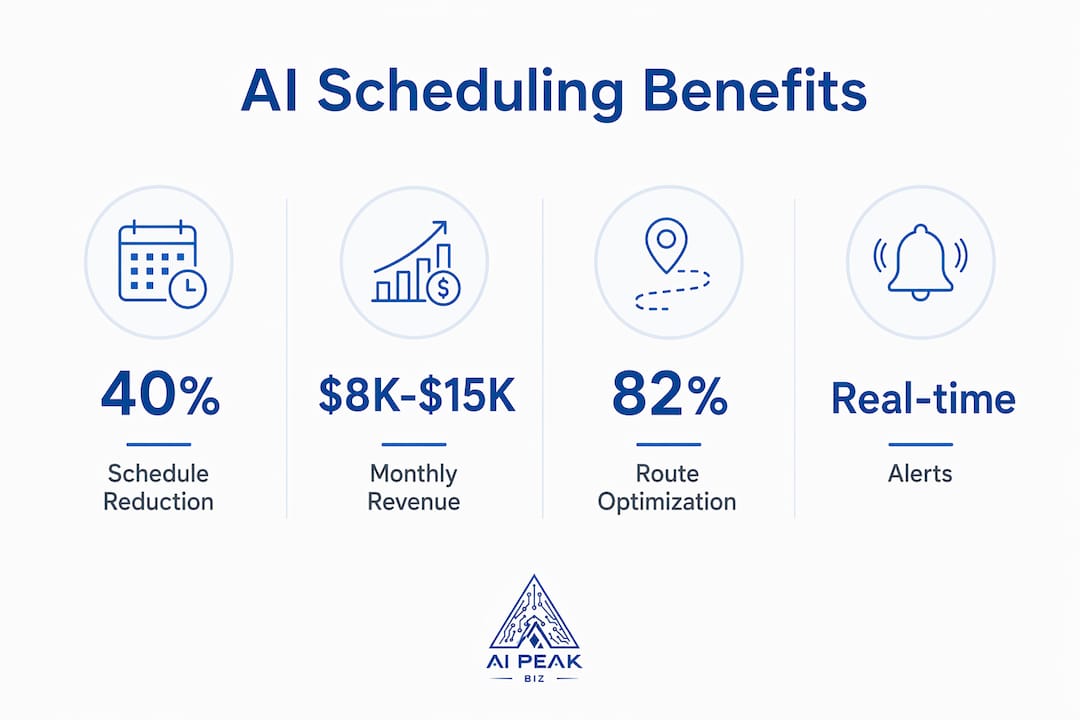
Route optimization alone changes the math on daily job capacity. AI handles 82% of route optimization tasks across the industry, cutting drive time and fitting more jobs into each technician’s day. The revenue impact is direct: fitting one or two extra jobs per technician per day adds $2,250–$4,500 in daily revenue.
The table below summarizes the primary benefit categories contractors report after adopting AI scheduling tools:
| Benefit category | What it means in practice |
|---|---|
| Revenue recovery | Fewer missed calls and faster lead follow-up convert more inbound inquiries into booked jobs |
| Route efficiency | AI-optimized routing cuts drive time and increases daily job capacity per technician |
| Crew conflict prevention | Cross-project calendar views flag double-bookings before crews are deployed |
| Real-time schedule accuracy | Timelines update automatically as field conditions change, reducing rework |
| Communication automation | AI handles intake, appointment reminders, and follow-up texts without staff involvement |
Beyond the numbers, the operational benefits compound over time. A contractor using AI for appointment scheduling stops losing leads to voicemail. A project manager using AI for crew calendaring stops discovering conflicts the morning of deployment. These are not marginal improvements. They change how a business runs day to day.
Additional benefits contractors consistently report include:
- Faster client response times, which directly affect close rates on new bids
- Reduced administrative burden on office staff, freeing them for higher-value tasks
- Improved customer satisfaction scores tied to on-time arrivals and proactive communication
- Better documentation of schedule changes for dispute resolution and contract compliance
For contractors who want a practical starting point, AI tools for contractors that focus on call answering and appointment booking deliver the fastest visible ROI before you tackle full schedule integration.
What challenges and best practices should contractors consider when adopting AI scheduling?
AI scheduling fails most often because of bad data, not bad algorithms. 95% of AI project failures trace back to poor baseline schedule data rather than any limitation in the AI itself. If your existing schedule has vague durations, missing logic ties, or outdated resource assignments, the AI will produce unreliable output from day one.
A stepwise adoption approach reduces risk and builds team confidence:
- Start with reminders and routing. Deploy AI for appointment reminders and technician routing first. These functions have clear inputs, measurable outputs, and low risk if something goes wrong.
- Add intake automation. Use AI to handle inbound calls, qualify leads, and book appointments around the clock. This is where revenue recovery happens fastest.
- Integrate with your existing platform. AI adds the most value when it connects to tools you already use. Integration with Primavera P6 or similar CPM platforms preserves contractual logic and float calculations while adding an analytic layer.
- Activate real-time monitoring. Once your baseline data is clean, turn on agentic monitoring for schedule drift and crew conflicts.
- Expand to generative scheduling. Use AI to model alternative execution paths and stress-test your schedule against supply chain or labor disruptions.
The most common adoption mistake is ignoring AI flags. Unheeded crew conflict alerts lead directly to capacity problems and jobsite errors. Successful contractors treat AI warnings as mandatory review items, not optional suggestions. Build a protocol where flagged conflicts require a human decision before the schedule moves forward.
Pro Tip: Before you deploy any AI scheduling tool, audit your existing schedule data. Fix missing logic ties and update resource assignments. Clean inputs produce reliable AI outputs. Garbage in still means garbage out.
Selecting the right tool matters too. Entry-level field apps handle routing and reminders well but lack CPM integration. Enterprise platforms offer full schedule analytics but require more setup time and staff training. Match the tool’s capability to your current data maturity and team readiness, not to the most impressive feature list.
Key Takeaways
AI in contractor scheduling delivers the greatest value when clean baseline data, human oversight, and phased adoption work together to produce reliable, revenue-generating results.
| Point | Details |
|---|---|
| AI accelerates project timelines | Generative scheduling tools reduce project duration by up to 40% on complex builds. |
| Human oversight is non-negotiable | Schedulers must review AI flags and apply project context before acting on recommendations. |
| Revenue recovery is measurable | Contractors report $8,000–$15,000 per month in recovered revenue after adopting AI dispatch tools. |
| Data quality drives AI success | 95% of AI scheduling failures stem from poor baseline data, not algorithm limitations. |
| Phased adoption reduces risk | Start with reminders and routing, then expand to full schedule integration as data quality improves. |
What I’ve learned from watching AI reshape contractor scheduling
I’ve watched contractors adopt AI scheduling tools with two very different mindsets, and the mindset matters more than the software.
The contractors who get results treat AI as a capable assistant with a blind spot. They feed it clean data, review its flags, and override it when site conditions demand it. The contractors who struggle hand the AI the keys and walk away. They discover the problem when a crew shows up to a job that was double-booked three days ago.
The most underrated benefit of AI in construction management is not speed. It’s the quality of conversations it enables. When a project manager can pull a real-time schedule analysis in plain English, the conversation with a subcontractor or owner shifts from “I’ll check and get back to you” to “here’s where we stand right now.” That credibility is worth more than any algorithm.
I also think the AI versus human receptionist debate misses the point for most contractors. The real question is what your human staff should be doing instead of answering routine calls and chasing confirmations. AI handles the repetitive communication. Your people handle the relationships. That division works.
The contractors who will win in the next five years are not the ones with the most sophisticated AI. They are the ones who build clean data habits now, adopt AI incrementally, and keep experienced schedulers in the loop. Technology without discipline produces expensive noise.
— Wylie
How Aipeakbiz helps contractors recover revenue through smarter scheduling
Missed calls and slow follow-up are where contractor revenue leaks quietly. Aipeakbiz built its AI system specifically to stop that leak. The platform answers calls and texts instantly, qualifies leads, and books appointments around the clock, so no inquiry sits unanswered until Monday morning.
For contractors already managing complex project schedules, Aipeakbiz handles the front-end communication layer that feeds your schedule with confirmed, qualified appointments. That means your crew calendar fills with real jobs, not tentative callbacks. Explore AI scheduling for contractors to see how the system fits your workflow, or review Aipeakbiz pricing to find the plan that matches your call volume and booking needs.
FAQ
What is the role of AI in contractor scheduling?
AI in contractor scheduling automates data entry, route optimization, crew conflict detection, and appointment booking while providing predictive insights that help project managers make faster decisions. It works alongside CPM scheduling methods, not as a replacement for them.
How much revenue can contractors recover with AI scheduling tools?
Contractors implementing AI dispatch and scheduling tools report $8,000–$15,000 per month in recovered revenue, with ROI above 500% within 90 days, primarily from reduced missed calls and better route optimization.
Does AI replace human schedulers on construction projects?
AI does not replace human schedulers. It removes repetitive data tasks so schedulers can focus on CPM logic review, risk analysis, and strategic decision-making. Human judgment remains essential for interpreting AI output and applying project-specific context.
What is the biggest risk when adopting AI scheduling software?
Poor baseline schedule data is the leading cause of AI scheduling failure. Auditing and cleaning your existing schedule data before deployment is the single most effective step you can take to get reliable results from any AI scheduling tool.
How does AI route optimization benefit contractors?
AI handles 82% of route optimization tasks across the industry, cutting technician drive time and increasing daily job capacity. Fitting one to two extra jobs per technician per day produces $2,250–$4,500 in additional daily revenue.
Recommended
Want to see what your business is losing?
Take our free revenue assessment and find out how much missed calls, slow follow-up, and dormant leads are costing you every month.
Take the Free Assessment