How AI Qualifies Patient Appointment Requests in 2026

How AI Qualifies Patient Appointment Requests in 2026
AI patient appointment qualification is defined as the automated process of capturing a patient’s reason for visit, urgency level, and scheduling availability to match them with the right provider without manual staff intervention. This is the industry term for what many administrators call “AI appointment screening.” Understanding how AI qualifies patient appointment requests matters now more than ever, because booking time reductions of over 96% are already documented in clinical simulation tests. That figure represents a drop from 155 minutes to under 6 minutes per appointment. Systems like those built on BioBERT-BiLSTM triage models and platforms such as Heidi Comms and IPAS are proving that AI in patient scheduling is no longer experimental. It is operational, and it is reshaping front desk workflows across healthcare practices.
How AI qualifies patient appointment requests: core technologies
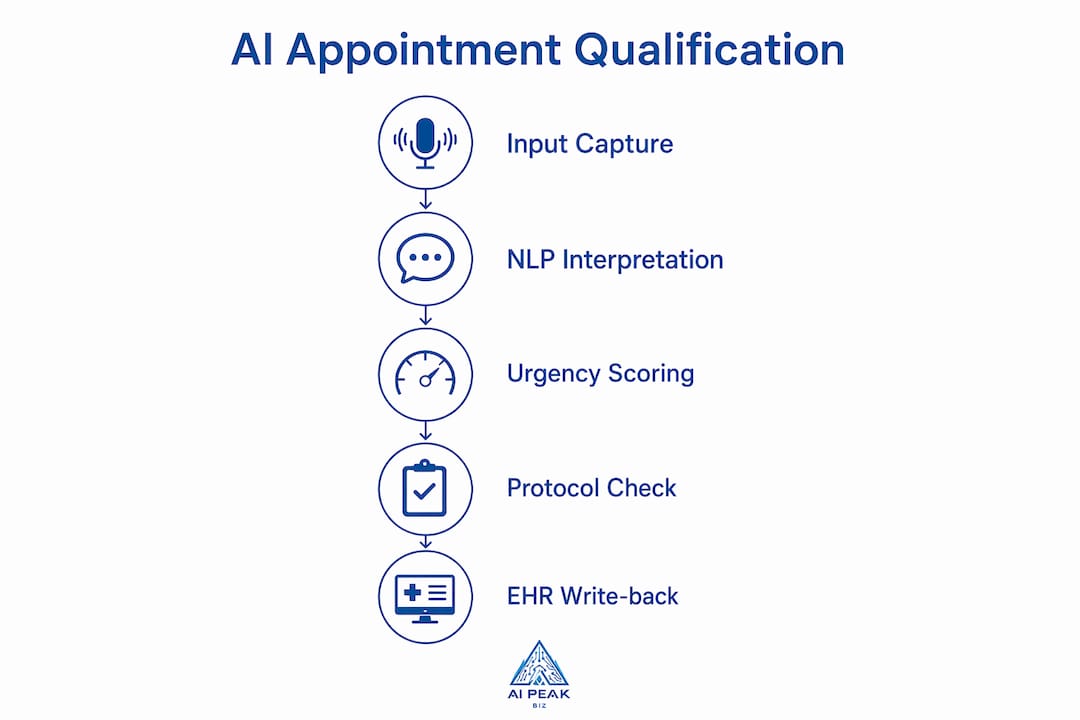
AI qualifies appointment requests by running patient input through three parallel systems at once: a natural language processing layer, a machine learning triage classifier, and a clinical rules engine. Each layer handles a distinct job, and they work together in real time.
The NLP layer reads or listens to the patient’s stated reason for the visit. It interprets informal language, medical shorthand, and ambiguous phrasing to extract structured clinical data. A patient who says “my chest feels tight after walking upstairs” gets flagged differently than one who says “I need a refill on my blood pressure medication.” The system does not guess. It classifies based on trained clinical language models.

The triage classifier then assigns an urgency score. AI triage models achieve an AUC of 0.92 and an F1 score of 0.87 in urgency classification. That level of accuracy rivals experienced clinical intake staff. High-urgency flags trigger immediate escalation to a clinician or same-day scheduling, while routine requests move into automated booking.
The clinical rules engine checks provider availability, specialty match, and any protocol requirements before confirming a slot. AI scheduling systems integrate clinical rules and real-time provider availability to coordinate appointments without manual input. Exceptions, such as patients with complex histories or unusual requests, get handed off to staff automatically.
Pro Tip: Map every exception type your front desk currently handles manually before deploying any AI qualification system. Exceptions that are not mapped become failure points.
Safe EHR write-back is the final step. FHIR bidirectional write-back with idempotency keys prevents duplicate or conflicting entries when the AI writes appointment data back to patient records. Without idempotency controls, distributed write systems create data drift over time.
How does AI improve efficiency and safety in scheduling workflows?
The efficiency gains from AI appointment qualification are measurable and significant. The reduction from 155 minutes to 5.73 minutes per booking is not a theoretical projection. It comes from simulation testing of production-grade systems. That kind of time recovery translates directly into staff hours redirected toward clinical care.
Safety is built into the architecture, not added as an afterthought. Production triage pipelines separate intake collection from urgency red-flag detection, allowing urgent cases to be escalated before full intake is even complete. A patient reporting chest pain does not wait for the system to finish collecting their insurance information. The red-flag pipeline runs in parallel and overrides the intake queue when needed.
| Metric | Manual Process | AI-Assisted Process |
|---|---|---|
| Average booking time | 155 minutes | 5.73 minutes |
| Human intervention rate | High (all cases) | Reduced by 70% |
| Urgency classification accuracy | Variable by staff | AUC 0.92, F1 0.87 |
| PHI audit trail | Manual logging | Automated, 6-year retention |
HIPAA compliance is non-negotiable in this context. Handling PHI in AI scheduling requires signed Business Associate Agreements, encryption, role-based access, and audit logs retained for at least six years. Any AI system touching patient data without these controls is a liability, not an asset.
“No gray area exists under HIPAA for AI handling PHI during patient scheduling calls. All interactions must be accounted for with compliance safeguards.” — HIPAA Compliant Voice AI
Voice AI handling appointment calls must comply fully with HIPAA, including state laws for call recording consent. This applies to every interaction, every time. Practices that treat compliance as optional discover the cost the hard way.
What are the limitations and pitfalls in AI appointment qualification?
The most common failure in AI appointment qualification is deploying a scripted chatbot and calling it AI. Scripted bots follow fixed decision trees. When a patient’s language falls outside the script, the bot fails. Agentic AI systems outperform scripted chatbots by adapting to language variability and handling exceptions through planning and reasoning. The difference in patient experience between the two is substantial.
The four most common deployment pitfalls are:
- Skipping workflow mapping. Deploying AI before documenting your current scheduling process guarantees gaps. Every manual step that is not mapped becomes an unhandled edge case.
- Ignoring language variability. Patients describe symptoms in dozens of ways. A system trained on narrow clinical language will misclassify or fail to respond to informal descriptions.
- Inadequate EHR integration. FHIR write-back without idempotency keys creates duplicate records. Duplicate records cause downstream clinical errors that staff must manually correct.
- Treating compliance as a checkbox. PHI handling requires active enforcement, not a one-time setup. Audit logs must be reviewed, BAAs must be current, and access controls must be tested regularly.
Scheduling automation fails most often due to deploying scripted chatbots without mapped processes. Agentic AI that plans and adapts is the standard that actually works at scale.
Pro Tip: Run a 30-day pilot on a single specialty or patient cohort before full deployment. Catch exception patterns early, before they affect your entire patient population.
You can also review how agentic AI compares to scripted workflows in appointment qualification to understand where the real performance gaps appear.
How can healthcare practices implement AI for appointment qualification?
Effective implementation starts with workflow documentation, not vendor selection. You need a complete picture of your current scheduling process before any AI system can be configured to replace or support it.
Define your success metrics first
Set measurable targets before go-live. The right metrics for AI appointment qualification include no-show rate reduction, staff hours saved per week, patient satisfaction scores, and first-contact resolution rate. Without these baselines, you cannot evaluate whether the system is performing or failing.
Select the right AI capabilities
Not all AI scheduling tools are equal. The AI tools available for medical office management in 2026 vary significantly in their EHR integration depth and triage sophistication. Prioritize systems with:
- Bidirectional FHIR integration with idempotency controls
- Agentic reasoning rather than fixed decision trees
- Configurable clinical rules engines by specialty
- Built-in HIPAA compliance with BAA support and audit logging
- Clinician review workflows for high-urgency or complex cases
Clinical intake agents dynamically query only the missing clinical data needed to complete protocol checklists. This loop-based approach is more efficient than attempting to collect all data in a single pass. It also reduces patient frustration during intake conversations.
Deploy incrementally and validate
Start with one specialty or one patient cohort. Measure performance against your defined metrics for 30 days. Identify exception patterns that the AI does not handle correctly, then refine the configuration before expanding. Incremental deployment with operational observability produces better long-term adoption than a full practice rollout on day one.
| Implementation Approach | Risk Level | Time to Value |
|---|---|---|
| Full practice rollout, day one | High | Delayed by exception handling |
| Single specialty pilot, 30 days | Low | Fast, with validated configuration |
| Phased by patient cohort | Medium | Moderate, with iterative improvement |
Vendor compliance is not optional. Before signing any contract, confirm the vendor will sign a BAA, provide encryption documentation, and demonstrate audit log capability. Voice AI compliance requirements extend to state-level call recording laws, which vary by location.
Key Takeaways
AI qualifies patient appointment requests most effectively when agentic reasoning, FHIR-compliant EHR integration, and layered triage pipelines work together within a fully mapped clinical workflow.
| Point | Details |
|---|---|
| Booking time reduction | AI cuts average booking time from 155 minutes to under 6 minutes in tested systems. |
| Agentic AI over scripted bots | Scripted chatbots fail on language variability; agentic AI adapts and handles exceptions. |
| Parallel triage pipelines | Separating intake from red-flag detection allows urgent cases to escalate before intake completes. |
| HIPAA compliance is mandatory | Signed BAAs, encryption, role-based access, and six-year audit logs are required without exception. |
| Incremental deployment wins | Piloting by specialty before full rollout catches exception patterns early and improves adoption. |
Why agentic AI is the only honest answer for appointment qualification
I have watched healthcare practices spend real money on chatbot-based scheduling tools and then spend more money fixing the problems those tools created. The pattern is consistent. A practice sees a demo, the demo works perfectly because the patient inputs are scripted, and then real patients arrive with real language and the system breaks.
The honest answer to appointment qualification is agentic AI. Not because it is newer, but because patient language is genuinely unpredictable. A patient describing knee pain might say “my leg gives out,” “my joint clicks,” or “I can’t walk right after sitting.” A fixed script handles one of those. An agentic system handles all three and asks a clarifying question when it needs one.
What I find most underappreciated is the compliance dimension. Practices focus on efficiency gains and overlook the audit trail requirement. Six years of PHI logs is not a suggestion. It is a federal requirement, and AI systems that do not enforce it create exposure that no efficiency gain justifies.
The practices that get this right share one habit. They map their workflows completely before they touch a vendor. They know every exception, every escalation path, and every edge case their staff currently handles. That documentation becomes the configuration blueprint for the AI. Without it, you are guessing, and guessing with patient data is not a position any administrator wants to be in.
The future of AI appointment qualification is not about replacing clinical judgment. It is about protecting clinical judgment by removing the administrative noise that surrounds it.
— Wylie
Aipeakbiz handles appointment qualification so your staff does not have to
Healthcare practices lose revenue every time a call goes unanswered or a patient request sits in a queue waiting for manual review. Aipeakbiz built its AI front desk for healthcare practices specifically to solve this problem.
The Aipeakbiz AI voice assistant answers patient calls instantly, collects intake information, assesses urgency, and books appointments around the clock. It uses NLP-driven qualification and real-time schedule matching within HIPAA-compliant workflows. Your staff handles clinical care. The AI handles the front desk. Practices using Aipeakbiz report fewer missed appointments and faster response times from day one. If you want to see exactly how the system works for your practice, the AI appointment setter page walks through the full qualification process with healthcare-specific examples.
FAQ
What does AI actually do when qualifying a patient appointment request?
AI captures the patient’s reason for visit, assesses urgency using NLP and machine learning triage models, checks real-time provider availability, and books or escalates the appointment without manual staff input.
How accurate is AI at classifying appointment urgency?
Tested AI triage systems achieve an AUC of 0.92 and an F1 score of 0.87 in urgency classification, which is comparable to trained clinical intake staff performance.
Is AI appointment qualification HIPAA compliant?
It can be, but only when the system includes signed Business Associate Agreements, data encryption, role-based access controls, and audit logs retained for at least six years.
What is the difference between a scripted chatbot and agentic AI for scheduling?
Scripted chatbots follow fixed decision trees and fail when patient language falls outside the script. Agentic AI reasons through variability and handles exceptions dynamically.
How should a practice start implementing AI appointment qualification?
Map your current scheduling workflow completely, define success metrics, then run a 30-day pilot on one specialty or patient cohort before expanding to the full practice.
Recommended
Want to see what your business is losing?
Take our free revenue assessment and find out how much missed calls, slow follow-up, and dormant leads are costing you every month.
Take the Free Assessment