How to Personalize Customer Experience in Home Service

How to Personalize Customer Experience in Home Service
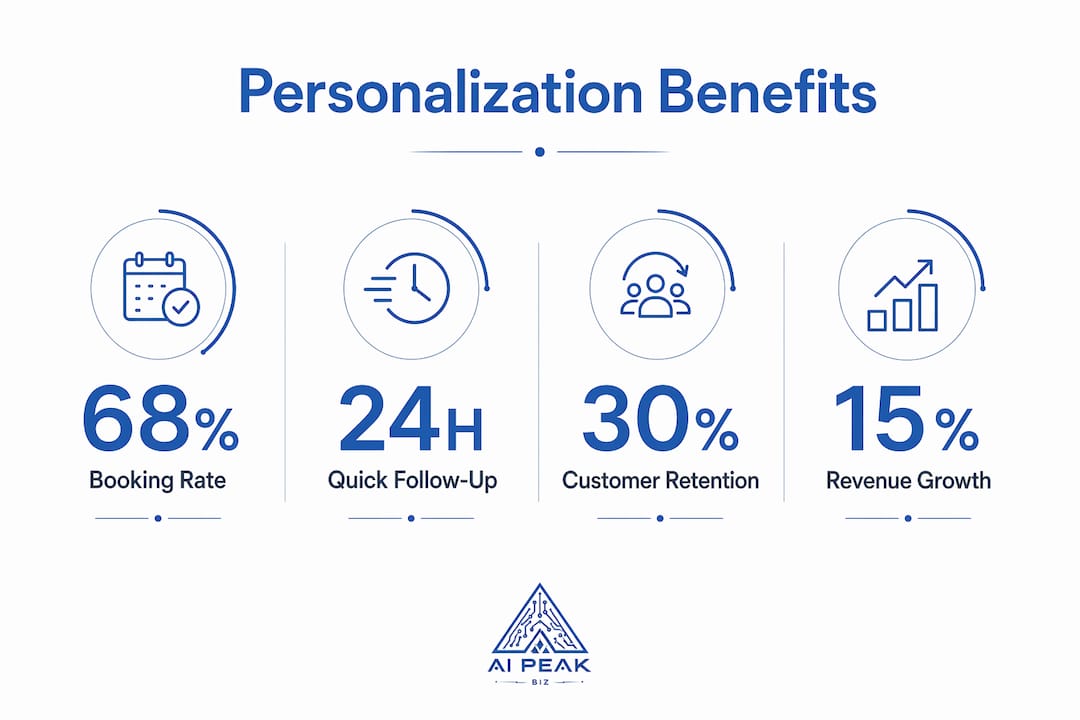
Personalizing customer experience in home service means delivering relevant, context-rich interactions based on each customer’s specific service history, equipment details, and communication preferences. Home service providers who master this approach see measurable results: one HVAC firm saw booking rates rise from 42% to 68% in just three months after implementing automated, personalized follow-up. The industry term for this practice is hyper-personalization, and it goes far beyond inserting a customer’s first name into a text message. Aipeakbiz helps home service businesses build this capability without adding staff or complexity.
What data and tools do you need to personalize home service experiences?
Effective personalization starts with the right data. Without it, every customer interaction defaults to generic, and generic does not build loyalty.
The four categories of customer data that matter most in home services are:
- Contact and household details: Name, address, phone, and preferred contact method
- Service history: Dates, job types, technicians assigned, and outcomes
- Equipment records: Make, model, age, and last maintenance date for HVAC units, water heaters, or appliances
- Stated preferences: Appointment time windows, communication channel preferences, and any notes from past visits
These data points become useful only when they live in one place. A CRM built for home services connects call records, job notes, and follow-up schedules into a single customer profile. Consistent data capture across calls, CRM entries, and service visits enables hyper-personalization without adding process complexity. That means your technician arriving on-site already knows the customer’s equipment age and last service date before saying a word.
The table below shows the feature categories that matter when evaluating personalization tools for home service businesses.

| Feature category | What it does | Why it matters |
|---|---|---|
| CRM with service history | Stores job records, equipment data, and customer notes | Powers context-aware communication |
| AI call answering | Captures lead details and context on every inbound call | Prevents data loss from missed calls |
| Automated follow-up | Sends personalized texts and emails referencing job specifics | Increases rebooking without manual effort |
| Scheduling integration | Books appointments based on urgency and customer availability | Reduces friction in the booking process |
| Review request automation | Triggers post-service review prompts tied to specific jobs | Builds online reputation at scale |
Pro Tip: Start with service history and equipment records before anything else. Those two data points unlock the most powerful personalization messages, such as “Your water heater is approaching its 10-year mark” rather than a generic seasonal promotion.
How to implement personalized communication in home service step by step
Personalized communication does not happen by accident. It requires a deliberate workflow that captures context at every customer touchpoint and uses that context in every outbound message.
-
Capture context on the first contact. When a customer calls or submits a web form, collect more than a name and phone number. Ask about the equipment involved, the urgency, and the address. AI-powered call answering tools do this automatically, logging every detail into the CRM before a human ever picks up the file.
-
Send a follow-up that references the specific job. A message that says “We noticed your AC unit is 8 years old. Here’s what to watch for this summer” performs far better than a mass blast. Messages referencing specific customer details like equipment age and last maintenance date build authentic customer loyalty.
-
Trigger scheduling workflows based on urgency. Not every customer needs the same response time. A burst pipe gets a same-day callback workflow. A routine annual inspection gets a 48-hour follow-up sequence. Build these rules into your automation so the system responds with the right speed and tone.
-
Send a personalized post-service review request. Within 24 hours of job completion, send a message that names the technician, references the work done, and asks for a review. Automated post-service review requests can increase Google review volume by up to 3.4 times within 90 days. That kind of reputation growth does not happen with a generic “How did we do?” email.
-
Use rule-based outreach to win repeat business. Set automation rules that remind customers when their next service is due, referencing the last job date and equipment details. AI-driven outreach maintains fresh engagement without manual effort, keeping your business top of mind between visits.
Pro Tip: Use a single persistent communication thread shared between your AI system and your human staff. When a customer calls back, your team sees the full history and never asks the customer to repeat themselves. That continuity is what customers remember.
What mistakes should you avoid when personalizing home service delivery?
The most common personalization mistake is treating a customer’s first name as personalization. It is not. Simple name insertion fails without linking messages to concrete job history and customer details. A customer who received a tune-up six months ago does not feel recognized when they get the same email as someone who has never booked with you.
Watch for these specific pitfalls:
- Mass email blasts with no job context. Sending a seasonal promotion to your entire list without segmenting by service history or equipment type signals that you do not know your customers. It erodes trust rather than building it.
- Data silos between calls, CRM, and field staff. When your office team captures details on a call, but those notes never reach the technician, the customer has to repeat their story. That repetition signals disorganization.
- Poor hand-offs between AI and human staff. The transition from automated interaction to human conversation is where personalization most often breaks down. Shared communication threads between AI and human staff prevent redundant customer interactions and protect personalization continuity.
- Stale CRM records. A customer who replaced their HVAC unit last year should not receive a message about maintaining their old system. Update equipment records at every service visit.
Pro Tip: Review your engagement metrics monthly. Open rates, reply rates, and rebooking rates tell you which messages resonate and which feel generic. Adjust your templates based on what the data shows, not what sounds good in a team meeting.
Customer touchpoints in home service span calls, texts, emails, and on-site visits. Each one is an opportunity to either reinforce or undermine the personalized experience you are building.
How does personalized customer experience improve home service business outcomes?
Personalization is not a soft benefit. It produces hard numbers.
The clearest proof comes from booking rates. One HVAC firm’s booking rate climbed from 42% to 68% over three months after implementing automated, personalized follow-up. That is a 26-percentage-point gain without adding a single salesperson. The gain came entirely from responding faster and more relevantly to leads who were already interested.
Online reputation follows the same pattern. Businesses that send personalized, job-specific review requests see significantly higher response rates than those sending generic prompts. A 3.4x increase in Google reviews within 90 days is achievable with the right automation in place. More reviews mean higher search rankings, which means more inbound leads without additional ad spend.
Personalization is a systematic approach ensuring every interaction follows guided workflows, reducing errors and increasing customer trust. When providers treat it as a quality assurance tool rather than a marketing tactic, the results compound over time.
Businesses without follow-up systems leave revenue on the table from past customers who would likely rebook if reminded appropriately. Personalized reminders referencing the last job date and equipment details convert past customers into repeat revenue. That is the most cost-effective growth channel available to a home service provider.
The table below summarizes the measurable benefits of personalization in home service.
| Benefit | Supporting evidence |
|---|---|
| Higher booking rates | HVAC firm increased bookings from 42% to 68% in 3 months |
| More online reviews | Up to 3.4x increase in Google reviews within 90 days |
| Stronger customer loyalty | Context-specific messages build trust over generic outreach |
| Increased repeat bookings | Automated reminders with job details convert past customers |
| Reduced customer churn | Timely, relevant follow-ups keep customers from switching providers |
Providers who want to reduce customer churn consistently find that personalization is the most direct lever available. Customers leave when they feel like a number. They stay when they feel known.
Key Takeaways
Personalizing customer experience in home service requires context-rich data, automated workflows, and consistent hand-offs between AI and human staff to produce measurable gains in bookings, reviews, and loyalty.
| Point | Details |
|---|---|
| Data is the foundation | Capture service history, equipment records, and preferences on every interaction. |
| Context beats name insertion | Reference job-specific details in every message to build real loyalty. |
| Automation drives scale | Rule-based follow-up and review requests produce results without manual effort. |
| Hand-offs must be seamless | Shared communication threads between AI and staff prevent customer frustration. |
| Outcomes are measurable | Booking rates, review volume, and repeat bookings all improve with true personalization. |
What I have learned about personalization that most providers miss
I have watched home service businesses invest in CRM software, set up email campaigns, and still wonder why customers do not feel the difference. The technology was right. The approach was wrong.
The mistake is treating personalization as a marketing function. It is not. Personalization is a quality assurance tool that ensures every customer interaction follows a consistent, informed workflow. When you frame it that way, your whole team gets behind it because it reduces errors, not just because it sounds good in a pitch.
The providers I have seen succeed share one habit: they treat the customer’s home as a file, not a transaction. Every visit adds to that file. Every message draws from it. The customer feels the difference immediately, and they tell their neighbors.
The adoption barrier I hear most often is “we do not have time to set this up.” That concern is real but misplaced. The setup investment is front-loaded. Once your workflows are running, AI-powered automation handles the ongoing execution without your team lifting a finger. The providers who delay are the ones still manually following up on leads six months from now, wondering why their competitors are growing faster.
Personalization done right is not about being clever. It is about being consistent, informed, and present at the right moment.
— Wylie
How Aipeakbiz helps home service providers personalize at scale
Home service providers who want to personalize customer interactions without hiring more staff have a direct path forward with Aipeakbiz.
Aipeakbiz answers every inbound call and text instantly, captures job-specific details, and logs them directly into your workflow. From there, automated follow-ups go out with the customer’s equipment details, last service date, and technician name already included. Review requests fire automatically after each completed job, building your Google reputation without anyone on your team sending a single message. Clients using the Aipeakbiz AI chatbot have reported measurable gains in both booking rates and review volume within the first 90 days. If you are ready to see what personalized, automated engagement looks like for your business, explore Aipeakbiz for home services and see how the system works in practice.
FAQ
What does it mean to personalize customer experience in home service?
Personalizing customer experience in home service means using each customer’s service history, equipment details, and preferences to deliver relevant, timely communication at every touchpoint. It goes beyond using a customer’s name and requires context-specific messaging tied to real job data.
How does personalization increase booking rates for home service businesses?
Automated, personalized follow-up systems have driven booking rate increases from 42% to 68% in as little as three months for home service providers. The gain comes from responding faster and more relevantly to leads who are already interested in booking.
What is the biggest mistake in home service personalization?
The biggest mistake is inserting a customer’s name into a generic message without referencing any job-specific details. True personalization requires linking every message to concrete service history, equipment records, and customer preferences.
How do I get more Google reviews through personalization?
Send a post-service review request within 24 hours of job completion that names the technician and references the specific work done. Automated, job-specific review requests can increase Google review volume by up to 3.4 times within 90 days.
How does AI help home service providers personalize customer interactions?
AI call answering and automated follow-up tools capture customer details on every inbound contact, log them to a CRM, and trigger personalized outreach without manual effort. Shared communication threads between AI and human staff keep the full customer history visible at every hand-off.
Recommended
Want to see what your business is losing?
Take our free revenue assessment and find out how much missed calls, slow follow-up, and dormant leads are costing you every month.
Take the Free Assessment