How to Reduce Customer Churn in Home Services
How to Reduce Customer Churn in Home Services
Customer churn in home services is defined as the rate at which clients stop using your business after one or more service visits. The financial damage is real and measurable. Acquiring a new customer costs 5–7 times more than keeping an existing one, and a 5% improvement in retention can increase profits by 25–95%. Repeat customers also spend 67% more than first-time clients. That gap makes client retention the single highest-return activity for any home service provider. Whether you run an HVAC company, a plumbing operation, or a general home maintenance business, the strategies to reduce churn are the same: consistent communication, structured membership plans, and personalized follow-up.
What are effective strategies to reduce customer churn in home services?
The most proven home service retention strategies target communication failures before they become cancellations. 70% of customer losses stem from perceived indifference. Clients do not leave because your price went up or your work was imperfect. They leave because they feel forgotten. Fixing that is a communication problem, not a quality problem.
The core strategies that directly decrease customer turnover in home services are:
- Enhance every customer touchpoint. From the first call to the post-job follow-up, every interaction shapes whether a client books again. Review your customer touchpoints and identify where clients go silent after a job.
- Personalize your outreach. Generic newsletters do not build loyalty. Texts and calls tied to a client’s specific service history do. A message that says “Your HVAC filter is due for a change based on your last visit in march” outperforms any mass email.
- Implement membership and maintenance plans. Recurring revenue plans lock in repeat visits and give you a predictable schedule to reach out. Members renew at far higher rates than demand-only customers.
- Use CRM and automation tools. A CRM like ServiceTitan or Jobber tracks service history, flags dormant clients, and triggers follow-up sequences automatically. Automation handles timing so your team handles relationships.
- Run Net Promoter Score (NPS) surveys after every job. NPS data tells you which clients are at risk before they disappear. A score below 7 is a warning sign that warrants a personal call within 48 hours.
Pro Tip: Set up a 72-hour post-job text sequence for every completed service. The first message thanks the client. The second, sent 48 hours later, asks for a review. The third, sent on day 7, offers a seasonal maintenance reminder. This three-touch sequence costs nothing extra and keeps your brand top of mind.
How can membership and maintenance plans improve retention?

Membership plans are the most reliable structure for improving customer loyalty in home maintenance. The data is clear: HVAC maintenance plan members renew at 89–96% versus 40–60% for demand-only customers. That gap represents the difference between a business with predictable revenue and one that restarts from zero every season.
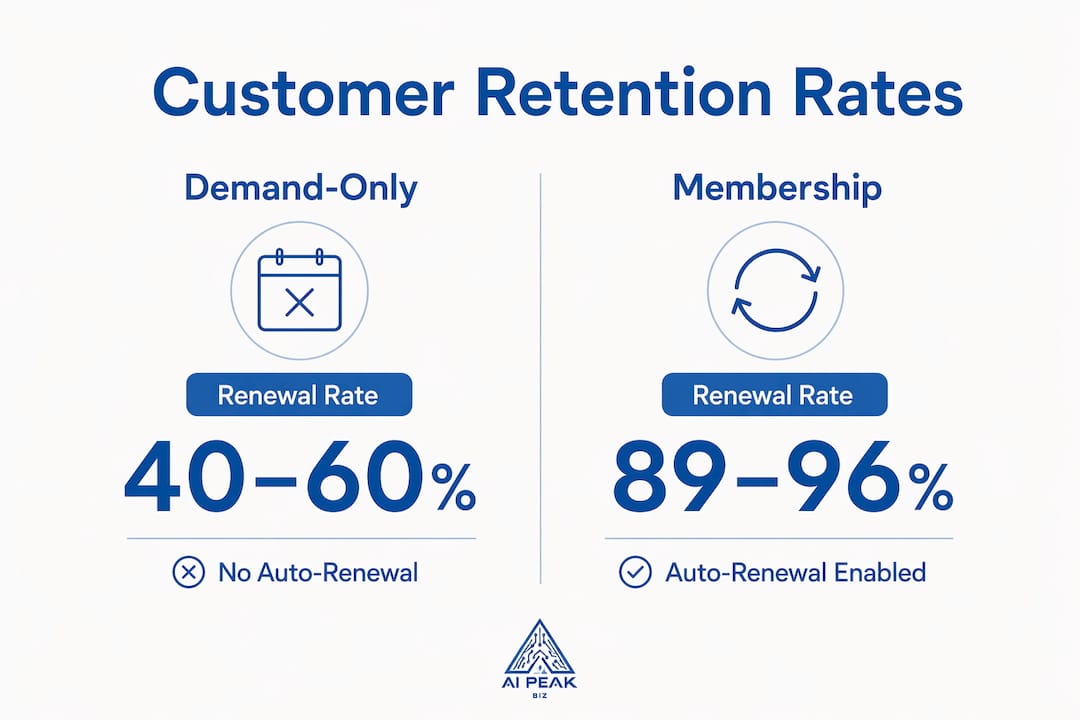
The structure of a high-performing membership plan matters as much as the price. Here is how demand-only compares to a membership model:
| Factor | Demand-only customers | Membership members |
|---|---|---|
| Annual renewal rate | 40–60% | 89–96% |
| Revenue predictability | Low | High |
| Communication frequency | Reactive | Scheduled |
| Upsell opportunity | Occasional | Built into plan |
| Churn risk | High | Low |
Auto-renewal on a card-on-file billing system is the single biggest driver of membership retention. When clients must actively re-enroll, many simply forget or delay. Auto-renewal removes that friction entirely. Adding a human phone call before the renewal date pushes renewal rates 6–8 points higher than auto-renewal alone. That call does not need to be a sales pitch. A simple “We wanted to confirm your plan renews next week and check if you have any questions” is enough.
The biggest threat to membership revenue is involuntary churn from failed card payments. Failed-card recovery requires multi-step retries combined with a mandatory human follow-up call. Automated emails alone do not recover these accounts at meaningful rates. The best programs retry the card on days 1, 3, and 7, then assign a team member to call the client directly on day 8. This process recovers a significant share of accounts that would otherwise cancel silently.
Pro Tip: Bundle two or three services into your membership plan at a price that saves the client 10–15% versus booking separately. Clients who see clear dollar savings renew at higher rates and refer more often than those on single-service plans.
How do personalized follow-up and segmented reactivation campaigns reduce churn?
Dormant clients represent your lowest-cost growth opportunity. Dormant customers who have not had service in 18 or more months are 3–5 times cheaper to win back than new prospects. A well-executed reactivation sequence can recover 15–25% of those clients. The key word is “well-executed.” Generic win-back campaigns achieve only a 1–2% response rate. Segmenting by last service type pushes that rate to 8–15%.
Here is a proven 30-day reactivation sequence for dormant home service clients:
- Day 1: Personalized text message. Reference the client’s last service by name and date. “Hi [Name], we serviced your water heater back in april 2024. We want to make sure everything is still running well.” This specificity signals that you remember them.
- Day 5: Follow-up call from a team member. A live voice call carries far more weight than a text. Keep it brief and focused on their specific equipment or service history.
- Day 10: Email with a tailored offer. Offer a discount or priority scheduling tied to the service they last used. A plumbing client gets a drain inspection offer. An HVAC client gets a tune-up deal.
- Day 18: Second text with a deadline. Create a soft urgency. “Our spring scheduling fills up fast. We have a few slots left this month if you want to lock one in.”
- Day 25: Final outreach call. This is your last touch. If there is no response after this, move the client to a quarterly newsletter list and revisit in six months.
Segmentation is what separates this approach from a mass blast. A database reactivation campaign built around service history converts at multiples of a generic promotional email. AI tools can automate the timing and personalize the content at scale, so your team focuses on the calls rather than the scheduling.
What role does technician training play in keeping customers?
Technician behavior during a service visit is the most direct driver of repeat business. Clients do not evaluate your company on your website or your pricing page. They evaluate it on how your technician showed up, communicated, and left the home. Customer service rituals like wearing shoe covers, scripted review requests, and photo updates reduce callbacks by 22% and increase review conversion to 55–70%.
The specific behaviors that drive retention include:
- Home-arrival rituals. Wearing shoe covers, introducing yourself by name, and explaining the work before starting signals professionalism and respect for the client’s space.
- Post-job walkthroughs. Walk the client through what you did, what you found, and what to watch for. This conversation builds trust and reduces the “I’m not sure what they even did” feeling that causes clients to shop around next time.
- Scripted review requests. Asking for a review at the right moment, right after the client confirms they are satisfied, converts at dramatically higher rates than a follow-up email. Train every technician to ask directly: “If you’re happy with the work today, would you mind leaving us a quick Google review?”
- Photo documentation. Sending before-and-after photos to the client after a job creates a tangible record of value. It also gives the client something to share, which drives referrals.
Weekly structured ride-along training and scripted review asks increase repeat rates by 40–60% within 6–9 months. Top operators generate 6–8 new five-star reviews per truck per month and maintain 60% or higher repeat rates. Those numbers are not accidental. They come from deliberate, repeatable training systems.
Pro Tip: Record a short video walkthrough of your post-job ritual and use it as onboarding material for every new technician. Consistency across your team matters more than perfection from one person.
Key Takeaways
The most effective way to reduce customer churn in home services combines structured membership plans, personalized reactivation campaigns, and consistent technician training to build loyalty that compounds over time.
| Point | Details |
|---|---|
| Retention beats acquisition | Keeping a client costs 5–7 times less than finding a new one, making retention your highest-ROI activity. |
| Membership plans anchor loyalty | Members renew at 89–96% versus 40–60% for demand-only clients; auto-renewal plus a human call adds 6–8 points. |
| Segmented outreach wins back clients | Campaigns tailored by last service type achieve 8–15% response rates versus 1–2% for generic blasts. |
| Technician behavior drives repeat business | Scripted rituals and review requests increase repeat rates by 40–60% within 6–9 months. |
| Perceived indifference is the real churn driver | 70% of client losses come from feeling forgotten, not from price or quality issues. |
Why most contractors are solving the wrong churn problem
Most contractors I talk to assume churn is a price problem or a quality problem. They lower their rates or retrain on technical skills. Neither move addresses the real issue. The actual cause of most churn is poor post-job communication. Clients feel forgotten between visits, and when the next need arises, they search Google instead of calling you back.
What I have seen work, consistently, is treating communication as a system rather than a personality trait. You cannot rely on your best technician to remember to follow up with every client. You need a process that runs whether or not your best person is in the field that day. That means CRM automation, scripted touchpoints, and a reactivation calendar that runs on its own.
Technology supports that system, but it does not replace the human moments that matter most. The renewal call before a membership lapses, the personal text after a big job, the ride-along coaching session with a new tech. Those are the moments that turn a one-time client into a loyal customer who refers their neighbors. Build the system first, then let technology handle the timing so your team can handle the relationships.
— Wylie
How Aipeakbiz helps you stop losing clients between jobs
Revenue leaks quietly in home services. A missed call at 7 p.m., a slow follow-up on a reactivation text, a membership renewal that nobody remembered to confirm. These gaps add up fast.
Aipeakbiz built its AI Voice Assistant and AI Appointment Setter specifically for service businesses that cannot afford to let a single client slip through. The system answers calls and texts around the clock, qualifies leads, and books appointments without your team lifting a finger. That means your reactivation sequences get responses at 11 p.m., your membership renewal calls get handled on weekends, and no client ever hears a voicemail when they are ready to book. If you want to see what automated retention looks like in practice for a home services business, Aipeakbiz is worth a close look.
FAQ
What is customer churn in home services?
Customer churn in home services is the rate at which clients stop booking repeat services after their first or second visit. It is calculated by dividing lost clients in a period by total clients at the start of that period.
How much does customer churn cost a home service business?
Acquiring a new customer costs 5–7 times more than retaining one, and repeat customers spend 67% more than first-time clients. Even a small reduction in churn produces a measurable increase in annual revenue.
What is the best membership plan renewal rate to target?
Top-performing home service membership programs achieve renewal rates of 89–96%. Adding auto-renewal billing and a personal phone call before the renewal date pushes rates to the higher end of that range.
How do I win back dormant home service clients?
Segment dormant clients by their last service type and run a multi-touch 30-day sequence using text, phone, and email. Segmented campaigns achieve 8–15% response rates compared to 1–2% for generic outreach.
Why do home service customers really leave?
70% of home service client losses stem from perceived indifference, not price or quality. Clients who feel forgotten after a job are far more likely to search for a new provider the next time a need arises.
Recommended
Want to see what your business is losing?
Take our free revenue assessment and find out how much missed calls, slow follow-up, and dormant leads are costing you every month.
Take the Free Assessment