The Role of AI in Appointment Scheduling for Business Owners

The Role of AI in Appointment Scheduling for Business Owners
AI appointment scheduling is defined as the use of intelligent automation to book, confirm, and reschedule appointments without human intervention. The role of AI in appointment scheduling goes far beyond replacing a receptionist. It captures leads at 2 a.m., qualifies them in seconds, and fills your calendar before your competition even picks up the phone. For business owners losing revenue to missed calls and slow follow-up, this technology is the most direct fix available. Aipeakbiz builds exactly this kind of system for service businesses, and the results speak clearly.
What AI technologies power modern appointment scheduling?
Agentic AI is the technology that separates modern scheduling systems from basic chatbots. A traditional chatbot follows a script. An agentic AI executes multi-step tasks autonomously, cross-referencing policies, applying discounts, finalizing bookings, and communicating with other systems in real time. No user clicks required. That shift from “answering questions” to “completing tasks” is what makes AI scheduling genuinely useful for busy service businesses.
Three core technologies work together inside a modern AI scheduling system:
- Natural language processing (NLP): The AI parses inputs like “next week, mornings” to identify service type, timeframe, and customer preferences. This removes the friction of rigid dropdown forms entirely.
- Pattern-aware scheduling: The system analyzes historical staff and service data to adjust availability dynamically, accounting for factors like staff fatigue and historically underbooked time slots.
- Machine learning for no-show prediction: The AI tracks past behavior to flag high-risk appointments and trigger targeted reminders before a slot goes to waste.
Full-stack integration is what makes these technologies work together. Agentic AI requires back-end system connections to calendars, CRMs, and communication tools to function as an execution engine rather than a simple automation widget. Without that integration, you get a fancy form, not a real scheduling assistant.
Pro Tip: When evaluating any AI scheduling tool, ask specifically whether it integrates with your existing calendar and CRM. A system that cannot write back to your records creates more manual work, not less.

How does AI improve business outcomes in appointment scheduling?
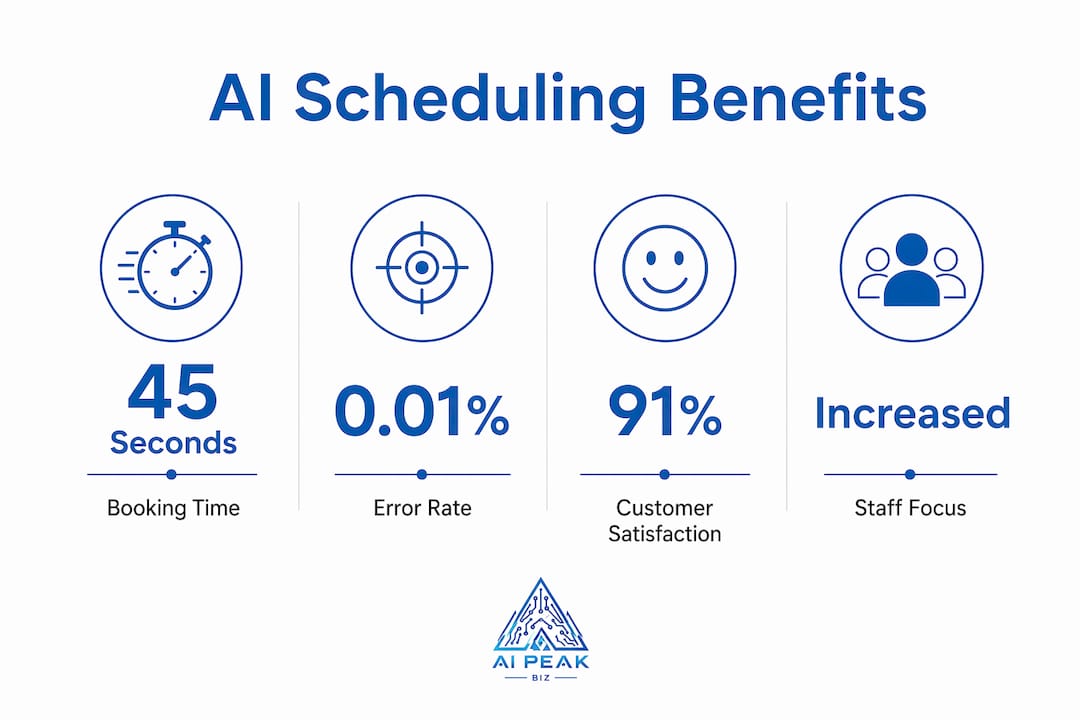
The business case for AI in scheduling is grounded in hard numbers. Agentic AI cuts booking time from 22 minutes to under 45 seconds and lifts customer satisfaction from 62% to 91%. That is not a marginal improvement. It is the difference between a customer who books and one who hangs up and calls your competitor.
| Metric | Before AI | After AI |
|---|---|---|
| Average booking time | 22 minutes | Under 45 seconds |
| Customer satisfaction score | 62% | 91% |
| Human data entry error rate | 4% | 0.01% |
| Routine rebooking handled by AI | Low | 80% |
| Operational cost reduction | Baseline | Up to 40% |
The error rate drop from 4% to 0.01% deserves attention on its own. Every data entry mistake in a scheduling system creates a downstream problem: a double booking, a missed confirmation, or a customer who shows up at the wrong time. AI eliminates that category of error almost entirely.
Customer communication also improves when AI handles scheduling. Response times drop from hours to seconds as the system learns from past interactions to improve accuracy over time. That speed matters because customers who do not get a fast response simply move on. The role of automated appointment booking in customer retention is direct: respond instantly, or lose the lead.
Staff utilization improves as well. When AI handles routine rebookings and confirmations, your team focuses on the work that actually requires human judgment. Dead time in schedules drops because the AI fills gaps proactively rather than waiting for a customer to call back.
How does AI appointment scheduling differ from traditional methods?
Traditional scheduling systems are built on static rules. A staff member picks from a fixed list of available slots, fills out a form, and sends a confirmation. The process works when volume is low and customers are patient. Neither condition holds in a competitive service market.
AI scheduling operates on intent rather than rules. The customer describes what they need in plain language, and the system figures out the best fit. That shift removes the back-and-forth that frustrates customers and wastes staff time. AI also suggests modifications to bookings proactively, such as moving a lower-value appointment to a less desirable slot to free up prime time for higher-value work. A human scheduler rarely does this because it requires weighing multiple variables simultaneously.
| Dimension | Traditional scheduling | AI scheduling |
|---|---|---|
| Input method | Rigid forms, fixed dropdowns | Natural language, conversational |
| Availability logic | Static rules set by admin | Dynamic, pattern-aware adjustment |
| Error rate | Up to 4% human entry errors | Near zero (0.01%) |
| Operating hours | Business hours only | 24 hours a day, 7 days a week |
| No-show management | Manual reminders | Predictive, automated outreach |
| Scalability | Limited by staff capacity | Scales without adding headcount |
The scalability gap is the most important difference for growing businesses. A human scheduler hits a ceiling. AI does not. You can double your lead volume without hiring a second receptionist.
Pro Tip: Run a one-week audit of your missed calls and after-hours inquiries before switching systems. That number is your baseline. Measure against it 30 days after deploying AI scheduling to see the real impact.
What steps should business owners take to implement AI scheduling?
Implementation works best when it follows a clear sequence. Skipping steps creates the most common failure: a system that is technically running but not actually improving results.
-
Audit your current workflow. Map every touchpoint where a customer tries to book an appointment. Identify where calls go unanswered, where forms get abandoned, and where staff spend the most time on scheduling tasks. This audit tells you exactly where AI will deliver the fastest return.
-
Define your ideal client profile before configuring the AI. Effective booking systems start with lead qualification before scheduling. If your AI books anyone who asks, your calendar fills with low-value appointments. Build qualification questions into the booking flow from day one.
-
Choose a tool with agentic autonomy and full-stack integration. Entry-level scheduling widgets connect to a calendar. Agentic systems connect to your CRM, your communication tools, and your back-end data. The AI appointment setter category is where you want to focus. These tools qualify leads, book appointments, and follow up without human input.
-
Train the system on your service catalog and scheduling patterns. Feed it your service types, average durations, staff availability, and any rules about buffer times. The more context it has, the better its pattern-aware scheduling performs from the start.
-
Set KPIs before launch. Track missed call rate, booking conversion rate, no-show rate, and average response time. Automation in appointment setting increases sales team effectiveness by offloading early qualification tasks. Measure that effect directly by comparing your sales team’s close rate before and after implementation.
-
Review and refine monthly. AI scheduling systems improve with data. Review the patterns the system surfaces, adjust buffer times, and update qualification criteria as your business evolves. A system you set and forget will drift out of alignment with your actual needs.
For home service businesses specifically, the 2026 guide to AI in home services covers deployment patterns that apply directly to field-based scheduling challenges.
Key takeaways
AI appointment scheduling delivers the fastest, most measurable return when it combines agentic autonomy, natural language input, and full-stack integration with your existing business systems.
| Point | Details |
|---|---|
| Agentic AI vs. basic chatbots | Agentic AI executes tasks autonomously; chatbots only answer questions. |
| Speed and satisfaction gains | Booking time drops from 22 minutes to under 45 seconds, with satisfaction rising from 62% to 91%. |
| Error elimination | AI reduces human data entry errors from 4% to near zero, cutting downstream scheduling problems. |
| Qualification before booking | Build lead qualification into the booking flow to protect calendar quality and pipeline value. |
| Measure before and after | Set KPIs for missed calls, conversion rate, and response time before launch to prove real impact. |
Why I think most businesses are still thinking about this wrong
Most business owners I talk to treat appointment scheduling as an administrative task. They want to reduce the time it takes. That is a reasonable goal, but it misses the larger opportunity.
Appointment booking is pipeline control. Every slot on your calendar is a revenue decision. When you let a slow or manual system manage that process, you are not just losing time. You are losing qualified leads to competitors who respond faster. The businesses that understand this treat their scheduling system the way a sales leader treats a CRM: as a tool that directly controls revenue output.
The shift to agentic AI makes this framing even more important. These systems do not just fill slots. They qualify leads, prioritize high-value accounts, and adjust dynamically based on what the data shows. That is not administration. That is sales infrastructure.
My honest advice: stop asking “how do I make booking easier?” Start asking “how do I make sure every qualified lead gets booked before they lose interest?” Those are different questions, and they lead to very different systems. The AI tools that improve customer experience are the ones built around that second question.
— Wylie
How Aipeakbiz helps you capture every appointment
Service businesses lose real revenue every time a call goes unanswered or a lead waits hours for a reply. Aipeakbiz built its AI appointment setter specifically to close that gap. The system answers calls and texts instantly, qualifies leads around the clock, and books appointments directly into your calendar without any manual input from your team.
If you run a service business and want to see what hands-free booking actually looks like in practice, Aipeakbiz offers a direct look at how the system works for your industry. Visit aipeakbiz.com to see how the platform handles lead qualification, booking, and follow-up from the first contact forward.
FAQ
What is an automated booking system?
An automated booking system uses AI to receive, qualify, and confirm appointments without human involvement. Modern systems use natural language processing to understand customer requests and agentic AI to execute the full booking workflow.
How does AI in scheduling reduce missed calls?
AI scheduling systems operate 24 hours a day, answering calls and texts the moment they arrive. This means no lead goes unanswered outside business hours, which is when a large share of booking attempts occur.
What is the role of appointment booking in sales?
Appointment booking functions as pipeline control, not just calendar management. Effective booking systems qualify leads before scheduling, so sales teams spend time on high-value conversations rather than early-stage outreach.
How does automated booking improve customer satisfaction?
AI-driven systems lift satisfaction scores from 62% to 91% by responding instantly and reducing booking friction. Customers get confirmed appointments in seconds rather than waiting on hold or filling out rigid forms.
How do I automate appointment booking from leads?
Connect your lead capture channels (web forms, calls, texts) to an agentic AI system that qualifies each inquiry and books directly into your calendar. Aipeakbiz handles this full workflow for service businesses, from first contact to confirmed appointment.
Recommended
Want to see what your business is losing?
Take our free revenue assessment and find out how much missed calls, slow follow-up, and dormant leads are costing you every month.
Take the Free Assessment