The Role of AI in Patient Communication: 2026 Guide

The Role of AI in Patient Communication: 2026 Guide
AI in patient communication is defined as the use of generative AI, chatbots, and machine learning tools to improve how clinicians deliver information, how patients understand it, and how healthcare systems manage ongoing dialogue. The role of AI in patient communication has moved well beyond appointment reminders. Research now shows AI-supported instructions produce stronger patient comprehension than traditional verbal or written methods alone. Tools like retrieval-augmented generation systems, AI chatbots, and clinician-first messaging platforms are reshaping what doctor-patient dialogue looks like at every touchpoint. This guide breaks down what works, what fails, and how your practice can deploy these tools without sacrificing the human care patients still expect.
How does AI improve patient understanding and recall of medical instructions?
Only 47% of patients correctly recall verbal advice and 58% recall written advice after a clinical encounter. That gap is not a patient failure. It reflects how dense, clinical language fails people under stress. AI changes that equation by simplifying discharge instructions into plain language, personalizing them to the patient’s condition, and presenting them in formats patients can revisit at home.
AI-generated patient-centered instructions show stronger comprehension than standard discharge documents. The mechanism is straightforward: generative AI rewrites clinical notes into short, clear sentences, removes jargon, and structures information around what the patient needs to do next. A post-surgical patient, for example, receives step-by-step wound care instructions written at a reading level they can actually process, not a dense paragraph copied from a clinical protocol.

The benefits of AI in healthcare extend beyond the hospital discharge moment. Outpatient practices use automated patient messaging systems to send pre-visit preparation reminders, post-visit summaries, and medication adherence prompts. Each message is tailored to the individual visit record, not a generic template. That personalization closes the gap between what clinicians communicate and what patients retain.
Key areas where AI improves patient understanding:
- Discharge summaries: AI rewrites clinical language into plain, actionable steps patients can follow at home.
- Medication instructions: Automated messaging sends dosage reminders tied to the patient’s specific prescription, not a generic schedule.
- Pre-visit preparation: AI tools send condition-specific preparation instructions days before appointments, reducing no-shows and incomplete preparation.
- Follow-up comprehension: Post-visit AI messages reinforce verbal instructions, giving patients a written record they can reference.
Pro Tip: Pair AI-generated discharge instructions with a short patient confirmation prompt. Ask patients to reply with one question they still have. This surfaces comprehension gaps before they become readmission risks.
What are clinician-first AI workflows and their impact on patient messaging?
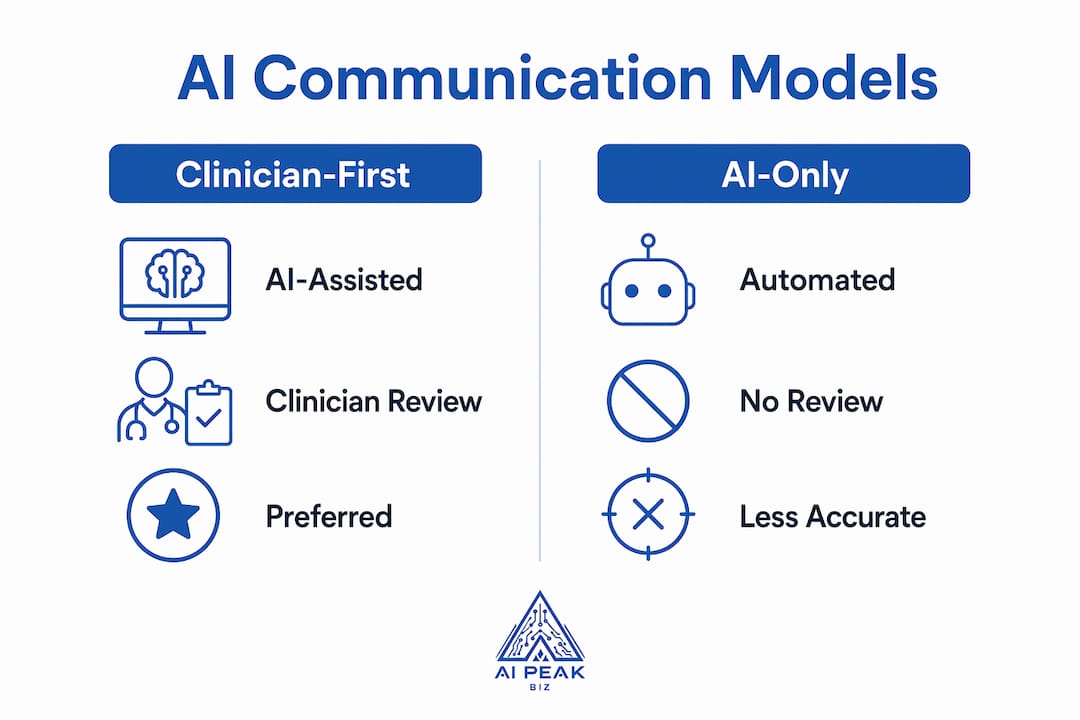
Clinician-first AI workflows are defined as a model where AI drafts or enhances patient messages, and a clinician reviews and approves them before delivery. This is not AI replacing the physician. It is AI doing the first draft so the physician can focus on accuracy, tone, and clinical judgment.
Research comparing three messaging approaches shows a clear winner. AI-enhanced messages were preferred in 38.8% of cases, compared to 27.6% for AI-only messages and 25.5% for physician-only messages. Patients rated the combined approach higher on clarity and empathy. The data also shows critical omissions in 1.12% of AI-enhanced messages, which is why clinician review remains non-negotiable.
| Messaging approach | Patient preference | Critical omission rate |
|---|---|---|
| Clinician-first AI-enhanced | 38.8% | 1.12% |
| AI-only | 27.6% | Higher than combined |
| Physician-only | 25.5% | Baseline |
The table makes the case plainly. Neither AI alone nor the physician alone produces the best outcome. The combination wins on both preference and safety. Clinicians who adopt this workflow report spending less time on routine message drafting and more time on complex patient concerns that genuinely require their expertise.
How AI improves doctor-patient dialogue in this model is not about volume. It is about quality. AI handles the structural work: formatting, plain language conversion, and completeness checks. The clinician adds clinical judgment, empathy cues, and accountability. That division of labor produces messages patients trust and understand.
Pro Tip: When training clinical staff on AI-assisted messaging, focus the review step on two things: clinical accuracy and tone. AI drafts tend to be accurate but occasionally flat. A single sentence of warmth from the clinician transforms the patient’s experience of the message.
What challenges and patient concerns arise with AI in communication?
AI in healthcare communication creates real risks alongside its benefits. The most underreported risk is not a bad AI output. It is a degraded patient input. Patients interacting with AI provide less clinically suitable symptom descriptions, lowering diagnostic accuracy compared to interactions with human clinicians. Patients hold back detail, simplify their language, and trust the AI less to handle nuance. That behavior directly affects the quality of care they receive.
A second risk involves how patient tone shapes AI responses. Urgent or demanding patient messages lead AI systems to recommend higher-urgency care compared to neutral messages describing the same symptoms. A patient who writes “I need help NOW” receives a different clinical pathway recommendation than a patient who describes identical symptoms calmly. That is a systemic bias your team needs to account for in any AI deployment.
Patient satisfaction concerns add another layer. Qualitative interviews reveal patient dissatisfaction even when clinical outcomes are positive, if patients feel they lacked personal attention. Patients do not separate the clinical result from the relational experience. A technically correct AI message that feels cold or generic erodes trust over time.
The concerns your patients are most likely to raise include:
- Loss of personal attention: Patients worry AI replaces the human relationship, not just the paperwork.
- Reduced empathy: Automated messages can feel transactional, especially during emotionally difficult diagnoses.
- Accuracy doubts: Patients question whether AI understands their specific situation or is applying a generic template.
- Privacy concerns: Patients want to know who sees their messages and how their data is used.
“Maintaining personalized attention alongside AI use is key to preventing patient dissatisfaction despite improved clinical outcomes.” — JMIR Research, 2026
Generative AI risks recasting clinicians as technical supervisors rather than holistic care providers if institutions deploy it without clear boundaries. The technology does not know when a patient needs a human voice. Your clinical team does. That judgment must stay with people.
How can healthcare systems effectively implement AI tools to enhance patient engagement?
Effective implementation of AI tools for patient engagement starts with institutional knowledge, not off-the-shelf software. Generic AI models do not know your triage protocols, your patient population, or your clinical standards. Retrieval-augmented generation systems that access triage protocols improve AI’s ability to ask useful follow-up questions without offering unsanctioned medical advice. Vanderbilt Health’s AI assistant demonstrates this: it draws on institutional data to help patients formulate better questions for their care teams, not to replace those teams.
A practical implementation framework follows this sequence:
- Audit your current communication gaps. Identify where patients most often misunderstand instructions, miss appointments, or fail to follow up. These are your highest-value AI deployment points.
- Select AI tools with active prompting interfaces. Passive chatbots that wait for patient input miss the problem. Effective AI tools prompt patients for missing symptom details to ensure clinical suitability. The interface must ask, not just receive.
- Integrate institutional data. Connect your AI system to your EHR, triage protocols, and clinical guidelines. An AI that knows your formulary and your discharge criteria produces far more useful patient messages than one operating on general medical knowledge.
- Train clinicians on the review workflow. Staff need to understand what AI drafts, what they must verify, and when to override the system entirely. This is not a one-time orientation. Build it into ongoing clinical education.
- Design feedback loops. Track patient comprehension scores, readmission rates, and message response rates. Use that data to refine your AI prompts and review criteria quarterly.
Patients now arrive at consultations pre-structured by AI interactions, having already researched their symptoms through AI tools before the appointment. Clinicians must adapt to this reality. The consultation no longer starts from zero. It starts from whatever the patient’s AI interaction told them, accurately or not. Training clinicians to surface and address AI-influenced symptom understanding is now a core communication skill.
Pro Tip: Build a short intake question into your patient portal: “Did you use any AI tool to research your symptoms before this visit?” That single question gives your clinician a critical context cue before the appointment begins.
For practices exploring AI tools for medical office management, the integration of patient-facing AI with back-office workflows produces the most consistent results.
Key takeaways
AI in patient communication delivers the strongest outcomes when clinician oversight, institutional data, and patient-centered design work together rather than independently.
| Point | Details |
|---|---|
| Recall gap is real | Only 47% of patients recall verbal advice; AI-generated instructions close that gap measurably. |
| Clinician-first wins | AI-enhanced messages reviewed by clinicians are preferred over AI-only or physician-only messages. |
| Patient input degrades with AI | Patients give less detailed symptom reports to AI, so interfaces must actively prompt for detail. |
| Tone shapes AI decisions | Urgent patient messages trigger higher care escalation from AI, creating a bias clinicians must monitor. |
| Institutional data is required | AI tools perform best when connected to your triage protocols and clinical guidelines, not general knowledge. |
Why the human layer in AI communication is not optional
I have watched healthcare administrators treat AI communication tools as a staffing solution. Deploy the chatbot, reduce the front-desk load, move on. That framing gets the technology right and the strategy wrong.
The research on post-Turing clinical relationships is the piece most administrators miss. Patients are not arriving at your practice as blank slates anymore. They have already talked to an AI about their symptoms. They have a narrative. They have expectations. Your clinician’s job now includes unpacking that AI-mediated understanding before the real clinical work can begin. That is a new skill, and it requires investment.
What I find genuinely encouraging is the clinician-first data. Patients prefer the combined human-AI message over either alone. That tells you something important: patients are not rejecting AI. They are rejecting AI without accountability. When a clinician’s judgment is visibly part of the process, trust holds. The moment it disappears, satisfaction drops even when the clinical outcome is fine.
The practices that will get this right are the ones that treat AI as a communication assistant, not a communication replacement. They will use it to draft, to simplify, to remind, and to prompt. They will keep their clinicians in the loop on every message that matters. And they will measure patient comprehension, not just patient volume, as a core performance metric.
AI does not reduce the need for empathy in healthcare. It raises the stakes for it. Every automated message your practice sends is a representation of your clinical team. Make sure it reads like one.
— Wylie
How Aipeakbiz supports healthcare communication with AI
Healthcare practices lose patient relationships the same way service businesses lose revenue: through slow responses, missed calls, and gaps between what patients need and what they receive.
Aipeakbiz builds AI communication systems designed for exactly this problem. The AI chatbot for healthcare practices answers patient inquiries around the clock, qualifies appointment requests, and routes urgent concerns to the right staff member without delay. The AI appointment setter books patients directly into your schedule, reducing no-shows and front-desk workload simultaneously. For practices ready to go deeper, Aipeakbiz’s AI consulting services help your team build a communication workflow that fits your clinical environment, not a generic template. No patient should slip through the cracks because your phone was busy.
FAQ
What is the role of AI in patient communication?
AI in patient communication improves how patients receive, understand, and act on clinical information. It does this through tools like generative AI, chatbots, and automated messaging systems that simplify language, personalize content, and prompt patients for missing details.
Does AI replace clinicians in patient messaging?
AI does not replace clinicians. Research shows clinician-first AI-enhanced messages are preferred by patients over AI-only messages and produce fewer critical omissions when clinicians review the AI draft before delivery.
Why do patients give worse symptom reports to AI than to doctors?
Patients provide less detailed and less clinically suitable symptom descriptions to AI compared to human clinicians. This behavior reduces diagnostic accuracy, which is why AI interfaces must actively prompt patients for missing information rather than passively receiving input.
How does patient tone affect AI-generated medical advice?
Urgent or demanding patient messages cause AI systems to recommend higher-urgency care than neutral messages describing the same symptoms. Healthcare teams must monitor this bias and build clinician review into any AI triage workflow.
What is the first step for a healthcare practice implementing AI communication tools?
Audit your current communication gaps first. Identify where patients most often misunderstand instructions or fail to follow up, then deploy AI tools at those specific points using institutional data and clinician oversight from the start.
Recommended
Want to see what your business is losing?
Take our free revenue assessment and find out how much missed calls, slow follow-up, and dormant leads are costing you every month.
Take the Free Assessment