The Role of AI in Revenue Recovery for Service Businesses

The Role of AI in Revenue Recovery for Service Businesses
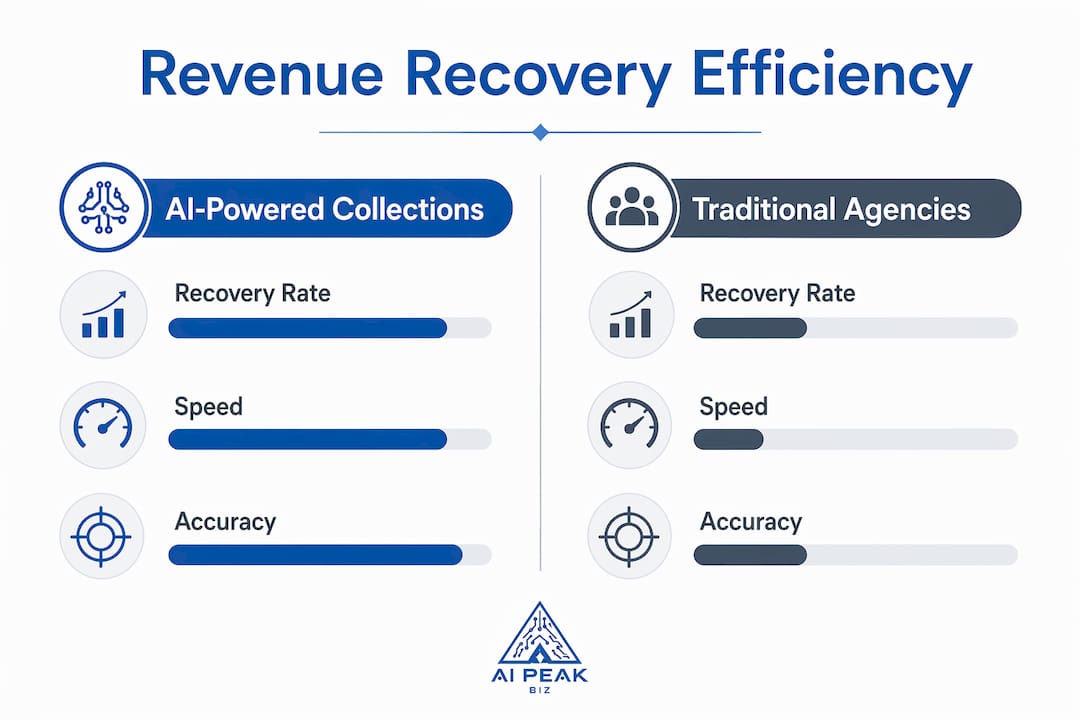
AI-driven revenue recovery is defined as the use of automated systems and machine learning to identify, prioritize, and collect outstanding revenue faster and at lower cost than traditional methods. The role of AI in revenue recovery goes far beyond automation. It acts as a proactive engine that shapes cash flow before defaults happen. Platforms like Gaviti and Goldfinch AI have demonstrated this shift clearly. AI-powered platforms recover approximately 50% of placed accounts within 20 days, compared to 20–30% over six months using traditional agencies. That gap is not incremental. It is a structural change in how service businesses protect their revenue.
How does AI improve efficiency in revenue recovery?
AI changes the economics of collections at a fundamental level. Traditional agencies operate at a fraction of the account coverage AI delivers. AI operates at a 1:1 agent-to-account ratio, reducing cost per dollar recovered to roughly $0.10 versus $0.35 with traditional methods. That means you recover more money while spending less to do it.
The accuracy gains are equally significant. AI-powered cash application tools reach 95% matching accuracy before the workday begins, eliminating hours of manual reconciliation. Businesses using AI in collections also achieve an average 25% reduction in Days Sales Outstanding (DSO). Lower DSO means cash arrives faster, which directly improves your ability to cover payroll, reinvest, and grow.

Here is a direct comparison of AI versus traditional collection methods:
| Factor | AI-Powered Collections | Traditional Agencies |
|---|---|---|
| Recovery rate | ~50% within 20 days | 20–30% over 6 months |
| Agent-to-account ratio | 1:1 | Limited by headcount |
| Cost per dollar recovered | ~$0.10 | ~$0.35 |
| Cash application accuracy | 95% before workday | Manual, error-prone |
| DSO reduction | Up to 25% | Minimal |
Pro Tip: Track your DSO monthly before and after AI adoption. A 25% reduction in DSO on a $500,000 receivables balance frees up $125,000 in working capital. That number alone justifies the investment.
The AI in financial recovery model also removes the bottleneck of human bandwidth. Your team stops triaging and starts focusing on relationships and exceptions that actually need judgment.
What AI-driven strategies improve customer engagement in collections?
The most effective AI-driven revenue management approach treats every customer differently based on data, not gut instinct. AI transforms collections from reactive payment chasing to a proactive, data-driven engine that shapes customer engagement and cash flow strategy. That shift changes everything about how you communicate with customers who owe you money.
Here are the core strategies AI uses to improve engagement and payment rates:
- Dynamic segmentation. AI scores each account by payment likelihood, account age, and behavioral signals. High-probability payers receive a gentle reminder. At-risk accounts get escalated outreach before they go delinquent.
- Multi-channel communication. AI deploys email, SMS, and voice calls based on each customer’s preferred channel and response history. Reaching someone on the right channel at the right time increases response rates significantly.
- Proactive outreach timing. Rather than waiting for an invoice to age, AI sends reminders before due dates. This prevents late payments rather than chasing them after the fact.
- Empathetic, compliant messaging. AI addresses the traditional “dignity deficit” in collections by replacing high-pressure tactics with nuanced, brand-safe outreach. Customers respond better when they feel respected, not cornered.
Platforms like DPDzero have built their entire model around this empathy-first approach. The result is higher consumer acceptance and fewer disputes. For service businesses, this matters because your customers are also your neighbors, referral sources, and repeat buyers. Burning a relationship to collect a payment is a bad trade.
The impact of AI on revenue here is not just financial. It is relational. AI lets you recover money without damaging the trust you spent years building.
What challenges come with implementing AI for revenue recovery?
AI does not install itself and run perfectly on day one. The biggest barrier is data quality. Clean, structured data and real-time processing infrastructure are baseline requirements for any AI revenue recovery system. Traditional batch processing creates slow, reactive outcomes. AI needs live data to make accurate decisions.
Here are the four most common implementation challenges, in order of frequency:
- Legacy system modernization. Most service businesses run billing and CRM on systems that were not built for real-time data exchange. Connecting these to an AI layer requires integration work upfront.
- Schema and data cleanup. Inconsistent customer records, duplicate entries, and missing fields all degrade AI accuracy. Cleaning your data before launch is not optional.
- Defining policy-clear tasks. AI works best on narrow, well-defined tasks such as prioritization, dispute routing, and cash application. Trying to automate complex judgment calls leads to errors and customer complaints.
- Human-in-the-loop design. Human oversight remains critical for complex, high-touch disputes. AI handles volume. Humans handle nuance. The best implementations define exactly where the handoff happens.
Implementation timelines vary widely. Simple AI lead response systems can launch in weeks. Comprehensive revenue orchestration platforms require months of infrastructure preparation. Set realistic expectations with your team before you start.
Pro Tip: Start with one AI application, such as automated payment reminders or lead qualification, before expanding. A focused first deployment builds internal confidence and gives you clean data on what works before you scale.
How do multi-agent AI systems increase pipeline conversion?
Multi-agent AI revenue orchestration represents the most advanced form of artificial intelligence revenue solutions available today. These systems do not run a single AI model. They deploy 8–9 specialized AI agents working in parallel across the full revenue lifecycle, from demand generation to renewal protection.
Goldfinch AI is one example of this architecture in practice. Each agent handles a specific function: one qualifies leads, another monitors payment behavior, another manages renewal risk, and so on. The agents share data in real time, which means a signal in one part of the pipeline immediately informs decisions in another.
The results are measurable. Multi-agent systems increase pipeline conversion rates by 25–40% and improve revenue forecast accuracy by 25–35 percentage points. Those are not marginal gains. They change how confidently you can plan hiring, inventory, and growth.
| Metric | Before Multi-Agent AI | After Multi-Agent AI |
|---|---|---|
| Pipeline conversion rate | Baseline | Up 25–40% |
| Revenue forecast accuracy | Inconsistent | Improved by 25–35 pts |
| Revenue lifecycle coverage | Siloed by department | End-to-end orchestration |
| Renewal protection | Reactive | Proactive, signal-driven |
For service businesses, this level of optimizing revenue with AI means fewer leads falling through the cracks and more predictable monthly revenue. You stop guessing which customers will renew and start acting on data before they churn.
The partner platform Interval AI applies similar multi-agent logic specifically to professional services, adding compliance and empathy layers that protect client relationships during collections.
Key Takeaways
AI-driven revenue recovery outperforms traditional methods on every measurable dimension, from recovery speed and cost to customer engagement and forecast accuracy.
| Point | Details |
|---|---|
| Recovery speed advantage | AI recovers ~50% of accounts within 20 days versus 20–30% over 6 months traditionally. |
| Cost efficiency | AI reduces cost per dollar recovered from $0.35 to ~$0.10, freeing budget for growth. |
| Customer engagement | Dynamic segmentation and empathetic messaging improve payment rates without damaging relationships. |
| Implementation discipline | Start with clean data and narrow, policy-clear tasks before expanding AI scope. |
| Multi-agent upside | Orchestration systems improve pipeline conversion by 25–40% and sharpen revenue forecasting. |
What I have learned watching AI change collections for service businesses
I have watched a lot of service business owners adopt AI tools with high expectations and mixed results. The ones who succeed share one trait: they treat AI as a precision instrument, not a magic switch. They identify one painful, repetitive task, such as chasing overdue invoices or following up on missed calls, and they automate that specific thing first. The wins come fast. The confidence builds. Then they expand.
The owners who struggle try to automate everything at once. They skip the data cleanup. They do not define where human judgment takes over. And when an AI agent sends the wrong message to a long-term client, the damage to that relationship costs more than the invoice was worth.
The insight I keep coming back to is this: AI is a multiplier for lean teams, not a replacement for human care. A two-person billing team using AI can manage the workload of a ten-person department. But the two people still matter. They handle the exceptions, the sensitive conversations, and the judgment calls that no algorithm should make alone.
The future I see for service businesses is one where AI aids recovery without the customer ever feeling chased. Payments arrive on time because the system reminded them gently, on the right channel, at the right moment. Relationships stay intact. Cash flow becomes predictable. That is not a distant vision. It is available right now for businesses willing to implement it thoughtfully.
— Wylie
How Aipeakbiz applies these principles for service businesses
Service businesses lose real money every day to missed calls, slow follow-up, and leads that go cold before anyone responds. Aipeakbiz was built specifically to close that gap.
The Aipeakbiz AI Voice Assistant answers calls and qualifies leads around the clock, so no inquiry goes unanswered. The revenue recovery solutions apply the same proactive engagement principles discussed throughout this article, booking appointments and following up with leads automatically. You stay focused on delivering your service. Aipeakbiz handles the front-line revenue work that too often falls through the cracks. If you are ready to stop losing revenue to slow response times, Aipeakbiz offers a direct path forward.
FAQ
What is the role of AI in revenue recovery?
AI in revenue recovery automates prioritization, outreach, and cash application to collect outstanding revenue faster and at lower cost than manual methods. Platforms like Gaviti recover approximately 50% of accounts within 20 days using AI-driven processes.
How does AI reduce Days Sales Outstanding?
Businesses using AI in collections achieve an average 25% reduction in DSO by automating reminders, improving cash application accuracy, and prioritizing high-probability accounts for faster resolution.
Can AI handle collections without human involvement?
AI handles high-volume, routine tasks well, but human oversight remains essential for complex disputes and sensitive accounts. The most effective systems use a human-in-the-loop model that defines clear handoff points.
How long does it take to implement AI for revenue recovery?
Simple systems like automated lead follow-up can launch in weeks. Comprehensive revenue orchestration platforms require months of data preparation and infrastructure work before going live.
Does AI improve customer relationships during collections?
AI improves customer acceptance by replacing high-pressure tactics with empathetic, compliant messaging. This approach addresses the traditional dignity deficit in collections and protects long-term customer relationships.
Recommended
Want to see what your business is losing?
Take our free revenue assessment and find out how much missed calls, slow follow-up, and dormant leads are costing you every month.
Take the Free Assessment