The Role of AI Receptionists in Clinics: 2026 Guide

The Role of AI Receptionists in Clinics: 2026 Guide
AI receptionists in clinics are defined as automated voice and text systems that handle patient calls, book appointments, send reminders, and manage front desk workflows without human staff. The role of AI receptionists in clinics has moved from experimental to essential, with medical practices losing $200 per no-show appointment and AI systems proven to reduce those losses by 30–40%. Human receptionists cost $57,000–$93,000 annually. AI receptionists cost $3,600–$11,000 annually. That gap is why clinic managers across the country are rethinking their front desk model entirely.
How do AI receptionists automate patient communication in clinics?
The core function of an AI receptionist is intent recognition. When a patient calls, the system identifies what they need, whether that is scheduling, prescription refills, or directions, and routes the request accordingly. AI receptionists manage multi-step tasks including pulling EHR records, verifying insurance, and completing bookings without any human involvement.
Scheduling integration is where these systems earn their keep. A well-configured AI receptionist connects directly to your scheduling software and EHR, checking real-time availability and confirming appointments in under 90 seconds. Patients get a confirmed slot without waiting on hold. Your staff gets a full schedule without lifting a phone.

Automated reminders are the most underrated feature in patient management. The system sends confirmation texts, pre-appointment instructions, and follow-up messages through SMS, email, or voice. This multi-channel approach is what drives the 30–40% reduction in no-shows that clinics report after deployment.
Key communication functions AI receptionists handle in clinics:
- Call answering: Responds instantly, 24 hours a day, 7 days a week, including weekends and holidays
- Appointment booking: Checks live availability and confirms slots directly in your scheduling system
- Multilingual support: Dynamically switches languages mid-call based on caller responses, a feature nearly impossible at scale with human staff
- Reminder sequences: Sends automated texts and calls before appointments to reduce cancellations
- Call filtering: Identifies and blocks spam and sales calls, keeping your staff focused on patients
- After-hours coverage: Captures patient calls after hours and books next-day appointments while your clinic is closed
Pro Tip: Set your AI receptionist to send a reminder 48 hours before the appointment and a second one 2 hours before. Two-touch reminder sequences consistently outperform single reminders in reducing no-shows.
What measurable benefits do clinics gain from AI receptionists?
The financial case for automated clinic reception is straightforward. AI handles 58% of calls without human help, which means your human staff spend more time on complex patient needs and less time repeating clinic hours over the phone. Confirmed bookings increase by 15–25% within the first 30 days of deployment.
Staffing gaps are a real operational problem. Multi-provider practices spend 95–110 days per year understaffed due to recruitment challenges. An AI receptionist fills that gap without recruiting, onboarding, or managing additional staff. It answers every call on the first ring, regardless of how many lines are ringing at once.
“Patients now select clinics offering instant, 24/7 call answering over those with voicemail or busy signals. The front desk experience has become a competitive differentiator, not just an administrative function.”
Patient satisfaction improves when calls are answered immediately. 80% of callers who reach voicemail do not leave a message. That means every unanswered call is a lost patient, not a callback waiting to happen.
| Metric | Human receptionist | AI receptionist |
|---|---|---|
| Annual cost | $57,000–$93,000 | $3,600–$11,000 |
| Availability | Business hours only | 24/7, every day |
| Call handling speed | Variable | Under 90 seconds |
| No-show reduction | Inconsistent | 30–40% |
| Multilingual support | Limited | Native language support |
| Calls handled without escalation | Varies by volume | 58% autonomously |
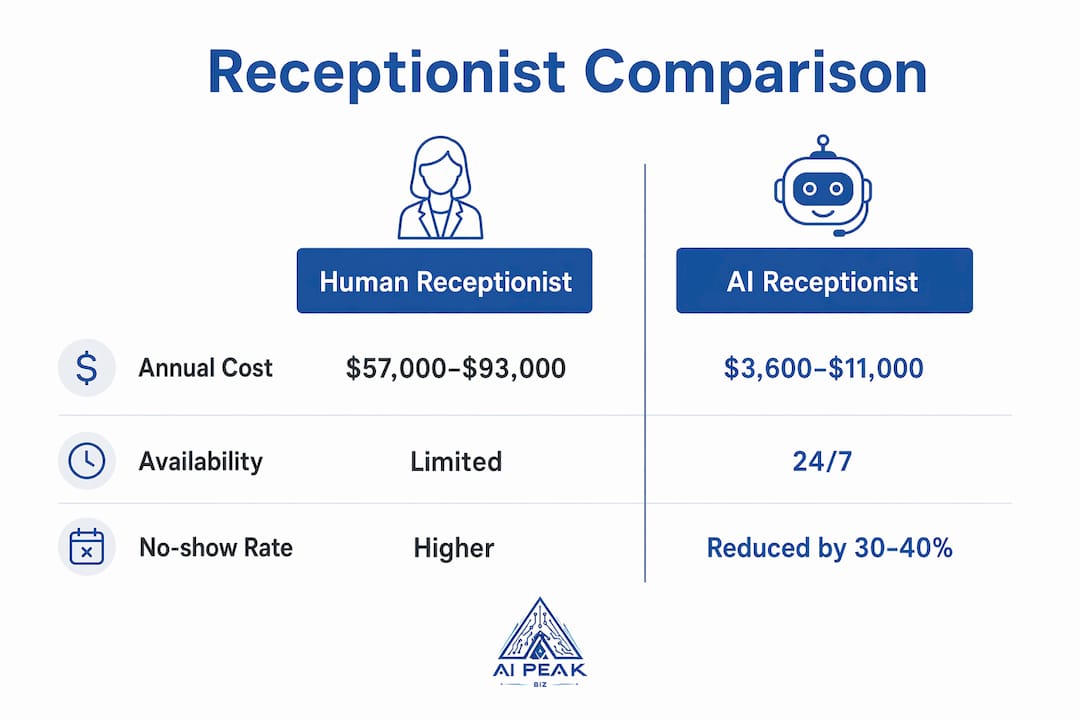
The cost difference alone justifies a serious evaluation. Add the no-show reduction and after-hours booking capability, and the return on investment becomes clear within the first quarter.
What challenges should clinics expect when implementing AI receptionists?
Implementation is not instant. EHR integration is rarely plug-and-play, and clinics should expect 4–20 hours of configuration to map AI logic to their specific scheduling rules and workflows. Skipping this step produces robotic, frustrating interactions that patients notice immediately.
Effective implementation requires close collaboration between your IT team and clinical staff. The AI needs to understand your triage protocols, your appointment types, and your escalation rules before it goes live. Rushing this phase is the most common reason clinics report poor results in the first 60 days.
Here is a practical implementation sequence that reduces risk:
- Audit your current call volume. Categorize calls by type: scheduling, billing, clinical questions, and general inquiries. This tells you exactly what the AI needs to handle.
- Map your scheduling rules. Define appointment types, durations, provider availability, and any booking restrictions before touching the AI configuration.
- Integrate with your EHR. Work with your IT team to connect the AI to your scheduling system. Test every appointment type before going live.
- Set escalation protocols. Define which call types transfer immediately to a human. Emotional distress, urgent clinical concerns, and complex billing disputes all require a person.
- Run a pilot period. Deploy the AI on one phone line for two to four weeks. Review call recordings, check booking accuracy, and adjust prompts before full rollout.
- Schedule monthly reviews. Ongoing prompt tuning is not optional. Clinic workflows change, and your AI configuration needs to keep pace.
The hybrid model is the right long-term structure for most clinics. Hybrid setups use AI for routine calls and humans for complex or emotional situations. The quality of the handoff between AI and human determines whether patients feel cared for or processed.
Pro Tip: Record and review 10 AI-handled calls every week for the first three months. You will catch prompt gaps and workflow mismatches before they affect patient experience at scale.
How can clinic managers reduce missed appointments using AI receptionists?
Reducing missed appointments requires more than just sending reminders. The full workflow starts at the moment of booking and continues through the day of the appointment. AI in patient management gives clinic managers the ability to automate every touchpoint in that sequence.
Practical strategies that produce results:
- Confirmation at booking: Send an immediate SMS confirmation the moment an appointment is booked. Patients who receive instant confirmation cancel less often.
- Multilingual outreach: AI receptionists provide native language support that human-only models cannot sustain at scale. Patients who receive communication in their preferred language show higher appointment adherence.
- Smart call routing: Systems identify caller intent in real time and route urgent calls immediately. This prevents urgent needs from sitting in a queue and reduces same-day cancellations driven by patient frustration.
- Performance analytics: Review weekly reports on call volume, booking rates, no-show rates, and escalation frequency. Use that data to adjust reminder timing and call scripts. For guidance on call routing setup, proper configuration makes a measurable difference in patient experience.
- After-hours capture: Patients who call after hours and reach a live AI receptionist book appointments at a significantly higher rate than those who reach voicemail. After-hours coverage is not a luxury. It is a retention tool.
The advantage of AI receptionist roles in this context is consistency. A human receptionist has good days and bad days. An AI receptionist delivers the same response quality on a Monday morning as it does at 10:00 PM on a Friday. That consistency is what builds patient trust over time. For a deeper look at how AI qualifies and manages patient appointment requests, the workflow details matter as much as the technology itself.
Key Takeaways
AI receptionists reduce clinic no-shows by 30–40%, cut front desk costs by up to 90%, and deliver 24/7 patient communication that human staff cannot match at the same price point.
| Point | Details |
|---|---|
| Cost advantage is significant | AI receptionists cost $3,600–$11,000 annually versus $57,000–$93,000 for human staff. |
| No-show reduction is measurable | Clinics report 30–40% fewer no-shows and 15–25% more confirmed bookings within 30 days. |
| Integration requires real effort | Expect 4–20 hours of EHR and scheduling configuration before going live. |
| Hybrid models outperform pure AI | Use AI for routine calls and humans for emotional or complex patient interactions. |
| After-hours coverage drives retention | AI captures patient calls when staff are unavailable, booking appointments that would otherwise be lost. |
What I have learned after watching clinics adopt AI receptionists
I have watched clinic managers approach AI receptionists in two very different ways. The first group treats it as a cost-cutting tool and deploys it fast with minimal configuration. The second group treats it as a patient experience investment and spends real time mapping their workflows before going live. The second group always gets better results.
The benefit that gets overlooked most often is not cost savings. It is competitive access. Patients now choose clinics the same way they choose restaurants: they call, and if no one answers, they move on. A clinic that answers every call instantly, in any language, at any hour, has a structural advantage that compounds over time.
The challenge I see most often is the handoff. Clinics configure the AI well but design a poor escalation path. When a patient with a complex concern gets transferred to a voicemail or a hold queue, all the goodwill from the instant answer disappears. The handoff to a human needs to be as fast and warm as the initial AI response.
The future of AI in healthcare front desks is not replacement. It is augmentation. The clinics that will lead in patient retention are the ones that use AI to handle volume and humans to handle nuance. That balance is not a technology problem. It is a management decision. For clinic managers exploring AI tools for medical offices, the configuration decisions you make in the first 30 days shape everything that follows.
— Wylie
How Aipeakbiz supports clinics building a better front desk
Clinics that want to reduce missed appointments and capture more patient calls need more than software. They need a system configured for their specific workflows and a team that stays involved after launch.
Aipeakbiz builds AI front desk systems for medical clinics that answer calls instantly, book appointments around the clock, and qualify patient requests without adding staff. The system integrates with your existing scheduling tools and handles multilingual patient communication from day one. Clinic managers who want consistent call handling, real-time booking, and measurable no-show reduction can explore the AI appointment setter built specifically for service-based practices. Aipeakbiz stays hands-on through setup and beyond, so your front desk performs the way your patients expect.
FAQ
What is the role of AI receptionists in clinics?
AI receptionists in clinics handle patient call answering, appointment booking, insurance verification, and automated reminders without human staff. They operate 24/7 and integrate directly with EHR and scheduling systems.
How much do AI receptionists cost compared to human receptionists?
AI receptionists cost $3,600–$11,000 annually, compared to $57,000–$93,000 for human receptionists. The cost difference allows clinics to reallocate staff to higher-value clinical tasks.
Can AI receptionists reduce no-show rates?
AI receptionists reduce no-shows by 30–40% through automated reminder sequences sent via SMS, email, and voice calls before each appointment.
How long does it take to set up an AI receptionist for a clinic?
Setup requires 4–20 hours of configuration to integrate with EHR systems and map scheduling rules. Clinics that invest in thorough setup see faster results and fewer patient experience issues.
Do AI receptionists support patients who speak languages other than English?
AI receptionists provide native language support and can switch languages mid-call based on caller responses, covering multilingual patient populations that human-only front desks cannot serve consistently.
Recommended
Want to see what your business is losing?
Take our free revenue assessment and find out how much missed calls, slow follow-up, and dormant leads are costing you every month.
Take the Free Assessment