AI in Home Service Businesses: Your 2026 Guide

AI in Home Service Businesses: Your 2026 Guide
AI in home service businesses is defined as the use of automated voice agents, scheduling systems, and customer follow-up tools that handle routine operational tasks without human involvement. The role of AI in home service businesses goes well beyond answering phones. Tools like Lua and Service1 now qualify leads, book appointments, dispatch technicians, and request reviews, all without a single staff member picking up the phone. AI voice agents handle 30–50% of incoming calls automatically, freeing your team to focus on the work that actually generates revenue. If you run an HVAC company, a plumbing operation, or a roofing crew, this technology is already reshaping how your competitors win jobs.
How AI reduces missed calls and captures leads around the clock
Home service companies lose 30–50% of inbound calls to voicemail during business hours and nearly all after-hours calls without AI assistance. That is not a minor inconvenience. Every missed call is a potential job handed to a competitor who picked up.
AI voice agents solve this problem at the source. Tools like Lua answer calls within two rings, 24 hours a day, seven days a week. They qualify the caller, provide a quote range, and book the appointment directly into your calendar or CRM. Onboarding takes only a few clicks: forward your phone number, load your service playbook, and the system goes live within 24 hours. Full call transcription and summaries are included automatically.
The lead qualification process is where AI earns its keep. Instead of a caller reaching voicemail and hanging up, they reach a voice agent that asks the right questions, confirms the service address, checks availability, and locks in a time slot. That entire interaction happens in under three minutes with no hold music and no menu navigation.
Key benefits of AI call handling for home service owners:
- 24/7 availability with no downtime, sick days, or missed shifts
- Automatic lead qualification that filters serious buyers from tire-kickers
- Direct calendar integration so booked appointments appear in real time
- Emergency escalation that routes urgent calls like burst pipes to an on-call technician immediately
- Full call logs and summaries for every interaction, giving you visibility without listening to recordings
Pro Tip: Set your AI voice agent to send a confirmation text immediately after booking. Customers who receive a text confirmation within 60 seconds of a call are far less likely to cancel or book with another provider.
What AI automates beyond the phone call
Call handling is only the beginning. AI automation in home businesses now covers scheduling, technician dispatch, post-job follow-up, and membership retention, all running in the background while your crew is in the field.
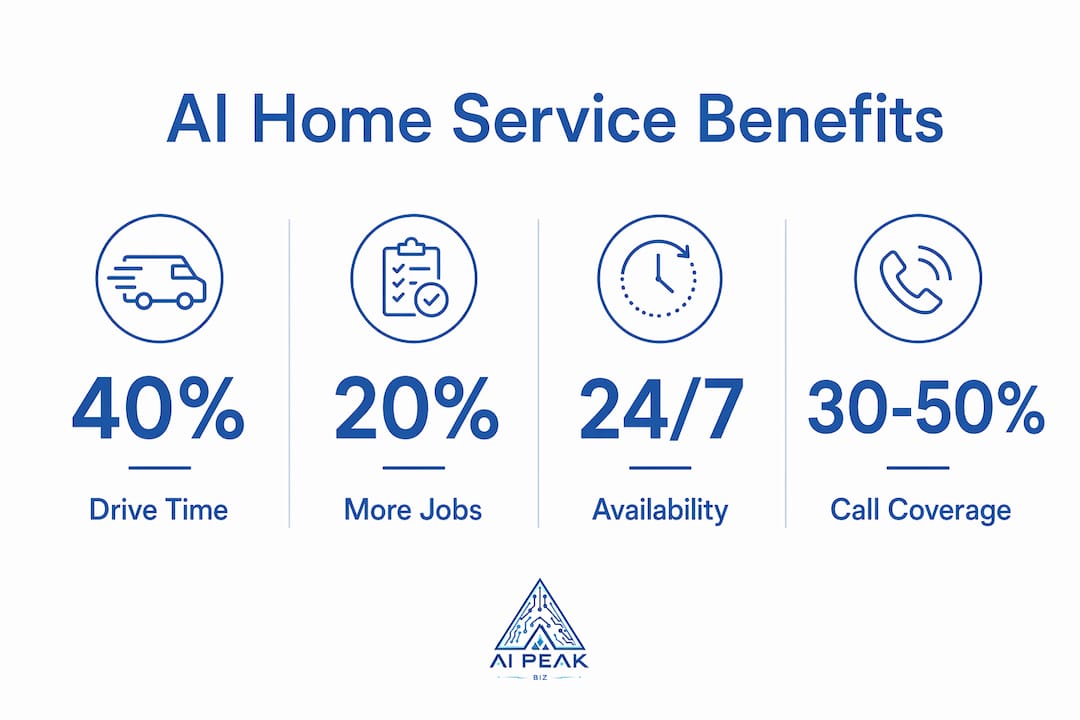
AI-powered dispatch reduces drive time by 25–40% and increases the number of jobs each technician completes daily by 20–30%. That means more revenue from the same headcount. The system analyzes job locations, technician skill sets, and traffic patterns to assign the most efficient route automatically.
Post-job customer engagement is another area where AI delivers measurable results. Texting customers for a review within 30 minutes of job completion yields a 25–40% response rate. That response rate translates to 5–8 new Google reviews per day for an active service company, which directly improves your local search ranking and organic lead flow.
Membership and maintenance plan follow-up is where revenue leaks quietly for most home service businesses. AI handles this automatically. Automated follow-ups recover 15–25% of lapsed memberships by reaching out at the right moment with the right message, without requiring a staff member to make awkward retention calls.
Stat to know: Automated customer follow-ups increase Google review volume by 3–5x compared to businesses that rely on manual requests or verbal asks at the job site.
Additional workflows AI handles without staff involvement:
- Appointment confirmation texts and reminder calls 24 hours before service
- No-show follow-up to reschedule canceled appointments
- Seasonal maintenance reminders for HVAC tune-ups or gutter cleaning contracts
- Upsell prompts for service plan upgrades after a completed repair
AI vs. traditional call handling: which actually works better?
Traditional IVR systems, the “press 1 for billing, press 2 for service” menus, frustrate callers and produce high hang-up rates. AI voice agents understand natural language, eliminating rigid menus entirely. A caller says “I need someone to look at my AC unit tomorrow morning” and the agent books it. No menu. No hold. No friction.
The cost difference is significant. AI systems operate at 10–30% of the cost of a full-time service employee. That includes call handling, lead qualification, scheduling, and follow-up. A human receptionist working 40 hours per week cannot cover nights, weekends, or holidays without overtime. An AI agent covers all of it at a flat rate.
| Feature | Traditional call handling | AI voice agent |
|---|---|---|
| Availability | Business hours only | 24/7, no exceptions |
| Lead qualification | Manual, inconsistent | Automatic, script-driven |
| Booking speed | Minutes to hours | Under 3 minutes |
| Cost vs. full-time staff | 100% | 10–30% |
| Error rate | High (manual entry) | Low (CRM integrated) |
| Scalability | Hire more staff | Handles volume spikes automatically |
Hybrid AI-human models deliver the best balance for most home service companies. Routine calls go to the AI agent. Complex situations, disputes, or emergency escalations route to a human. This approach keeps costs low while maintaining quality where it matters most.
Pro Tip: Review your AI call summaries weekly. Patterns in caller questions reveal gaps in your service menu, pricing clarity, or scheduling availability that you can fix before they cost you jobs.
How to implement AI in your home service business
Starting with AI does not require a technology background or a large budget. The fastest path to results follows a clear sequence.
- Forward your business number to an AI voice agent. This single step captures every call you currently miss after hours or during busy periods. Tools like Lua go live within 24 hours of setup.
- Load your service playbook. Define your service area, job types, pricing ranges, and escalation rules. The AI uses this to qualify callers accurately from day one.
- Connect your calendar or field service management software. Direct integration with tools like ServiceTitan, Jobber, or Google Calendar prevents double-booking and keeps your schedule current in real time.
- Activate post-job review requests. Set the system to send a review request text 30 minutes after a job is marked complete. This single workflow generates more Google reviews than most businesses collect in a year of manual asking.
- Add dispatch optimization. Once call handling is stable, layer in AI-powered routing to reduce drive time and increase daily job capacity.
- Review analytics weekly. Call summaries, booking rates, and missed call logs show exactly where revenue is leaking and what to fix next.
AI adoption in home services is led by HVAC, plumbing, and roofing companies. These trades benefit most from 24/7 booking and emergency escalation workflows. Cleaning and lawn care companies lag behind but see strong results when they implement AI workflows in the correct order, starting with call answering before adding dispatch or follow-up automation.
Integrating AI with CRM, ERP, and field service management systems is the step most business owners skip. Surface-level automation answers calls but does not update your job board. Deep integration means a booked call instantly creates a job record, assigns a technician, and triggers a confirmation text, all without anyone touching a keyboard.
Pro Tip: Build trade-specific scripts for your AI agent. A plumbing company needs emergency escalation logic for burst pipes. An HVAC company needs seasonal contract pitches baked into every tune-up call. Generic scripts leave money on the table.
Key takeaways
AI in home service businesses delivers the highest return when it handles calls, dispatch, and follow-up as a connected system rather than isolated tools.
| Point | Details |
|---|---|
| Missed calls cost real revenue | Home service companies lose 30–50% of inbound calls without AI, each one a potential lost job. |
| AI agents work around the clock | Voice agents like Lua answer within two rings, qualify leads, and book appointments 24/7. |
| Dispatch optimization multiplies output | AI routing increases daily jobs per technician by 20–30% without adding staff. |
| Post-job reviews compound over time | Automated review requests sent within 30 minutes generate 3–5x more Google reviews. |
| Hybrid models balance cost and quality | Routine calls go to AI; complex issues escalate to humans for the best operational balance. |
What I’ve learned after watching AI reshape home service operations
I have watched a lot of home service business owners approach AI the wrong way. They buy a tool, forward their calls, and expect the results to show up automatically. The ones who see real gains treat AI as a team member that needs onboarding, not a switch they flip once.
The biggest mistake I see is skipping the playbook. Your AI agent is only as good as the instructions you give it. A generic script that does not mention your service area, your pricing structure, or your emergency policy will confuse callers and lose bookings. Spend two hours building a detailed playbook before you go live. That investment pays back within the first week.
The second mistake is treating AI as a replacement for your people. The best results come from hybrid human-AI collaboration, where AI handles volume and humans handle relationships. Your technicians and office staff are still your brand. AI just makes sure no one falls through the cracks while your team is focused on the job in front of them.
The trend I am watching most closely right now is real-time dispatch optimization combined with AI-generated customer communication. When these two systems talk to each other, a technician finishing a job early can trigger an automatic call to the next customer offering an earlier arrival window. That kind of responsiveness used to require a full-time dispatcher. Now it runs on its own.
If you are not yet using AI to recover lost leads from missed calls, you are leaving a measurable amount of revenue on the table every single week. The technology is affordable, the setup is fast, and the results show up in your booking rate within the first month.
— Wylie
How Aipeakbiz helps home service businesses stop losing revenue
Home service business owners who are ready to put AI to work have a clear starting point with Aipeakbiz. The platform is built specifically for service businesses losing jobs to missed calls and slow follow-up.
Aipeakbiz’s AI voice assistant answers every call within seconds, qualifies the lead, and books the appointment directly into your schedule, day or night. For owners who want to go further, the AI appointment setter handles client intake and scheduling without any manual coordination. Both tools integrate with your existing calendar and service software, so your team sees every booking in real time. Aipeakbiz is not a generic software platform. It is a hands-on solution designed to make sure no customer slips through the cracks while you focus on delivering great work.
FAQ
What is the role of AI in home service businesses?
AI in home service businesses acts as a 24/7 virtual assistant that answers calls, qualifies leads, books appointments, dispatches technicians, and follows up with customers automatically. Its core function is to capture revenue that would otherwise be lost to missed calls and slow response times.
How much of call volume can AI handle automatically?
AI voice agents handle 30–50% of incoming calls automatically, covering routine tasks like booking, quoting, and FAQs. Approximately 70% of all inbound calls fall into routine categories that AI can manage without human involvement.
How quickly can a home service business go live with AI?
Platforms like Lua allow businesses to go live within 24 hours by forwarding a phone number and loading a service playbook. No technical background is required for basic setup.
Does AI replace my office staff or receptionist?
AI does not replace your team. Hybrid AI-human models route routine calls to AI and escalate complex situations to humans, delivering the best balance of cost savings and customer experience.
Which home service trades benefit most from AI?
HVAC, plumbing, and roofing companies lead AI adoption in home services because their high call volume and emergency service needs align directly with what AI voice agents do best.
Recommended
Want to see what your business is losing?
Take our free revenue assessment and find out how much missed calls, slow follow-up, and dormant leads are costing you every month.
Take the Free Assessment