Handle Customer Complaints Efficiently: 2026 Guide

Handle Customer Complaints Efficiently: 2026 Guide
Efficient complaint management is defined as the structured process of acknowledging, investigating, resolving, following up, and documenting customer issues within defined timeframes to protect trust and prevent churn. Service businesses that master this process turn frustrated customers into loyal ones. Tools like Gorgias, Zendesk, and HelpCrunch have shaped the current industry standard for complaint resolution, and their frameworks share one common thread: speed and ownership matter more than any single policy. This guide to handle customer complaints efficiently gives you a practical, scalable system built for service-oriented professionals who cannot afford to lose a client over a mishandled issue.
What are the essential steps in an efficient complaint handling process?
The five-step complaint handling process is the current industry standard for efficient, trackable complaint resolution. Each step is non-negotiable. Skip one and you lose the ability to scale or measure your results.
Step 1: Acknowledge receipt and commit to a timeline
Contact the customer within the hour. Tell them exactly when they will hear back with a resolution or update. Vague responses like “we’ll look into it” create anxiety and invite escalation. A specific commitment, such as “You will receive an update by 3 PM today,” signals that your team is in control.
Step 2: Investigate with full context
Gather every relevant detail before forming a response. Review the order history, service record, and any prior interactions. Never assume you know the root cause before you have the facts. Assumptions lead to wrong fixes, which double the frustration.

Step 3: Resolve with empowered agents
Frontline agents need defined authority limits so they can act without waiting for manager approval on every case. Defined authority tiers reduce unnecessary escalations and speed resolution. An agent who can approve a refund up to $150 or issue a service credit on the spot closes complaints faster than one who must escalate every decision.
Step 4: Follow up to confirm satisfaction
Contact the customer after resolution to verify the fix worked. This step separates average service from memorable service. A short follow-up call or message shows the customer they were not just a ticket number.
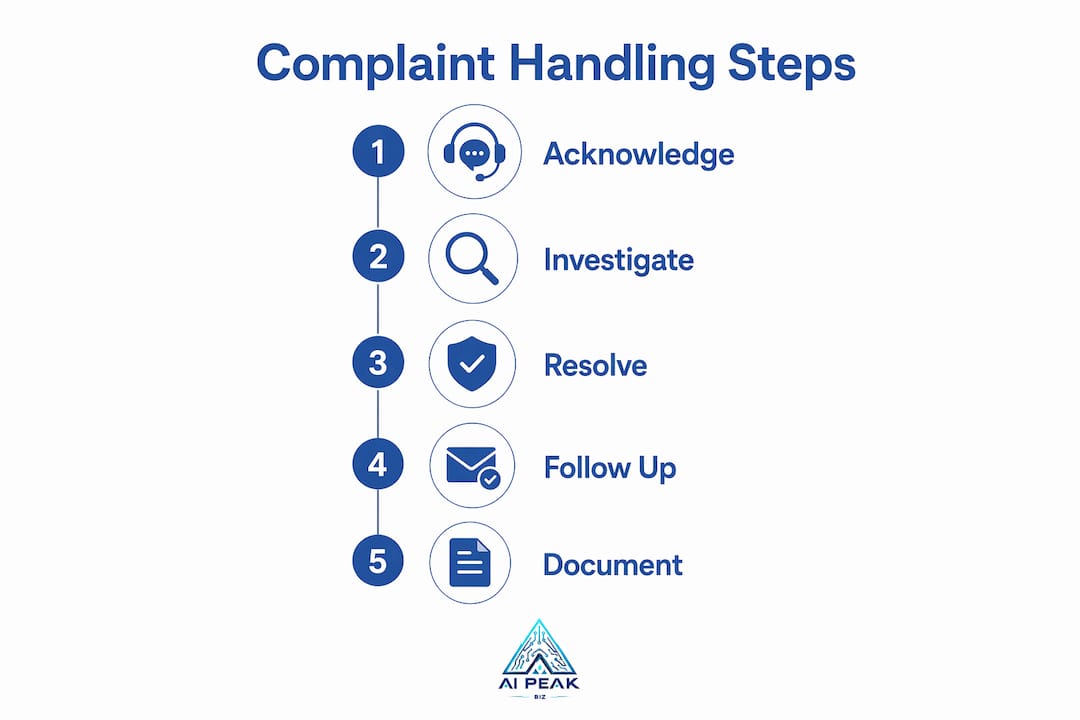
Step 5: Document everything
Log the complaint category, root cause, resolution method, time to resolution, and whether the customer confirmed satisfaction. Without this data, recurring issues stay invisible.
| Step | Owner | Output |
|---|---|---|
| Acknowledge | First-contact agent | Confirmation message with timeline |
| Investigate | Assigned agent or team lead | Root cause summary |
| Resolve | Empowered frontline agent | Confirmed fix with options offered |
| Follow up | Agent or account manager | Satisfaction confirmation |
| Document | Agent or CX system | Complaint log entry |
Pro Tip: Set a calendar reminder or automated trigger in your CRM to prompt the follow-up step. Without a system, it gets skipped under pressure.
How can you respond quickly and thoughtfully to customer complaints?
Responding within one hour is the industry benchmark for initial complaint acknowledgment. That first hour is when a customer decides whether to escalate publicly or wait for a real solution. Miss that window and you are already managing a bigger problem.
Speed does not require sacrificing empathy. The goal is a fast, personal acknowledgment that buys you time to investigate properly. Here is how to build that capacity:
- Use live chat and AI chatbots for first contact. Tools like HelpCrunch and Gorgias handle initial complaint intake around the clock. AI and automation tools reduce response times and route issues to the right team without human delay.
- Build a library of acknowledgment templates. Templates speed up the first response without making it feel robotic. Personalize the customer’s name, the specific issue, and the expected timeline before sending.
- Train agents to respond before they have answers. Acknowledging receipt is not the same as resolving the issue. Customers need to know you heard them, even if the fix takes another hour.
- Use multichannel monitoring. Complaints arrive by phone, email, text, and social media. Missing a complaint on one channel because your team only watches another is a preventable failure.
- Set internal SLA alerts. Configure your CX platform to flag any complaint that has not received a response within 45 minutes. That buffer gives agents time to act before the one-hour mark passes.
Pro Tip: Verify customer contact information at the start of every complaint interaction. Frustrated customers sometimes provide inaccurate details. Confirming a working phone number or email before you begin investigating saves significant time later.
What are best practices for delivering resolutions that satisfy customers?
The language you use during resolution determines whether the customer feels heard or dismissed. Using “I” and “we” statements to accept responsibility signals sincerity and reduces escalation. “I apologize for the delay and we are fixing this now” lands very differently than “the system experienced an issue.”
Follow this sequence when delivering a resolution:
- State ownership clearly. Open with a direct apology that names the specific problem. Avoid passive language like “mistakes were made.” Say “We shipped the wrong item and I want to fix that for you today.”
- Offer multiple resolution options. Providing choices like a full refund, expedited replacement, or account credit gives the customer a sense of control. One-size-fits-all fixes feel dismissive.
- Set a clear timeline for the fix. Tell the customer exactly when the replacement ships, when the refund posts, or when the technician arrives. Vague timelines breed follow-up calls.
- Empower agents to act within defined limits. Agents with clear authority thresholds can approve refunds, credits, and service upgrades without escalating. Define those limits in writing so every agent knows their range.
- Take high-value apologies offline. For long-term or high-value clients, personalized offline gestures such as a handwritten note or a physical apology package communicate a level of care that no email can match. These gestures build retention that discounts alone cannot buy.
Clear communication throughout the resolution process directly influences customer satisfaction. Customers who receive timely updates during a fix report higher satisfaction than those who receive a faster fix with no communication. The process matters as much as the outcome.
How do you use complaint data to improve service over time?
Complaint documentation must capture category, root cause, resolution method, time to resolution, and satisfaction confirmation to be operationally useful. Without those five data points, your complaint log is just a list of problems with no path to fixing them.
Data-driven complaint analysis shifts a business from reactive to proactive. When you analyze complaint trends across 30, 60, and 90 days, patterns emerge. A spike in billing complaints after a pricing change tells you the communication failed, not the product. A cluster of scheduling complaints on Mondays points to a staffing gap, not a service quality issue.
| Data point | What it reveals | Action it enables |
|---|---|---|
| Complaint category | Which service area generates the most friction | Targeted training or process fix |
| Root cause | Whether the issue is systemic or one-off | Policy change vs. individual coaching |
| Time to resolution | Where delays occur in your process | Workflow or staffing adjustment |
| Satisfaction confirmation | Whether the fix actually worked | Resolution quality improvement |
CX software like Zendesk automates complaint tagging and routing, which means your data is clean and consistent without relying on agents to categorize manually. Clean data produces reliable trends. Reliable trends produce real fixes. This is how complaint data drives revenue growth by identifying the friction points that push customers toward competitors.
The most underused insight from complaint data is churn prediction. When a customer submits three complaints in 60 days with no follow-up confirmation, the probability of losing that customer rises sharply. Flag those accounts and assign proactive outreach before they cancel. That single practice, built from your complaint log, can protect a meaningful portion of your recurring revenue. For more on reducing attrition through service recovery, the Aipeakbiz guide on reducing customer churn covers this in depth.
Key takeaways
Handling customer complaints efficiently requires a five-step process, empowered agents, and systematic documentation to turn service failures into loyalty opportunities.
| Point | Details |
|---|---|
| Respond within one hour | The first hour determines whether a complaint escalates or resolves. |
| Use ownership language | “I” and “we” statements reduce defensiveness and build customer trust. |
| Offer multiple resolution options | Giving customers choices increases satisfaction and perceived control. |
| Document every complaint fully | Capturing root cause and resolution time reveals patterns for systemic fixes. |
| Empower frontline agents | Defined authority limits let agents resolve issues without unnecessary escalation. |
What I have learned from years of watching businesses handle complaints
The businesses that handle complaints well share one trait: they treat the complaint as information, not an attack. The ones that struggle treat every complaint as a threat to defend against. That defensive posture shows up in passive language, slow responses, and resolutions that technically solve the problem but leave the customer feeling worse.
The most common mistake I see is the gap between resolution and follow-up. A business fixes the issue, closes the ticket, and moves on. The customer never hears back. From the customer’s perspective, the silence reads as indifference. That one missing step, a 90-second follow-up call or a short text, is often the difference between a customer who stays and one who leaves a negative review.
Investing in frontline agent training pays back faster than most business owners expect. An agent who knows their authority limits, uses ownership language, and can offer a refund without calling a manager closes complaints in minutes instead of hours. That speed protects revenue and reputation simultaneously.
The tools matter too. Platforms like Gorgias, Zendesk, and HelpCrunch exist because manual complaint tracking at scale fails. If your team is still managing complaints through a shared email inbox, you are losing data, missing follow-ups, and creating inconsistent experiences. The right communication practices combined with the right tools produce results that neither can achieve alone.
Complaints are not a sign that your business is broken. They are a signal that a customer still believes you can do better. Honor that belief with speed, ownership, and a real fix.
— Wylie
How Aipeakbiz helps you resolve complaints before they escalate
Service businesses lose clients not because they lack good intentions but because slow responses create the impression of indifference. Aipeakbiz addresses that gap directly.
The Aipeakbiz AI Voice Assistant answers calls instantly, day or night, so no complaint goes unacknowledged during off-hours. The AI Chatbot handles initial complaint intake through text and web chat, capturing the details your team needs before a human agent steps in. Both tools use consistent, ownership-focused language that sets the right tone from the first contact. For service businesses that want faster responses, cleaner complaint data, and fewer missed opportunities, Aipeakbiz delivers the infrastructure to make that happen reliably.
FAQ
What is the ideal response time for a customer complaint?
Responding within one hour is the industry benchmark for initial acknowledgment. That first response does not need to be a resolution, just a clear confirmation that the complaint is received and being addressed.
What should complaint documentation include?
Effective documentation captures the complaint category, root cause, resolution method, time to resolution, and customer satisfaction confirmation. Without all five data points, the log cannot support operational improvements.
How do I stop complaints from escalating?
Acknowledge the complaint fast, use ownership language, and give the customer a specific timeline for resolution. Verifying contact information early also prevents follow-up failures that frustrate customers further.
Should frontline agents have authority to offer refunds?
Yes. Defined authority thresholds allow frontline agents to approve refunds, credits, or replacements up to a set limit without manager approval. This speeds resolution and reduces unnecessary escalation.
How does complaint data improve customer retention?
Analyzing complaint trends over 30 to 90 days reveals systemic issues before they drive churn. Businesses that act on complaint patterns proactively reduce repeat issues and protect long-term client relationships.
Recommended
Want to see what your business is losing?
Take our free revenue assessment and find out how much missed calls, slow follow-up, and dormant leads are costing you every month.
Take the Free Assessment