HIPAA-Compliant AI Messaging Guide for Healthcare

HIPAA-Compliant AI Messaging Guide for Healthcare
A HIPAA-compliant AI messaging system is defined as any AI-driven communication tool that handles protected health information (PHI) under the full scope of HIPAA’s Privacy Rule, Security Rule, and Breach Notification Rule. For healthcare administrators and compliance officers, this is not a technical preference. It is a legal obligation. Violating HIPAA can trigger fines up to $1.9 million per violation category per year. That figure alone makes this hipaa-compliant ai messaging guide one of the most consequential reads on your desk. The Office for Civil Rights (OCR) at the U.S. Department of Health and Human Services (HHS) enforces these rules, and AI tools that touch patient data fall squarely within their scope.
What does a HIPAA-compliant AI messaging system actually require?
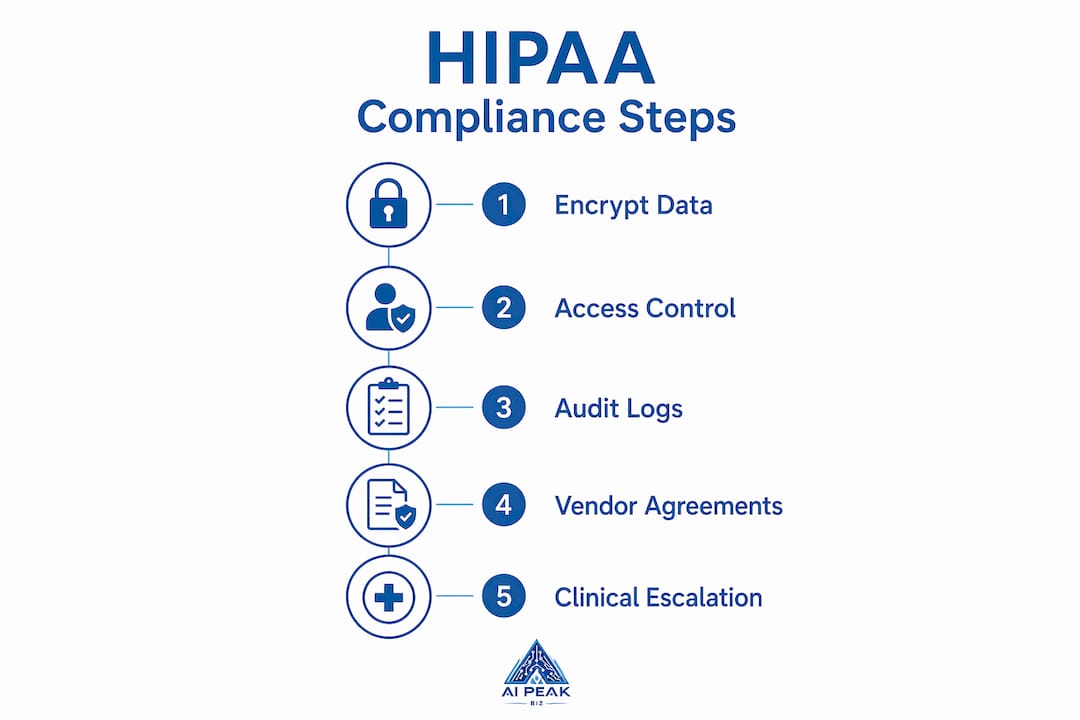
HIPAA compliance for AI messaging rests on three technical pillars: encryption, access control, and audit logging. Each one is non-negotiable. Miss any of them and your system fails the first OCR audit.
Encryption is the starting point. All data in transit must use TLS 1.2 or higher. Data at rest requires AES-256 encryption. These are not suggestions from a vendor brochure. They are the minimum standards recognized by HHS for electronic PHI (ePHI) protection.

Role-based access control (RBAC) limits who can view, edit, or export patient data within the AI system. Pair RBAC with multi-factor authentication (MFA) and you close the most common entry point for unauthorized access. Every staff member should access only the data their role requires. Nothing more.
Audit logging is where most organizations underestimate the work involved. Audit logs must capture the timestamp, user identity, action performed, and the specific ePHI elements affected. Records must be retained for a minimum of six years. AI interactions add a layer of complexity because the “user” is sometimes the AI itself, and those automated actions must also be logged.
Additional requirements include:
- Business Associate Agreements (BAAs): Any third-party vendor whose platform processes ePHI must sign a BAA. This contract defines each party’s compliance responsibilities. No BAA means no compliant deployment.
- Clinical escalation protocols: AI must route sensitive symptom queries to human clinicians. An AI that attempts to diagnose or manage clinical decisions without escalation creates both a compliance and a patient safety risk.
- Data residency: Self-hosted infrastructure keeps PHI entirely within your organization’s control. Cloud-hosted solutions require careful review of where data is stored, processed, and backed up.
Pro Tip: Before signing any vendor contract, ask specifically whether the vendor will use your patient data to train their AI models. If the answer is anything other than a clear “no,” walk away. PHI used for model training is a direct HIPAA violation.
How can healthcare organizations implement compliant AI messaging efficiently?
The build-versus-buy decision is the first fork in the road. Building a custom HIPAA messaging system can take 18 months. Integrating a HIPAA-eligible API reduces that timeline to weeks. For most healthcare organizations, the API route is the faster and more practical path, provided the implementation is configured correctly.
Configuration is where compliance is won or lost. A HIPAA-eligible API is not automatically compliant. Your team must activate the right settings. Here is the correct sequence:
- Map AI as a distinct asset in your risk analysis. Treat the AI messaging tool as a separate technology node with its own data flows, access points, and residual risks. Document everything. OCR expects to see AI-specific entries in your risk analysis, not a generic “software” category.
- Configure audit logging before go-live. Audit logs must be active from the first patient interaction. Retroactive logging is not acceptable. Set logoff timers to automatically end inactive sessions.
- Establish access controls by role. Define which staff roles interact with the AI system and what data each role can access. Test these controls before deployment, not after.
- Confirm PHI training restrictions in writing. Your BAA must explicitly prohibit the vendor from using ePHI to train or improve their AI models.
- Run a pre-launch compliance validation. Simulate patient interactions, verify that audit logs capture every event, and confirm that clinical escalation triggers work correctly.
HIPAA-eligible APIs require proper configuration of operational safeguards. Compliance depends on your implementation, not just the vendor’s offering. That distinction matters enormously when OCR comes knocking.
Pro Tip: Request a sample audit log from your vendor before signing. If they cannot produce a clear, readable log showing timestamp, user identity, action, and ePHI affected, their system is not ready for production.
Compliance documentation is also a deliverable, not an afterthought. Your risk analysis, BAA copies, training records, and system configuration logs must be organized and accessible. OCR investigations move fast, and disorganized documentation is treated as evidence of negligence.
What are the most common compliance pitfalls in AI messaging deployments?
73% of healthcare AI implementations fail HIPAA technical safeguards in the first audit. That statistic reflects a systemic problem, not isolated mistakes. The failures cluster around three recurring errors.
The first error is treating AI as a generic IT asset. AI messaging systems create new data flows that standard IT risk frameworks do not capture. When a patient sends a symptom description to an AI chatbot, that message may pass through multiple processing layers before a response is generated. Each layer is a potential compliance gap.
The second error is insufficient audit logging. Many organizations activate logging but fail to capture AI-generated actions. If the AI reads a patient record to personalize a response, that read event must appear in the log. Gaps in AI-generated event records are a common OCR finding.
The third error is the “de-identification trap.” Organizations sometimes assume that removing a patient’s name from a message makes it non-PHI. HIPAA’s de-identification standard under the Safe Harbor method requires removing 18 specific identifiers. Manual de-identification almost always misses at least one. The result is data that organizations believe is safe but legally remains PHI.
“HIPAA-compliant” is not a certification. No federal HIPAA certification exists. Every vendor that markets their product as “HIPAA certified” is making a self-assessment claim, not a verified one. Your organization is responsible for validating compliance independently through contracts, audits, and your own risk analysis.
Continuous monitoring is the final discipline most organizations skip. HIPAA compliance for AI messaging is not a one-time task. Every model update, workflow change, or new integration resets your risk exposure. Schedule quarterly reviews of audit logs, access controls, and vendor BAAs. When something changes in the system, update your risk analysis before the change goes live.
Common troubleshooting priorities include:
- Audit log gaps: Check whether AI-generated read and write events are captured separately from human user events.
- Access control drift: Staff roles change. Review RBAC assignments quarterly to remove access that no longer matches a person’s current role.
- Data flow errors: Map every point where ePHI enters or exits the AI system. Uncharted data flows are the most common source of unreported breaches.
Which architectural choices best support HIPAA compliance in AI messaging?
The architecture of your AI messaging system determines how much compliance control you retain. The two primary models are self-hosted infrastructure and cloud-hosted platforms. Each has distinct compliance implications.
Self-hosted AI infrastructure keeps patient queries entirely within your organization’s environment. PHI never reaches a third-party API. This model gives compliance officers the highest level of control over data residency, access, and audit logging. The tradeoff is higher internal IT overhead and longer deployment timelines.
Cloud-hosted platforms offer faster deployment and lower upfront cost. Compliance depends heavily on the vendor’s BAA scope, subprocessor policies, and data center certifications. Before selecting a cloud platform, verify the following feature categories:
| Feature category | What to verify |
|---|---|
| End-to-end encryption | TLS 1.2+ in transit, AES-256 at rest, confirmed in writing |
| Audit logging depth | AI-generated events captured, six-year retention, exportable format |
| Data residency | PHI stored only in U.S. data centers, no cross-border transfers |
| BAA scope | Covers all subprocessors, explicitly prohibits PHI model training |
| Clinical escalation | Configurable triggers that route sensitive queries to human providers |
| EHR connectivity | Integration method documented, data mapping reviewed for PHI exposure |
Clinical escalation guardrails are non-negotiable features of any compliant AI messaging platform. They mitigate liability and protect patient safety simultaneously. Any platform that cannot demonstrate configurable escalation triggers should not be in your evaluation pool.
Pro Tip: Ask vendors for their subprocessor list before signing. Cloud platforms often route data through multiple third-party services. Each subprocessor must be covered by the BAA or your compliance chain breaks.
For healthcare organizations evaluating AI tools for medical office management, the architecture decision should align with your existing EHR infrastructure and your internal IT team’s capacity to manage ongoing compliance obligations.
Key Takeaways
HIPAA-compliant AI messaging requires encryption, RBAC, tamper-evident audit logs, signed BAAs, and clinical escalation controls configured correctly before any patient interaction begins.
| Point | Details |
|---|---|
| Encryption is mandatory | Use TLS 1.2+ in transit and AES-256 at rest for all ePHI handled by AI systems. |
| Audit logs must capture AI actions | Log every AI-generated read and write event with timestamp, user identity, and ePHI affected. |
| No federal HIPAA certification exists | Validate vendor compliance through BAAs, audits, and your own risk analysis, not marketing claims. |
| Clinical escalation is a compliance feature | Configure AI to route sensitive symptom queries to human clinicians before deployment. |
| Compliance requires continuous review | Update your risk analysis after every model update, workflow change, or new integration. |
Why I think most organizations are still getting this wrong
The compliance failures I see most often are not technical. They are organizational. Healthcare administrators treat AI messaging as a software procurement decision and hand it to IT. Compliance officers get looped in after the vendor is already selected. By then, the BAA is half-negotiated and the audit logging configuration has already been set to defaults.
The uncomfortable truth is that no AI product is officially HIPAA certified. Every vendor claim of compliance is a self-assessment. I have reviewed BAAs from well-funded platforms that contained no explicit prohibition on PHI model training. That omission is not a technicality. It is a material compliance gap.
Clinical escalation guardrails are the feature I watch most closely. An AI that attempts to manage a patient’s symptom report without routing it to a clinician is not just a compliance risk. It is a patient safety event waiting to happen. The best implementations I have seen treat escalation as a workflow design problem, not a checkbox.
My strongest recommendation is this: treat your AI messaging system as a distinct participant in your HIPAA risk analysis, not a footnote under “other software.” Document its data flows, its access points, and its failure modes. OCR enforcement is moving toward AI-specific scrutiny, and organizations that have not updated their risk analyses to reflect AI tools will be the first to face penalties.
Operational discipline separates compliant organizations from vulnerable ones. Technology sets the floor. Your processes, your documentation, and your quarterly reviews determine whether you stay above it.
— Wylie
How Aipeakbiz supports secure AI patient communication
Healthcare organizations that need AI-driven patient communication without the compliance guesswork have a clear path forward with Aipeakbiz.
Aipeakbiz builds AI systems that answer calls and respond to patient messages around the clock, qualifying requests and booking appointments without letting a single contact slip through. For healthcare practices, that means faster patient response times and fewer missed opportunities, all within a framework designed for secure communication. The AI chatbot solutions from Aipeakbiz include configurable access controls, audit-ready interaction logs, and workflow customization that fits your compliance requirements. The AI voice assistant extends the same secure, always-on capability to phone-based patient communication. If your practice is ready to recover revenue from missed calls while keeping patient data protected, Aipeakbiz is built for exactly that.
FAQ
What is a HIPAA-compliant AI messaging system?
A HIPAA-compliant AI messaging system is an AI communication tool that handles ePHI under the full requirements of HIPAA’s Privacy Rule, Security Rule, and Breach Notification Rule, including encryption, audit logging, and access controls.
Does a vendor’s “HIPAA compliant” label guarantee compliance?
No. No federal HIPAA certification exists, so vendor claims are self-assessments. Your organization must independently validate compliance through BAAs, audits, and a deployment-specific risk analysis.
How long must AI messaging audit logs be retained?
HIPAA requires audit logs to be retained for a minimum of six years, capturing timestamp, user identity, action performed, and the ePHI elements affected in each event.
What is clinical escalation and why does it matter for compliance?
Clinical escalation is a configured trigger that routes sensitive patient symptom queries from the AI to a human clinician. It is a required compliance and patient safety feature for any AI messaging system handling clinical content.
How long does it take to implement a HIPAA-compliant AI messaging system?
Building a custom system can take up to 18 months. Integrating a properly configured HIPAA-eligible API reduces deployment to a matter of weeks, provided audit logging, access controls, and BAAs are set up correctly from the start.
Recommended
Want to see what your business is losing?
Take our free revenue assessment and find out how much missed calls, slow follow-up, and dormant leads are costing you every month.
Take the Free Assessment