How Small Businesses Compete With Automation in 2026

How Small Businesses Compete With Automation in 2026
Small businesses compete with automation by adopting AI tools strategically to amplify their natural strengths: speed, personal relationships, and local knowledge. This is not about matching corporate budgets. It is about choosing the right workflows to automate first and pairing AI execution with human judgment. Small businesses using AI-based workflow automation report 28% higher revenue per employee and grow revenue 2.1x faster than competitors within 18 months. That gap is closing fast, and the businesses pulling ahead are the ones treating automation as a multiplier, not a replacement.
How small businesses compete with automation: start with the right workflows
Not all automation delivers equal returns. The six core workflows that yield 80% of automation ROI are lead follow-up, client onboarding, invoicing, appointment scheduling, email marketing, and reporting. Every one of these touches revenue directly. That is why they pay off faster than automating internal processes like file organization or HR paperwork.
The most common mistake small business owners make is starting with back-office tasks. Automating your expense reports before you automate your lead follow-up is like fixing the break room before fixing a leaking roof. Revenue-generating workflows deserve your first automation dollar.
A phased pilot approach works best. Pick one high-ROI process, run a 4–8 week test, measure results, then scale. This keeps risk low and builds confidence in the technology before you commit more resources.
- Lead follow-up: Automate the first response within minutes of a new inquiry. Speed wins the job.
- Appointment scheduling: Let AI book, confirm, and remind clients without staff involvement.
- Client onboarding: Send contracts, intake forms, and welcome sequences automatically after booking.
- Invoicing: Trigger invoices on job completion and follow up on unpaid balances without manual tracking.
- Email marketing: Segment and send based on client behavior, not a calendar reminder.
- Reporting: Pull weekly performance data automatically so you review insights, not spreadsheets.
Pro Tip: Start automation with platforms that connect to the tools you already use. Switching your CRM, calendar, and email to new systems at the same time creates confusion and kills adoption.
How does automation improve small business competitiveness against larger firms?
The technology adoption gap between small businesses and large corporations has shrunk significantly. 91% of small businesses using AI report revenue increases, compared to 43% of non-adopters. That is not a marginal difference. It is the difference between growing and standing still.
Large firms have scale. Small businesses have speed. Automation lets you deploy a new workflow in days, not quarters. A regional HVAC company can launch an AI appointment system this week. A national chain needs approvals, IT reviews, and rollout plans that take months. Your agility is a genuine competitive edge, and automation makes it sharper.
“The real threat is not AI replacing your job. It is a competitor who uses AI effectively to triple output at lower cost, making them impossible to outcompete on speed and price alone.”
Personalization is the other edge. Large firms automate at scale but often sacrifice the personal touch. A small business owner knows their clients by name, neighborhood, and preference. When you combine that knowledge with AI-driven follow-up and scheduling, you deliver a faster and more personal experience than any enterprise platform can replicate at the individual level.
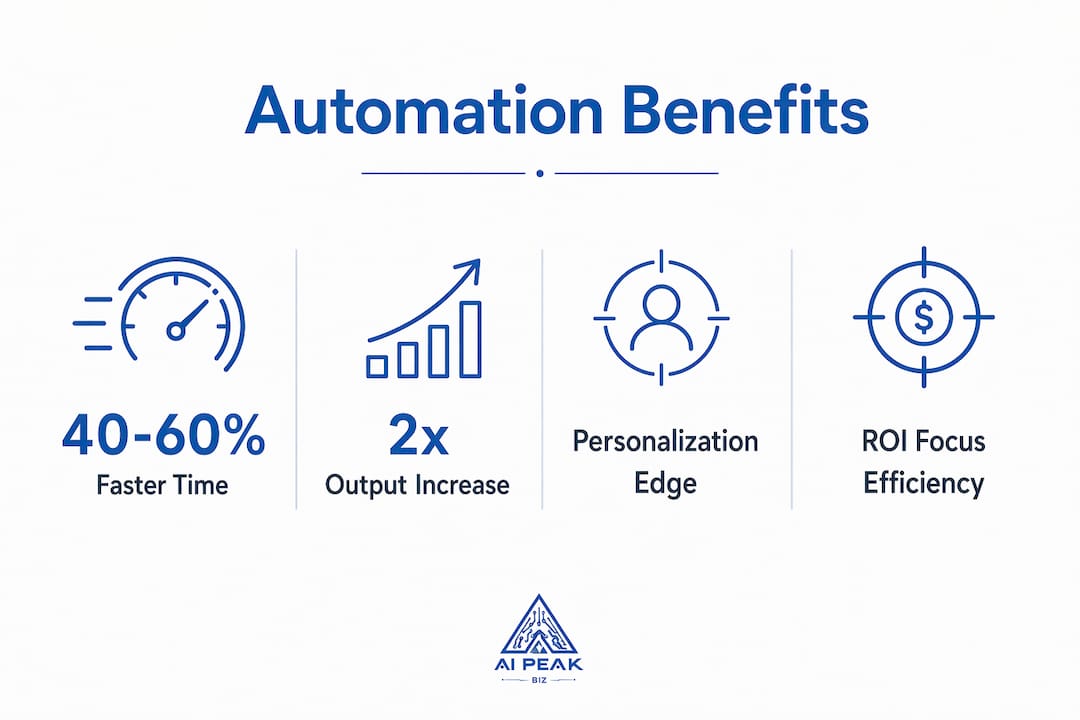
AI-augmented teams reduce time-to-market by 40–60%, effectively doubling output without adding headcount. For a small business owner wearing five hats, that kind of leverage changes what is possible in a single workday.

What human skills stay critical alongside automation?
AI handles execution. Humans handle judgment. That distinction is the foundation of every successful small business automation strategy. The highest-value human contributions focus on judgment, relationships, and strategic decision-making. These are the roles that AI cannot fill, and they are exactly where your time should go.
The shift looks like this in practice:
- Before automation: You spend 3 hours a day answering calls, sending follow-up texts, and manually booking appointments.
- After automation: AI handles those tasks. You spend those 3 hours on client consultations, referral relationships, and service quality.
- Before automation: Your team manually pulls weekly reports and updates spreadsheets.
- After automation: Reports generate automatically. Your team reviews trends and makes decisions.
Successful small businesses use AI to offload execution tasks and redirect human labor toward judgment and presence. This is not about working less. It is about working on the things that actually grow the business.
AI fluency is the skill that ties it all together. This means knowing how to write clear prompts, review AI outputs critically, and catch errors before they reach a client. AI fluency develops into expert intuition over time, including specialized mental models and prompt-crafting skills that make delegation to AI faster and more effective.
Pro Tip: Invest 30 minutes a week testing one new AI prompt or workflow. Small, consistent experiments build fluency faster than any course or certification.
How to design an effective small business automation strategy
A business-first approach to automation means you define the goal before you pick the tool. Experimenting with tools without goal mapping leads to operational chaos. Every automation initiative should map to one of three outcomes: revenue growth, cost reduction, or risk mitigation.
Here is a practical framework for building your automation plan:
- Audit your current workflows. List every repeating task your team performs weekly. Note the time cost and the revenue impact of each one.
- Rank by revenue impact. Prioritize workflows that directly affect lead conversion, client retention, or billing speed.
- Run a 4–8 week pilot. Automate one workflow. Measure the result against a clear baseline metric.
- Calculate ROI before scaling. Use a structured AI ROI calculation to confirm the workflow pays before you expand it.
- Connect your existing tools. The average small business uses 7–12 SaaS tools that often do not integrate. Connecting them through automation eliminates redundant manual work.
- Decide: build or buy. Generic AI plugins are fast to deploy but create vendor dependence. Custom AI integrations take more effort but become proprietary business assets that competitors cannot copy.
The build-vs-buy decision depends on your technical resources and long-term goals. If you have a developer or a technical partner, building custom workflows creates a durable competitive advantage. If you need results in 30 days, a well-configured third-party platform gets you moving faster. Most small businesses start with a quality platform and build custom layers over time as they learn what works.
What are the most common automation pitfalls for small businesses?
Most small business automation failures follow the same pattern. Automating back-office processes first instead of revenue-driving workflows is the single most common mistake. It feels productive but delivers no measurable return, which kills enthusiasm for the entire initiative.
Watch for these specific traps:
- Platform sprawl: Adding new tools without connecting them creates more manual work, not less. Every disconnected app is a gap where data gets lost.
- Generic AI wrappers: Buying a generic AI plugin that sits on top of your existing tools often delivers minimal customization and creates dependence on a vendor’s roadmap.
- Skipping measurement: Launching automation without a baseline metric makes it impossible to know if it is working. Define your success metric before you flip the switch.
- Automating a broken process: Automation speeds up whatever you give it. A broken follow-up sequence automated at scale becomes a broken follow-up sequence sent to everyone, faster.
- Stalled adoption: Teams resist new tools when they are not trained or when the benefit is not clear. Show your team how automation removes the tasks they dislike most.
Slow lead follow-up alone costs small businesses 40–60% of potential revenue. That single number should determine your first automation priority. Fix the revenue leak before you fix anything else.
Pro Tip: Tie every automation to one core business metric. If you cannot explain how a workflow affects revenue, cost, or risk, it is not the right place to start.
Key Takeaways
Small businesses that automate revenue-generating workflows first, pair AI execution with human judgment, and align every tool to a measurable business goal consistently outperform competitors who automate reactively or not at all.
| Point | Details |
|---|---|
| Start with revenue workflows | Lead follow-up, scheduling, and onboarding deliver the fastest and clearest ROI from automation. |
| Human judgment stays irreplaceable | Redirect time saved by AI toward relationships, strategy, and decisions that require real expertise. |
| Business-first beats tool-first | Map every automation to a revenue, cost, or risk goal before selecting any platform or plugin. |
| Pilot before scaling | Run a 4–8 week test on one workflow and measure results before committing to a broader rollout. |
| Build fluency over time | Consistent practice with AI prompts and outputs compounds into a durable competitive skill. |
Why I think most small businesses are solving the wrong automation problem
I have worked with enough small business owners to see a clear pattern. The ones who feel behind on automation are almost always focused on the wrong question. They ask, “Which AI tool should I buy?” when the real question is, “Which part of my business is leaking revenue right now?”
The answer is almost always the same: lead follow-up. A potential client calls, gets voicemail, and books with the next business that answers. That revenue leak is quiet and consistent, and it happens every single day. No amount of automated reporting or AI-generated social posts fixes it.
The businesses I have seen pull ahead are not the ones with the most tools. They are the ones who automated one critical workflow, measured the result, and built from there. They also kept their people focused on the work that requires a human. Clients do not want to talk to a bot about a complex service need. They want to talk to someone who knows their situation. AI handles the logistics. You handle the relationship.
The mindset shift that matters most is this: stop viewing automation as something large companies do and small businesses catch up to. The adoption gap has already closed. The question now is not whether to automate. It is whether you automate the right things first.
— Wylie
How Aipeakbiz helps you automate what matters most
Revenue leaks quietly when calls go unanswered and leads wait too long for a response. Aipeakbiz is built specifically for service businesses that cannot afford to lose a single qualified lead to slow follow-up or missed calls.
Aipeakbiz’s AI appointment setter qualifies leads and books appointments around the clock, without requiring staff to be available. The AI voice assistant answers calls instantly and handles routine inquiries so your team focuses on the work only they can do. The AI chatbot keeps website visitors engaged and converts them into booked clients, even at 2:00 AM. If you are ready to stop losing revenue to slow response times, Aipeakbiz is the place to start.
FAQ
How do small businesses compete with automation on a limited budget?
Start with one revenue-generating workflow, such as lead follow-up or appointment scheduling, and run a short pilot. Small businesses see measurable ROI within 90 days from a focused 4–8 week automation test.
What is the biggest automation mistake small businesses make?
Automating back-office processes before revenue-driving workflows is the most common error. Slow lead follow-up alone accounts for 40–60% of lost potential revenue, making it the highest-priority fix.
Do small businesses need technical staff to implement automation?
Not necessarily. Many service-focused platforms, including those offered by Aipeakbiz, are designed for non-technical owners and handle setup and integration with hands-on support.
Will automation replace my team?
Automation replaces repetitive execution tasks, not people. The most effective small businesses redirect their teams toward judgment, client relationships, and strategic work that AI cannot perform.
How do I know if my automation is working?
Define one measurable baseline metric before launch, such as lead response time, booking rate, or revenue per week. Compare results after the pilot period to confirm the workflow is delivering a return.
Recommended
Want to see what your business is losing?
Take our free revenue assessment and find out how much missed calls, slow follow-up, and dormant leads are costing you every month.
Take the Free Assessment