Improve Call Answer Rate Guide for Service Businesses

Improve Call Answer Rate Guide for Service Businesses
Call answer rate is defined as the percentage of inbound calls your business picks up out of the total calls received. For service businesses, this number directly controls revenue. Every unanswered call is a potential customer who calls your competitor next. This improve call answer rate guide covers the metrics, compliance standards, and operational tactics that actually move the needle. You will learn the 80/20 service-level benchmark, how STIR/SHAKEN authentication affects whether customers even pick up your outbound calls, and which technologies reduce missed calls without adding headcount.
What are the key metrics to track for improving call answer rates?
The industry standard for call center performance is the 80/20 service-level target: answer 80% of inbound calls within 20 seconds. That benchmark is a starting point, not a universal rule. Premium service operations often target 90/15, meaning 90% of calls answered within 15 seconds. Lower-priority queues may accept 70/30. The right target depends on your caller tolerance and the cost of staffing to meet it.
Three metrics give you the full picture of call handling performance:
- Service level: The percentage of calls answered within your target time window. This is your primary speed metric.
- Average speed of answer (ASA): The mean wait time before a caller reaches an agent. A rising ASA signals understaffing or poor scheduling.
- Abandonment rate: The percentage of callers who hang up before being answered. Abandonment under 5% is considered healthy. Below 3% is best-in-class.
Tracking only call pickup rates creates a blind spot. Pairing service level with FCR and CSAT gives you a complete view of whether speed is actually serving customers or just clearing the queue. A team that answers every call in 10 seconds but resolves nothing on the first attempt is not performing well.
One underused tool is Erlang modeling. Erlang-based queue analysis calculates the exact number of agents needed to hit a service-level target given your call volume and average handle time. Copying another company’s 80/20 target without running your own queue data can leave you overstaffed during slow periods and overwhelmed during peaks.

| Metric | Healthy Target | Best-in-Class |
|---|---|---|
| Service Level | 80% answered in 20 seconds | 90% answered in 15 seconds |
| Abandonment Rate | Below 5% | Below 3% |
| Average Speed of Answer | Under 30 seconds | Under 15 seconds |
How does caller ID reputation affect call answer rates?
Caller ID reputation is the trust score your phone number carries on carrier networks. If your number gets flagged as spam or scam, customers see a warning label before they decide whether to pick up. That label kills answer rates before a single word is spoken.
The federal STIR/SHAKEN framework is the primary defense against this problem. STIR stands for Secure Telephone Identity Revisited. SHAKEN stands for Signature-based Handling of Asserted information using toKENs. The FCC mandates that voice service providers implement this framework to authenticate caller identity. Providers must obtain SPC tokens and digital certificates and sign each call to prove it originates from a legitimate source. Calls that pass authentication receive an “A” attestation. Calls that fail or go unsigned are more likely to be labeled as potential spam.
For service businesses making outbound calls, the operational requirements matter just as much as the technical ones. Caller ID reputation functions like a network trust system where consistent authentication and accurate Robocall Mitigation Database filings are required to maintain deliverability. Filing once and forgetting it is not enough. You need to monitor your numbers regularly and refile if your calling patterns change.
Beyond compliance, branded caller ID is a proven tactic to increase call response rate. Local area codes can increase pick-up rates by up to 20% compared to toll-free or out-of-state numbers. Customers are more likely to answer a call that looks familiar. Branded caller ID takes this further by displaying your business name on the recipient’s screen, which builds recognition and trust before the call is answered.
Here is what to monitor and maintain for strong caller ID health:
- Register your numbers in the Robocall Mitigation Database and keep filings current.
- Work with your voice carrier to confirm STIR/SHAKEN attestation levels on outbound calls.
- Audit your numbers quarterly for spam labeling using carrier lookup tools.
- Use branded caller ID where your carrier supports it.
- Avoid high-volume burst calling from a single number, which triggers spam detection algorithms.
Pro Tip: If you run outbound call campaigns, rotate numbers carefully and keep call volume per number within normal business patterns. Sudden spikes in outbound volume from a single number are one of the fastest ways to earn a spam label.
What operational tactics actually boost call answer rates?
Speed and staffing are the two levers that control most of your call answer performance. Technology helps you pull both levers more precisely.
Here are the most effective operational tactics, ranked by impact:
-
Deploy workforce management (WFM) software. WFM tools improve schedule adherence and demand forecasting, which directly reduces wait times. Platforms like NICE Workforce Management and Verint forecast call volume by hour and day, then build schedules that match staffing to demand. Without this, you are guessing.
-
Offer queue callback. Queue callback options reduce abandonment rates by up to 35%. Instead of waiting on hold, callers request a callback and hang up. Your system calls them back when an agent is free. This keeps your service level intact without forcing customers to wait.
-
Use IVR to route and deflect calls. Interactive voice response systems sort callers by need before they reach an agent. Simple requests like appointment confirmations, hours of operation, or payment status can be handled without a live agent. This frees your team for calls that require real judgment.
-
Implement AI transcription and auto-summarization. AI-powered post-call processing reduces agent wrap-up time by automatically generating call summaries. Agents return to the queue faster. That directly raises your service level without adding staff.
-
Time outbound calls strategically. Research consistently shows that calls made Tuesday through Thursday between 10 a.m. and noon, or between 4 p.m. and 5 p.m., reach more people. Avoid Monday mornings and Friday afternoons for outbound campaigns.
| Tactic | Primary Benefit | Implementation Complexity |
|---|---|---|
| WFM Software | Reduces understaffing gaps | Medium |
| Queue Callback | Cuts abandonment by up to 35% | Low |
| IVR Routing | Deflects simple calls | Medium |
| AI Auto-Summarization | Speeds agent availability | Low |
| Strategic Call Timing | Increases outbound pickup | Low |
Pro Tip: For small service businesses without a formal call center, even a basic scheduling tool like Google Calendar integrated with a call routing app can reduce missed calls during peak hours. You do not need enterprise software to apply WFM principles.
How do you measure and continuously improve call answer rates?
Measurement without action is just data collection. The goal is a feedback loop where your metrics tell you what to fix and your fixes show up in the next reporting cycle.
Start with a real-time dashboard that tracks service level, ASA, and abandonment rate by hour and by queue. Most cloud phone systems, including RingCentral and Dialpad, include built-in dashboards that update live. If your current system does not offer this, it is worth switching. You cannot manage what you cannot see in real time.
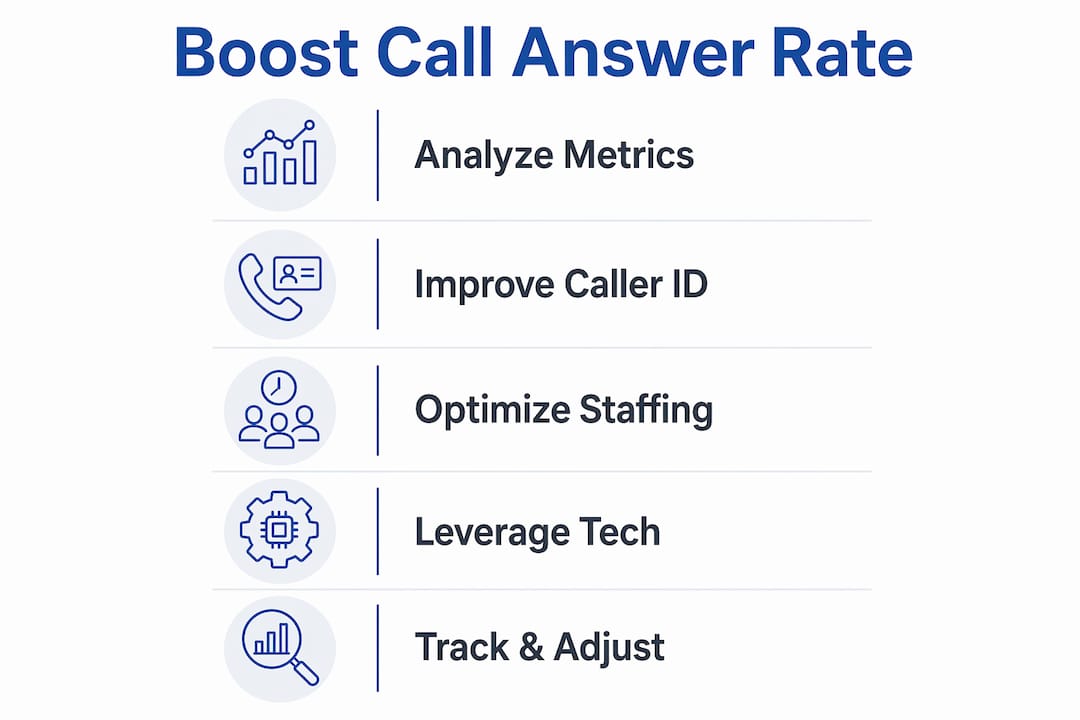
Segmenting your call queues by priority is the next step. Not every call deserves the same service level. A new lead calling for the first time is worth more than a routine billing question. Queue segmentation with Erlang modeling lets you assign higher staffing ratios to high-value queues and lower ratios to routine ones. This keeps your costs in check while protecting the calls that drive revenue.
Watch out for these common measurement mistakes:
- Counting short disconnects as abandonments. A caller who hangs up in under three seconds likely misdialed. Filtering out short disconnects prevents inflated abandonment numbers that trigger unnecessary staffing changes.
- Rushing calls to hit speed targets. Agents who feel pressure to answer fast may cut calls short, which hurts first-call resolution and CSAT. Speed metrics and quality metrics must be reviewed together.
- Ignoring after-hours data. Many service businesses lose a significant share of calls outside business hours. Tracking after-hours missed calls separately reveals whether you need an answering solution for nights and weekends.
You can use the missed call revenue calculator from Aipeakbiz to put a real dollar figure on your after-hours and peak-hour gaps. Seeing the revenue impact in concrete numbers makes the case for investment far easier.
Incorporate customer satisfaction scores into your monthly review. A team hitting 85% service level with a CSAT score below 70% has a quality problem hiding behind a speed metric. Fix the quality problem first. The cost of missed calls compounds over time when customers stop calling back entirely.
Key takeaways
Improving call answer rates requires combining the right benchmarks, authenticated caller ID, and operational tools into a system that runs consistently, not just during peak hours.
| Point | Details |
|---|---|
| Use the 80/20 benchmark as a baseline | Target 80% of calls answered in 20 seconds, then adjust based on your queue data and caller tolerance. |
| Authenticate your caller ID | STIR/SHAKEN compliance and branded caller ID directly increase the odds that customers pick up your calls. |
| Deploy queue callback | Offering callbacks instead of hold time reduces abandonment rates by up to 35%. |
| Measure quality alongside speed | Pair service level with CSAT and first-call resolution to avoid masking customer experience problems. |
| Filter your abandonment data | Remove short disconnects and misdials from abandonment reports to get accurate staffing signals. |
Why speed alone will not save your call answer rate
I have worked with service businesses that obsessed over their service level percentage and still lost customers. The number looked good on paper. Calls were answered fast. But agents were rushing through conversations, customers were not getting real answers, and the same people were calling back two and three times for the same issue.
The uncomfortable truth is that speed metrics are easy to game. You can answer every call in 10 seconds and still deliver a poor experience. The businesses that genuinely improve their call answer performance treat it as a system, not a single number. They look at caller ID health, staffing patterns, queue design, and customer satisfaction together.
The compliance side also gets underestimated. STIR/SHAKEN is not a one-time checkbox. It requires ongoing maintenance, accurate database filings, and monitoring. I have seen businesses invest in outbound calling campaigns only to find their numbers flagged as spam within weeks because they did not maintain their authentication records. That is a fixable problem, but it requires treating caller ID reputation as an ongoing operational responsibility.
My honest recommendation: start with your data. Pull your abandonment rate, your ASA, and your after-hours missed call volume. Those three numbers will tell you exactly where your biggest opportunity is. Then build from there. Technology like AI voice assistants and queue callback systems are genuinely useful, but only after you understand where your calls are actually going.
— Wylie
How Aipeakbiz helps you stop losing calls
Revenue leaks quietly when calls go unanswered after hours or during busy periods. Aipeakbiz is built specifically for service businesses that cannot afford to miss a lead.
The AI Voice Assistant answers calls instantly, qualifies leads, and books appointments around the clock without requiring a live agent. The Missed Call Text-Back service automatically follows up with callers you could not reach, keeping the conversation alive before they call someone else. The AI Appointment Setter handles scheduling so your team focuses on delivering service, not managing a phone queue. If you want to see what missed calls are actually costing you, the revenue recovery tools at Aipeakbiz give you a clear starting point.
FAQ
What is a good call answer rate for a service business?
A healthy target is answering 80% of inbound calls within 20 seconds, known as the 80/20 rule. Premium service operations often aim for 90% answered within 15 seconds.
How does stir/shaken affect my call answer rate?
STIR/SHAKEN authentication prevents your outbound calls from being labeled as spam. Calls that pass authentication are more likely to be answered because customers see a verified caller ID instead of a spam warning.
What is the fastest way to reduce call abandonment?
Offering a queue callback option is the most direct tactic. Allowing callers to request a callback instead of waiting on hold reduces abandonment rates by up to 35%.
Should i use a local number or a branded caller ID?
Both improve answer rates. Local area codes can increase pickup rates by up to 20% compared to toll-free numbers. Branded caller ID adds your business name to the display, which builds trust and recognition before the call is answered.
How do i know if my call answer rate improvement is actually working?
Track service level, average speed of answer, and abandonment rate together on a real-time dashboard. Add CSAT and first-call resolution to your monthly review to confirm that speed improvements are also improving customer outcomes.
Recommended
Want to see what your business is losing?
Take our free revenue assessment and find out how much missed calls, slow follow-up, and dormant leads are costing you every month.
Take the Free Assessment