The Role of AI in Service Call Management

The Role of AI in Service Call Management
AI-powered call management is defined as the use of automated voice agents and natural language processing to handle inbound calls, qualify leads, and book appointments without human intervention. Service businesses lose revenue quietly every day through missed calls. Small-to-medium businesses miss 27% to 40% of inbound calls on average. The role of AI in service call management is to close that gap by answering every call, capturing every lead, and booking every appointment, around the clock. Aipeakbiz was built specifically to solve this problem for service businesses that cannot afford to let a single customer slip through.
How does AI improve missed call recovery and lead capture?
Missed calls are not just an inconvenience. Each missed call can represent lost revenue ranging from $30 to $1,500 depending on your industry and customer lifetime value. A plumbing company missing five calls on a Saturday afternoon could lose thousands of dollars before Monday morning.
Traditional answering systems capture only 10–20% of missed call opportunities. AI front desks that answer within one to two rings push that capture rate to 70–85%. That is not a marginal improvement. It is a structural change in how revenue flows into your business.
The process works in a clear sequence:
- The AI detects an inbound call and answers within one to two rings.
- It greets the caller with a natural, conversational voice, not a rigid IVR menu.
- It asks qualifying questions: service type, location, urgency, and contact details.
- It books the appointment directly into your calendar or CRM.
- It logs the lead record automatically for follow-up.
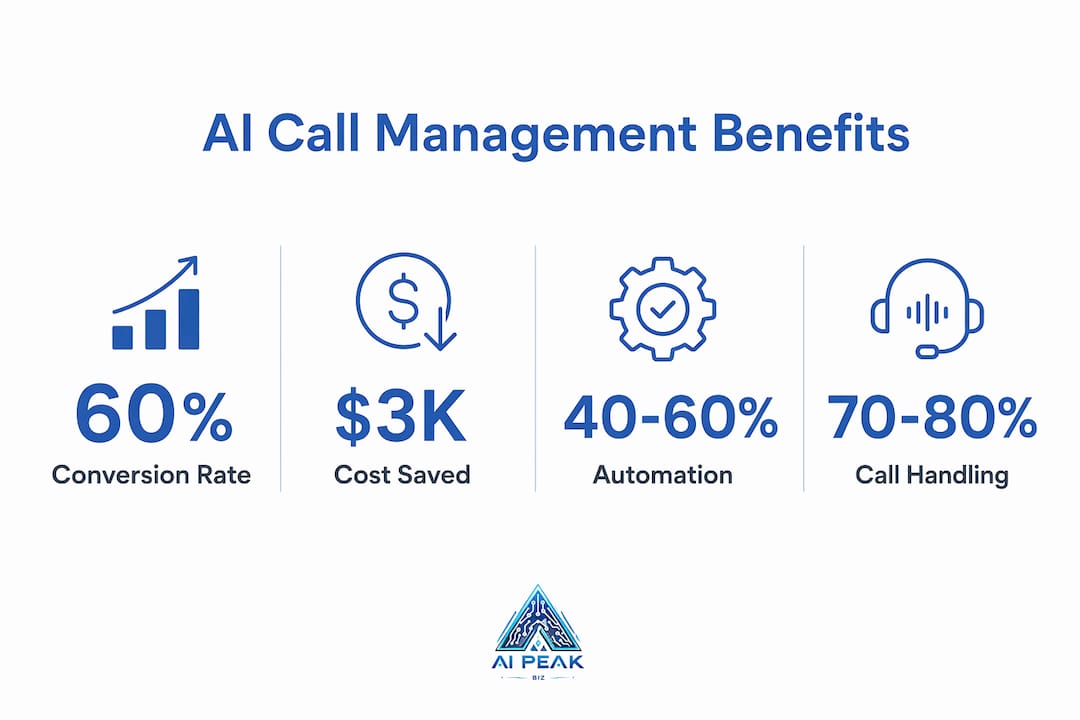
AI-powered voice agents achieve conversion rates of 35–60% on calls they answer. Compare that to a voicemail system where most callers simply hang up and call your competitor. The difference is live, interactive booking versus passive message collection.
Pro Tip: Connect your AI call system directly to your CRM from day one. Leads that enter a CRM within minutes of first contact convert at significantly higher rates than those logged hours later by a human.

What are the key operational benefits and cost savings?
The financial case for AI in customer service is straightforward. A full-time human receptionist costs roughly $3,000 per month in salary alone, before benefits, training, and turnover costs. AI systems operate at 10–30% of that cost while handling a higher volume of calls without fatigue or sick days.
Beyond cost, AI handles the repetitive work that consumes your team’s time. AI can automate 40–60% of initial contact center interactions, including FAQs, appointment scheduling, and status updates. That frees your human staff to focus on complex jobs, upselling, and customer relationships that actually require judgment.
Automation reduces call wait times and gives staff the space to handle cases that need real expertise. Customers who reach a human agent faster, because routine calls are handled by AI, report higher satisfaction. The operational math is simple: fewer hold times, better allocation of human talent, and lower overhead.
Pro Tip: Do not eliminate your human team when you add AI. The best results come from a hybrid model where AI handles volume and humans handle value. Your staff will thank you, and so will your customers.
What challenges should you consider when integrating AI into call workflows?
AI integration fails most often when businesses try to automate everything at once. The right approach is narrow, focused, and measurable. Start with a single predictable workflow like appointment scheduling, and build from there.
A structured rollout follows these steps:
- Identify your highest-volume, most repetitive call type. Appointment booking and FAQ calls are ideal starting points.
- Set up a human-in-the-loop review process. Have a team member audit AI interactions daily for the first 30 days. This builds trust and catches errors early.
- Define clear escalation triggers. Angry callers, billing disputes, and complex service issues should route to a human agent immediately.
- Measure conversion, not just call volume. Track how many AI-handled calls result in booked appointments versus dropped interactions.
- Expand gradually. Once appointment scheduling runs cleanly, add lead qualification, then follow-up texts, then status update calls.
One critical distinction separates high-performing AI deployments from mediocre ones. Call deflection is not the same as conversion. Routing a caller to voicemail or a callback queue is deflection. Booking an appointment during the live call is conversion. Your AI system must aim for conversion, not just deflection.
Managing customer expectations matters too. Callers do not need to know they are speaking with an AI, but they do need a clear path to a human if the conversation goes beyond the AI’s scope. A smooth handoff, with context passed to the human agent, prevents frustration and builds trust.
Pro Tip: Build your AI’s knowledge base before launch. A well-constructed script covering your top 20 most common questions will resolve issues faster and keep callers from asking to speak with a human unnecessarily.
How do hybrid AI-human models improve customer experience?
The optimal call management model is a hybrid approach where AI handles 70–80% of routine calls and human agents handle complex cases requiring empathy or authority. This is not a compromise. It is the most effective structure available to service businesses today.
Here is what the hybrid model looks like in practice:
- AI handles: appointment booking, service area questions, pricing FAQs, call-back scheduling, and status updates.
- Human agents handle: complaints, contract negotiations, emergency escalations, and situations where a caller is distressed.
- Handoff protocol: The AI passes a full call summary and lead record to the human agent before the transfer completes. The human never starts from zero.
AI voice agents understand natural language and integrate with CRM and scheduling systems for real-time processing. This means the AI does not just collect information. It acts on it immediately, entering data, booking slots, and sending confirmation texts before the call ends.
AI delegates routine tasks so human agents can focus on high-value work requiring judgment and expertise. An HVAC company using this model, for example, lets AI handle all scheduling calls during peak season while human technicians focus on diagnosing complex system failures. The result is faster response times, higher booking rates, and a team that is not burned out by repetitive phone work. Aipeakbiz builds this exact structure into its AI voice assistant platform for service businesses.
Key takeaways
AI in service call management delivers the highest return when deployed in supervised, measurable workflows that combine automated volume handling with human judgment for complex cases.
| Point | Details |
|---|---|
| Missed call recovery | AI front desks improve call capture rates from 10–20% to 70–85%, recovering significant lost revenue. |
| Cost efficiency | AI systems operate at 10–30% of human staff costs while automating 40–60% of routine interactions. |
| Conversion over deflection | AI must book appointments during live calls, not redirect to voicemail, to maximize revenue capture. |
| Hybrid model wins | AI handles 70–80% of routine calls; human agents handle complex, empathy-driven interactions. |
| Start narrow | Deploy AI on one predictable workflow first, review results with a human, then expand gradually. |
What I have learned from watching businesses deploy AI in their call workflows
Most business leaders I talk to approach AI call management with one of two wrong assumptions. The first is that AI will replace their front desk entirely. The second is that it is too complicated to be worth the effort. Both assumptions cost money.
The businesses that see real results start small and stay disciplined. They pick one workflow, usually appointment scheduling, and they measure it obsessively for 30 days. They do not declare victory after week one. They watch the data, fix the edge cases, and then expand. That patience is rare, and it is exactly what separates the businesses that recover revenue from the ones that buy a tool and abandon it.
The missed call problem is more expensive than most managers realize. Revenue leaks quietly. A call at 7 p.m. on a Tuesday that goes to voicemail is almost never returned by the caller. That is a lost job, a lost relationship, and a lost referral. AI does not get tired at 7 p.m. It answers, qualifies, and books. That consistency is the real value, not the technology itself.
I have also seen businesses overcomplicate their setup by trying to automate every possible scenario before launch. The result is a system that handles nothing well. Keep the initial scope tight. Get one workflow running cleanly. Then build. The AI tools improving customer experience that actually stick are the ones that solve one specific, painful problem first.
— Wylie
How Aipeakbiz helps service businesses recover revenue from missed calls
Service businesses that miss calls do not just lose a single transaction. They lose the lifetime value of a customer who called once and never tried again.
Aipeakbiz provides an AI voice assistant built specifically for service businesses. It answers calls instantly, qualifies leads, and books appointments 24 hours a day, 7 days a week. The system integrates with your CRM and calendar so every lead is captured and every appointment is confirmed without manual effort. For businesses ready to stop losing revenue to unanswered calls, Aipeakbiz also offers an AI appointment setter that handles the full booking workflow from first contact to confirmed job. No missed calls. No lost leads. No revenue left on the table.
FAQ
What is AI call handling?
AI call handling is the use of automated voice agents to answer inbound calls, respond to customer questions, and book appointments without a human receptionist. These systems use natural language processing to understand callers and act on their requests in real time.
How does AI help with missed call recovery?
AI front desks answer calls within one to two rings and capture lead information immediately, improving missed call recovery rates from 10–20% with traditional systems to 70–85%. This prevents callers from hanging up and contacting a competitor.
What is the role of AI in service call management for small businesses?
AI in service call management automates routine interactions like scheduling and FAQs, reducing staffing costs by 70–90% compared to a full-time receptionist while maintaining 24/7 availability for every inbound call.
Should AI fully replace human agents in a call center?
No. The most effective model has AI handling 70–80% of routine calls while human agents manage complex, sensitive, or high-stakes interactions. Full automation without human oversight leads to poor customer experience on edge cases.
How do I measure whether AI call management is working?
Track appointment booking rate, call capture rate, and lead-to-job conversion rate before and after deployment. A well-configured AI system should show measurable improvement in all three within the first 30 days of operation.
Recommended
- AI in Home Service Businesses: Your 2026 Guide | AI Peak Biz
- The Role of AI in Patient Communication: 2026 Guide | AI Peak Biz
- AI Voice Assistant for HVAC Companies: 24/7 Call Handling That Books Jobs | AI Peak Biz
- AI Answering Service vs. Traditional Answering Service: Which Is Right for Your Business? | AI Peak Biz
Want to see what your business is losing?
Take our free revenue assessment and find out how much missed calls, slow follow-up, and dormant leads are costing you every month.
Take the Free Assessment