What Is an AI Answering Service? A 2026 Guide

What Is an AI Answering Service? A 2026 Guide
An AI answering service is software that autonomously handles inbound business calls by greeting callers, qualifying their needs, booking appointments, routing calls, and logging every interaction. By 2026, the distinction between AI answering services and AI receptionists has effectively disappeared. Both now handle full call intake, appointment booking, payments, and CRM logging. For service business owners losing revenue to missed calls and slow follow-up, this technology represents the most direct fix available.
What is an AI answering service and how does it work?
An AI answering service is a virtual receptionist powered by conversational AI that manages phone calls without a human operator. The industry term for the underlying technology is a “voice AI agent,” and understanding that term helps you evaluate options with clarity. These systems use three core technologies working together: speech recognition to convert spoken words to text, natural language understanding to interpret caller intent, and text-to-speech to respond in a natural voice.
The speed of this process is what makes it feel human. AI call response takes about 2 seconds, with 200–500 milliseconds of round-trip processing time for each exchange. That latency is low enough that callers rarely notice they are speaking with an automated system.

What makes modern voice AI agents genuinely capable is their hierarchical, tool-calling architecture. Multiple specialized modules work together in milliseconds. One module handles intent recognition, another manages calendar access, and another triggers CRM updates. The system coordinates all of them within a single fluid conversation.
Pro Tip: Ask any AI answering vendor to demonstrate how their system handles an interruption mid-sentence. A well-built voice AI recovers naturally. A poorly built one either freezes or repeats itself. That single test reveals more about call quality than any feature list.
When a call exceeds the AI’s ability to resolve it, a warm handoff transfers the caller to a human staff member along with a full conversation summary, caller intent, and contact details. The caller never has to repeat themselves. That detail alone separates modern AI answering from legacy IVR phone trees.
Core features and benefits for service businesses
Modern AI answering services deliver a specific set of capabilities that directly address the revenue leaks service businesses face every day.
- 24/7 instant call pickup: The system answers on the first ring, every time, including nights, weekends, and holidays.
- Appointment booking: The AI checks availability and books directly into Google Calendar, Calendly, or your existing scheduling software.
- Lead qualification: The system asks intake questions and scores or routes leads based on your criteria before any human gets involved.
- Message capture: Callers who do not need an appointment get their message logged and delivered to you immediately.
- SMS confirmations and reminders: Automated follow-ups go out during or after the call, reducing no-shows without any manual effort.
- CRM logging: Every call is recorded, transcribed, and pushed to your CRM automatically.
The cost difference between AI and human answering is significant. AI answering services typically cost $50–$300 per month, while human-staffed answering services run $200–$1,500 per month. That makes AI answering roughly four to five times more affordable for comparable coverage. For a service business running on tight margins, that gap matters.
The customer experience benefit is just as real. Callers reach a live, responsive voice immediately instead of voicemail. Responses are consistent because the AI never has a bad day, never puts someone on hold to check a calendar, and never forgets to send a confirmation. For industries where the first caller to respond wins the job, that consistency is a direct competitive advantage. Aipeakbiz builds this consistency into every deployment it manages for service businesses.
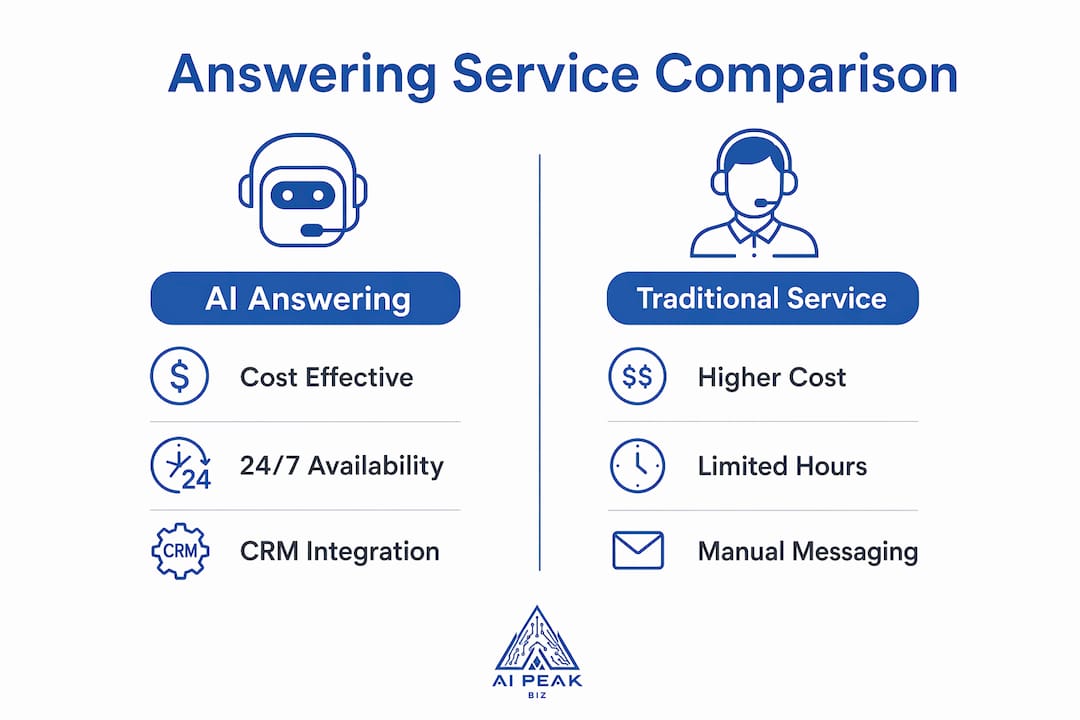
AI calendar and CRM integrations remove the phone tag and manual data entry that slow down most service business front desks. When a new lead calls at 9:00 PM on a Saturday, the appointment is booked before you wake up Sunday morning.
Signs your business needs an AI answering service
Identifying the right moment to adopt this technology saves you from paying for it before you are ready and from waiting too long while revenue slips away.
- You miss calls regularly. If your voicemail fills up during busy periods or after hours, you are losing leads to competitors who answer.
- Your human answering costs are rising. When a receptionist or answering service costs more than $500 per month and still misses calls, the math favors AI.
- Your intake process is inconsistent. If different staff members ask different questions and log information differently, lead quality suffers.
- You have no after-hours coverage. A caller who cannot reach you at 7:00 PM calls the next business on the list.
- Your team spends time on repetitive calls. Scheduling, directions, pricing questions, and confirmations are tasks AI handles without pulling your staff away from higher-value work.
When you decide to implement an AI answering service, the process works best when you treat it as a system design project, not a software purchase. Define your call flows before you configure anything. Map out every type of call your business receives and decide how each one should be handled. Train the AI with your actual business name, service descriptions, pricing ranges, and the tone your brand uses.
Pro Tip: Record your best human receptionist handling five different call types before you configure your AI. Use those recordings as the benchmark for how your AI should sound and respond. Most vendors allow you to upload call scripts or sample dialogs during setup.
Avoid the common mistake of skipping the warm handoff setup. An AI that cannot escalate a complex call gracefully will frustrate callers and damage your reputation. Build the handoff logic before you go live, and test it with real scenarios. For a deeper look at AI versus traditional answering options, the comparison is worth reviewing before you commit.
How does AI answering compare to traditional answering services?
The differences between AI answering, traditional human answering services, and in-house receptionists come down to four factors: cost, availability, capability, and consistency.
| Factor | AI answering service | Traditional answering service | In-house receptionist |
|---|---|---|---|
| Monthly cost | $50–$300 | $200–$1,500 | $3,000–$5,000+ |
| Availability | 24/7, first ring | Business hours or limited after-hours | Business hours only |
| Appointment booking | Yes, automated | Rarely included | Yes, manual |
| CRM logging | Automatic | Manual or not available | Manual |
| Consistency | Identical every call | Varies by operator | Varies by staff member |
| Scalability | Handles volume spikes instantly | Requires staffing increases | Hard cap at one person |
Traditional answering services answer calls and take messages. That is largely where their capability ends. They rarely book appointments, almost never integrate with your CRM, and charge per minute for every call. AI answering services replace legacy IVR and human answering by running 24/7 with instant first-ring answers and a consistent brand voice on every call.
An in-house receptionist still makes sense for businesses where complex, high-stakes conversations happen on nearly every call. A law firm handling sensitive client matters or a medical practice managing urgent triage calls may need a human in that role. For the majority of service businesses, though, the volume of routine calls makes AI the more practical choice. Industry experts advise focusing on feature capabilities and integration options rather than getting caught up in terminology when evaluating these tools.
For businesses that want to understand how AI handles the qualification side of this equation, the breakdown of how AI qualifies appointment requests shows exactly how the intake logic works in practice.
Key Takeaways
An AI answering service is the most cost-effective way for service businesses to achieve 24/7 call coverage, consistent lead qualification, and automated appointment booking without hiring additional staff.
| Point | Details |
|---|---|
| Definition is settled | AI answering services and AI receptionists now refer to the same technology with full front desk capabilities. |
| Speed enables trust | Sub-second processing and 2-second response times make AI conversations feel natural to callers. |
| Cost advantage is clear | AI answering costs $50–$300 per month versus $200–$1,500 for human-staffed services. |
| Warm handoff is non-negotiable | Any AI system without a graceful escalation path to a human will damage caller experience on complex calls. |
| Implementation requires planning | Mapping call flows and training the AI with your brand voice before launch determines whether the system performs well. |
The line between “answering service” and “receptionist” no longer exists
I have watched this technology category collapse two distinct job descriptions into one software layer, and the speed of that shift surprised even me. Three years ago, an “AI answering service” meant a system that picked up calls and took messages. Today, the same category includes full appointment booking, lead scoring, payment collection, and CRM sync. The label changed last. The capability changed first.
What I find most useful to tell business owners is this: stop evaluating these tools by what they are called and start evaluating them by what happens after a call ends. Does the lead show up in your CRM? Did the appointment land on your calendar? Did the caller get a confirmation text? Those three outcomes tell you more about a system’s real value than any feature checklist.
The businesses I see getting the most from AI answering are not the ones with the most sophisticated setup. They are the ones who defined their call flows clearly before they configured anything. The AI is only as good as the logic you give it. Garbage in, garbage out. That principle applies here more than almost anywhere else in business technology.
The next evolution I expect is AI answering systems that proactively follow up with leads who did not book on the first call. Some platforms are already doing this. For service businesses, that capability alone could recover a meaningful portion of the revenue that currently leaks through voicemail. For a broader look at how AI tools improve customer experience across service industries, the real-world examples are worth your time.
— Wylie
How Aipeakbiz handles AI answering for service businesses
Aipeakbiz builds AI front desk systems specifically for service businesses that cannot afford to miss a call or a lead. The system answers calls and texts instantly, qualifies leads with your intake questions, and books appointments directly into your calendar around the clock.
Every deployment includes CRM integration, SMS confirmations, and a warm handoff setup so complex calls always reach a human with full context. Aipeakbiz manages the configuration and ongoing tuning, so you are not left troubleshooting a software product on your own. Whether you run a real estate business, a coaching practice, or any other service operation, the system is built to fit your call flows. Review Aipeakbiz pricing to find the plan that fits your call volume and budget.
FAQ
What is an AI answering service in simple terms?
An AI answering service is software that answers your business phone calls automatically, using conversational AI to greet callers, collect information, book appointments, and route calls without a human operator.
How does AI answer business calls without sounding robotic?
Modern voice AI agents use natural language understanding and text-to-speech technology with sub-second processing, producing responses in about 2 seconds that most callers cannot distinguish from a human receptionist.
What does an AI answering service cost per month?
AI answering services typically cost $50–$300 per month, compared to $200–$1,500 per month for human-staffed answering services, making them four to five times more affordable for equivalent coverage.
What are the signs your business needs AI answering?
The clearest signs are regular missed calls after hours, rising costs for human answering coverage, inconsistent lead intake, and staff spending significant time on routine scheduling and inquiry calls.
Can an AI answering service book appointments automatically?
Yes. Most AI answering services integrate directly with Google Calendar, Calendly, and CRM platforms to book appointments in real time during the call, then send SMS confirmations to the caller automatically.
Recommended
Want to see what your business is losing?
Take our free revenue assessment and find out how much missed calls, slow follow-up, and dormant leads are costing you every month.
Take the Free Assessment