What Is Business Growth Automation? 2026 Guide

What Is Business Growth Automation? 2026 Guide
Business growth automation is defined as the strategic use of technology to automate repeatable, rules-based tasks across marketing, sales, operations, and customer support in ways that directly drive measurable business expansion. The industry standard term for this practice is business process automation, though growth-focused entrepreneurs increasingly apply it specifically to revenue-generating workflows. Tools like Zapier, HubSpot, and AI-enabled CRM platforms sit at the center of this shift. Automation ranges from simple if-this-then-that tasks to full department-wide processes, and the businesses that implement it correctly stop trading time for growth. This guide breaks down what business growth automation actually does, how to deploy it, and where most entrepreneurs go wrong.
What is business growth automation and why does it matter?
Business growth automation is the practice of replacing manual, repetitive work with technology-driven workflows that run without human intervention. Where traditional operations require a person to send a follow-up email, log a lead, or schedule a call, automation handles those steps instantly and consistently.
The practical impact is significant. End-to-end pipeline automation can score leads in 30 seconds, assign tasks, and send notifications, reducing manual delays from roughly 18 hours to seconds. That speed difference is the gap between winning and losing a customer.

Three named entities define this space in 2026: Zapier for connecting apps and triggering workflows, HubSpot for CRM and marketing automation, and AI-driven platforms like those offered by Aipeakbiz for voice, chat, and appointment workflows. Each solves a different layer of the growth problem.
The distinction between workflow automation, business process automation, and AI-driven automation matters here. Workflow automation handles task sequences. Business process automation covers full operational processes like onboarding or billing. AI-driven automation adds decision-making capacity, qualifying leads or routing calls without a script.
How does automation improve efficiency, lead conversion, and engagement?
Automation delivers leverage through speed and reliability. When a lead fills out a form at 11 p.m., an automated system responds in seconds. A human doing the same job might respond the next morning, by which point the lead has already called a competitor.
Here are the four core areas where automation produces measurable growth results:
- Lead scoring and routing. Automation tools evaluate leads based on behavior, demographics, and engagement signals, then route high-priority prospects directly to sales. This eliminates the hours of manual sorting that slow down pipelines.
- Customer onboarding. Automated onboarding sequences deliver welcome emails, setup guides, and check-in messages on a defined schedule. Retention improves because customers receive consistent attention without requiring staff time.
- Follow-up and re-engagement. Automation reduces manual re-entry, errors, and delays, freeing staff to focus on higher-value work. A missed call, for example, can trigger an immediate text response that keeps the conversation alive.
- Reporting and task assignment. Automated dashboards and task triggers replace manual status updates, so managers see real-time data without chasing it.
Pro Tip: Before automating any workflow, write out every manual step your team currently takes. You will almost always find two or three steps that are redundant and can be eliminated entirely before automation even begins.
What are the best practices for implementing growth automation?
Effective automation deployment follows a disciplined sequence. Start small by automating one workflow, measure its success via KPIs within 90 days, then scale to compound savings and reliability. Entrepreneurs who try to automate everything at once typically end up with a tangle of broken workflows and no clear owner for any of them.
The following practices separate successful automation programs from failed ones:
- Define the outcome before selecting the tool. Decide whether you want to reduce lead response time, increase booked appointments, or cut manual data entry. The metric comes first. The tool comes second.
- Assign human ownership to every automated workflow. Automations designed with event-based logic and SLAs prevent silent churn by assigning human owners to tasks triggered automatically. No workflow should run without someone accountable for its performance.
- Set a 90-day review window. Measure the workflow against its original KPI. If it is not delivering, adjust the logic before adding complexity.
- Avoid automating broken processes. Automation amplifies what already exists. A flawed manual process becomes a faster flawed process. Fix the process first, then automate it.
- Instrument every workflow. Automation initiatives fail when workflows lack clear business value or ROI measurement. Build tracking into the workflow from day one so you can prove its value to stakeholders.
Pro Tip: Use a simple scoring matrix to prioritize which workflows to automate first. Rate each candidate on two axes: time saved per week and revenue impact. Automate the high-high combinations first.
Which automation tools support growth across acquisition, conversion, and retention?
Automation connects systems to keep data consistent and automates predictable sales, marketing, and service workflows to grow acquisition, conversion, and retention. The tool category you need depends on which growth stage you are trying to accelerate.
| Growth Stage | Automation Type | Example Tools |
|---|---|---|
| Acquisition | Lead capture and nurture workflows | Zapier, HubSpot, Meta Lead Ads |
| Conversion | Pipeline management and follow-up | HubSpot CRM, Deelo, AI appointment setters |
| Retention | Onboarding sequences and renewals | ActiveCampaign, AI chatbots, SMS platforms |
| Operations | Data sync and task routing | Zapier, Make, robotic process automation |
Robotic process automation, or RPA, handles high-volume, structured data tasks like invoice processing or report generation. AI agents go further, making contextual decisions like qualifying a caller’s intent or recommending a service package. The “apps in silos” problem, where your CRM does not talk to your scheduling tool or your billing platform, is the most common reason automation fails to deliver. Connecting those systems is the first infrastructure step.
Aipeakbiz solves the acquisition-to-conversion gap specifically for service businesses by combining an AI voice assistant with an automated appointment setter. The system answers calls, qualifies leads, and books appointments without a human in the loop.
What steps can entrepreneurs take to start automating growth?
Growth transformations powered by automation must be data-driven and programmatic, embedding predictive modeling and AI to reduce growth costs and increase forecasting accuracy. For most entrepreneurs, the path starts much simpler than that.
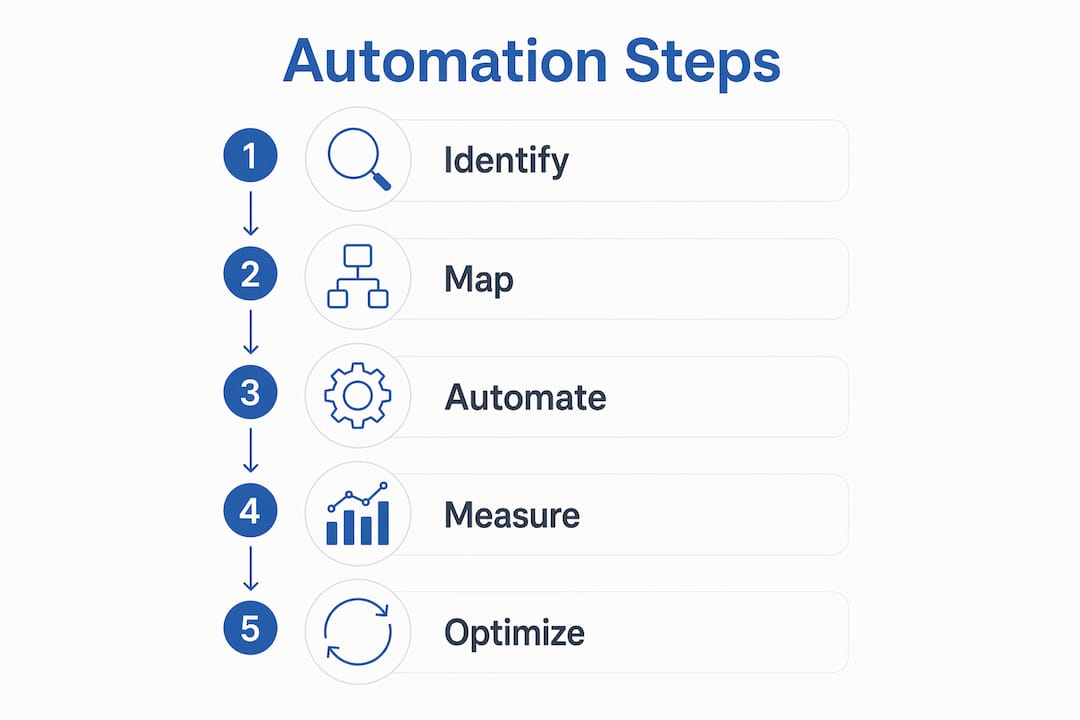
Follow this five-step implementation roadmap:
- Identify your biggest manual bottleneck. Where does your team spend the most time on repetitive tasks? Common answers include lead follow-up, appointment scheduling, and invoice chasing. That bottleneck is your starting point.
- Map the existing workflow end to end. Write out every step, every tool involved, and every handoff between people. This map reveals where automation can replace human action and where human judgment is still required.
- Select the highest-leverage automation opportunity. Start automation projects by analyzing processes, not tools, separating strategic judgment work from routine, pattern-based work ready for automation. The routine work is your target.
- Define ownership and SLAs. Every automated task needs a human owner who reviews exceptions and monitors performance. Set a service-level agreement for how quickly the system must act and what happens when it does not.
- Measure, iterate, and expand. Track your chosen KPI for 90 days. If lead response time dropped from 18 hours to under 5 minutes, document that result and use it to justify the next automation investment.
Pro Tip: For service businesses specifically, the missed call is the single most expensive manual bottleneck. An unanswered call at 7 p.m. is a lost appointment. Automating that first response, with a text or a voice reply, is the fastest path to measurable revenue recovery. Explore how AI for small businesses can make this practical even if you are not a tech person.
Key takeaways
Business growth automation delivers compounding returns when you start with a defined process, assign clear ownership, and measure outcomes within a fixed window before scaling.
| Point | Details |
|---|---|
| Define before you deploy | Set a measurable KPI for each workflow before selecting any tool. |
| Start with one workflow | Automate a single high-impact process and validate results within 90 days. |
| Assign human ownership | Every automated workflow needs an accountable owner to handle exceptions. |
| Match tools to growth stages | Use lead capture tools for acquisition, CRM automation for conversion, and onboarding sequences for retention. |
| Missed calls cost real money | Automating first-response to calls and texts is the fastest revenue recovery move for service businesses. |
The uncomfortable truth about automation most guides skip
I have watched business owners buy automation tools the same way they buy gym memberships. Full of intention in January, abandoned by March. The tool is not the problem. The missing process is.
Every time I see an automation project fail, the root cause is the same: someone automated a workflow that no one fully understood. They replicated the manual chaos in digital form and called it progress. The result is faster chaos.
What actually works is starting with the process on paper. Write out what happens today, step by step. Then ask which steps require human judgment and which are just pattern-matching. The pattern-matching steps are ready for automation. The judgment steps are not, at least not yet.
Speed and reliability are the two real benefits of automation, and they compound over time. A lead that gets a response in 30 seconds converts at a higher rate than one that waits 18 hours. That is not a technology insight. That is a human behavior fact. Automation just makes the fast response possible at scale.
The other thing I want you to hear: automation does not replace your team’s judgment. It protects their time so that judgment gets applied where it actually matters. The best automation programs I have seen treat technology as a support structure, not a replacement strategy.
Start small. Measure honestly. Build from there.
— Wylie
How Aipeakbiz helps you automate business growth today
Revenue leaks quietly when calls go unanswered and leads wait too long for a response. Aipeakbiz builds AI-powered systems specifically for service businesses that cannot afford to miss a single opportunity.
The Aipeakbiz AI Voice Assistant answers calls around the clock, qualifies the caller’s intent, and routes or books without human involvement. The AI Appointment Setter fills your calendar automatically, even at midnight. The AI Chatbot handles website inquiries and keeps leads engaged until they are ready to convert. These tools integrate with your existing workflows and are designed to deliver measurable results fast. If you are ready to stop losing revenue to slow follow-up, Aipeakbiz is built for exactly that problem.
FAQ
What is business growth automation in simple terms?
Business growth automation is the use of technology to handle repeatable tasks like lead follow-up, appointment booking, and customer onboarding automatically. The goal is to grow revenue and capacity without adding proportional headcount.
How does automation speed up lead conversion?
Automated pipelines can score and respond to leads in under 30 seconds, compared to the roughly 18-hour average for manual follow-up. Faster response times directly increase the rate at which leads convert to customers.
What is the biggest mistake entrepreneurs make with automation?
The most common failure is automating a process that is not clearly defined or measured. Automation initiatives fail when workflows lack clear business value or ROI tracking, so always instrument your workflows before scaling them.
Which automation tools are best for small service businesses?
Zapier handles app connections and simple workflow triggers. HubSpot covers CRM and marketing sequences. For call answering, lead qualification, and appointment booking, Aipeakbiz offers AI-powered tools built specifically for service businesses.
How long does it take to see results from business automation?
Most well-defined automation workflows show measurable results within 90 days. Tracking a single KPI, such as lead response time or booked appointments per week, gives you a clear signal on whether to scale or adjust the workflow.
Recommended
Want to see what your business is losing?
Take our free revenue assessment and find out how much missed calls, slow follow-up, and dormant leads are costing you every month.
Take the Free Assessment