How AI Reduces Customer Frustration in Service Businesses

How AI Reduces Customer Frustration in Service Businesses
AI reduces customer frustration by capturing full context in a single conversation, detecting emotional signals in real time, and routing issues to the right resolution without making customers repeat themselves. This is not a minor efficiency gain. Service businesses that deploy conversational AI, emotion detection tools, and closed-loop feedback systems report measurable drops in complaints, faster resolution times, and stronger customer loyalty. Tools like Perspective AI, Cyfuture voice emotion detection, and Arahi AI chatbots are already delivering these outcomes at scale. If you run a service business and your team still relies on hold queues, paper forms, or reactive complaint handling, this article shows you exactly what to change and why.
How AI reduces customer frustration at the source
The industry term for what AI does here is intelligent customer engagement automation. The informal phrase “how AI reduces customer frustration” describes the outcome. Understanding both helps you evaluate tools and set realistic expectations.
The single biggest driver of customer frustration is the repeat-yourself tax. This is the compounding effort customers experience when they explain their problem to a chatbot, then a phone menu, then a first agent, then a second agent. Each repetition erodes trust and raises the chance of churn. Perspective AI research shows this tax drives channel-switch effort up by 54%. That number tells you one thing: every time a customer has to re-explain their situation, you are actively pushing them toward a competitor.

Conversational AI solves this by gathering the full situation once. The system asks adaptive follow-up questions, builds a structured brief, and passes that brief to either an automated resolution or a human agent. No repetition. No lost context. The customer feels heard from the first message.
Here is what that looks like in practice for a service business:
- A customer contacts your HVAC company about a recurring issue. Instead of pressing “1 for billing, 2 for repairs,” the AI asks what is happening, when it started, and what was tried before. It captures the model number, the symptom, and the urgency level in one thread.
- That structured brief routes directly to the right technician with full context attached.
- If the issue requires a human, the agent opens the ticket already knowing the full story.
This approach is why AI first-contact resolution reaches 70–85% with conversational intake. Traditional phone trees rarely exceed 50% on the same metric.
Pro Tip: Before deploying any AI customer support solution, map every point in your current process where customers are asked to repeat information. Those are your highest-priority automation targets.
What does real-time emotion detection do for service calls?
Emotion detection is the capability that separates a basic chatbot from a genuinely useful AI customer support solution. Enterprise voicebots with real-time emotion detection cut handle time by 20–30% on emotional calls and improve first-call resolution by 20–25%. That is not a marginal improvement. It is the difference between a customer who cancels and one who renews.
Here is how the technology works in four steps:
- Signal detection. The AI monitors rising pitch, clipped speech patterns, and repeated phrases. These are the acoustic markers of frustration that human agents often miss when they are focused on the script.
- Tone adjustment. When frustration signals appear, the AI slows its pace, uses simpler language, and removes any steps that are not strictly necessary to resolve the issue.
- Proactive resolution. Rather than waiting for the customer to escalate, the AI proposes a fix before the customer has to ask. This shifts the dynamic from reactive to proactive.
- Intelligent escalation. If the frustration level crosses a threshold, the AI transfers the call to a human agent, but it passes the full conversation context along. The agent does not start from zero.
Cyfuture’s voice emotion detection research confirms that AI detects frustration through rising pitch, clipped speech, and repeated phrases, then adapts or escalates accordingly. The practical implication for service managers is clear: your AI system should never be a dead end. It should be a triage layer that gets smarter the more frustrated the customer becomes.
Emotion detection also protects your human agents. When the AI handles the initial frustration and only escalates genuinely complex cases, agents spend less time in high-stress interactions. That reduces burnout and improves the quality of human touchpoints.
AI-driven support vs. traditional human-centered support
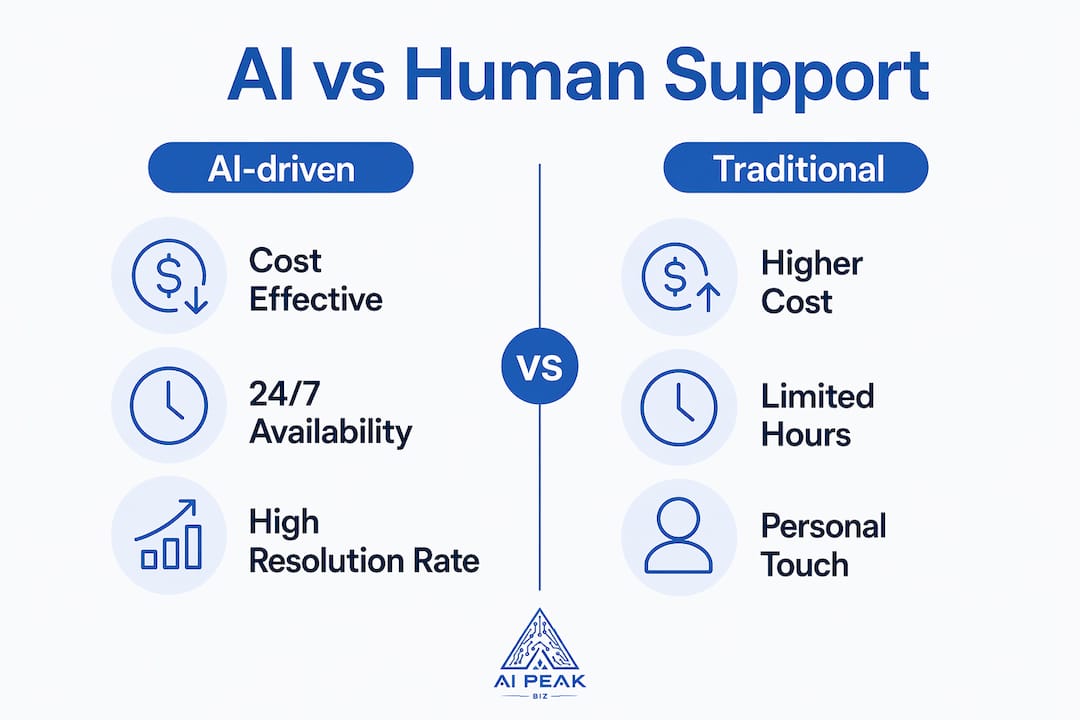
Cost and availability are where AI customer support solutions create the clearest business case. AI-handled resolutions cost about $0.62 per interaction versus $7.40 for human agents. That is a cost difference of nearly 12 to 1. At scale, that gap funds the AI investment many times over.
| Factor | AI-driven support | Traditional human support |
|---|---|---|
| Cost per interaction | ~$0.62 | ~$7.40 |
| Availability | 24/7, no gaps | Business hours, staffing dependent |
| First-contact resolution | 70–85% with conversational intake | Typically under 50% |
| Context retention | Full thread passed automatically | Depends on agent notes |
| Scalability | Handles volume spikes without added cost | Requires hiring and training |
| Emotional nuance | Detects signals, escalates with context | Variable by agent skill |
The table above does not argue for replacing your team. It argues for deploying your team where they create the most value. Arahi AI research shows that AI handles repetitive tickets in brand voice and escalates with full context to human agents, reducing agent workload while improving customer experience. Your best agents should be solving complex problems, not answering the same billing question for the 40th time this week.
Customers do have concerns about AI. The most common one is that they will get stuck in a loop with no path to a real person. The solution is explicit escalation design. Every AI interaction should have a clear, fast path to a human when needed. When that path exists and works well, customer satisfaction scores for AI-assisted service consistently match or exceed scores for human-only service.
For a detailed comparison of AI and traditional answering approaches, the AI vs. traditional service breakdown from Aipeakbiz covers the practical tradeoffs for service businesses specifically.
How AI systems close the feedback loop and reduce recurring complaints
Most service businesses treat complaints as individual events. A customer calls, the issue gets resolved, and the record closes. AI changes this by treating every complaint as operational data. This is the closed-loop feedback model, and it is the mechanism that reduces frustration structurally rather than symptom by symptom.
Andreessen Horowitz frames this shift directly: business leaders should view AI not as a cost-cutting tool but as a concierge enabling proactive, continuous, personalized relationships. That framing matters because it changes what you measure. Instead of tracking complaint volume, you track complaint recurrence. AI makes that possible.
Here is how a closed-loop system works in practice:
- The AI captures structured complaint data across every interaction, not just escalated ones.
- Patterns surface automatically. If 40 customers in one week mention the same billing confusion, the system flags it as a process issue, not a customer issue.
- The business receives a prompt to fix the underlying cause, whether that is a confusing invoice template, a broken confirmation email, or a scheduling gap.
- Resolution rates improve because the root cause is gone, not just managed.
Breaking the Loop research confirms that frustration often stems from broken internal processes. AI reduces frustration by fixing those structural causes, not merely through interpersonal de-escalation. This is the insight most service managers miss. Training your team to be nicer on the phone does not fix a broken booking system. AI-generated complaint data tells you exactly where the system is broken.
Customer Science’s service recovery research reinforces this: AI-driven closed-loop feedback uses complaint data as operational input for systemic fixes, reducing recurring frustration over time. The businesses that implement this model stop fighting the same fires repeatedly. They fix the conditions that start the fires.
Key Takeaways
AI reduces customer frustration most effectively when it captures full context once, detects emotional signals in real time, and feeds complaint data back into process improvement.
| Point | Details |
|---|---|
| Eliminate the repeat-yourself tax | Deploy conversational AI that gathers full context in one thread and passes structured briefs to agents. |
| Use emotion detection on voice calls | AI voicebots that detect frustration signals cut handle time by 20–30% and improve first-call resolution. |
| Compare costs honestly | AI costs ~$0.62 per interaction versus ~$7.40 for human agents, making the business case straightforward. |
| Build closed-loop feedback | Use AI to surface complaint patterns and fix root causes, not just manage individual incidents. |
| Design clear escalation paths | Every AI interaction needs a fast, visible path to a human agent to maintain customer trust. |
Why most businesses are still doing this wrong
I have worked with service businesses that spent months selecting an AI platform and then deployed it as a deflection bot. The goal was to reduce ticket volume. The result was higher frustration scores. Customers hit the bot, could not get a real answer, and called back angrier than before. The technology was not the problem. The strategy was.
The businesses that get real results from AI in customer service treat the AI as a first-responder, not a gatekeeper. They use shadow mode deployment first, letting the AI draft responses that humans review before anything goes live. This catches tone mismatches, wrong answers, and edge cases before customers ever see them. It is the most underused best practice in AI customer service adoption.
My honest recommendation: measure customer effort, not just satisfaction. Satisfaction scores tell you how people felt. Effort scores tell you how hard they had to work to get help. AI’s real value shows up in effort reduction. When you track that metric, you will see exactly where your AI is working and where it is creating new friction.
The other pitfall I see constantly is treating AI and human support as competing options. They are not. Andreessen Horowitz puts it well: AI collapses the cost of high-quality attention, enabling continuous engagement instead of episodic, reactive service. Your human team becomes more valuable when AI handles the volume. That is the combination worth building.
For service businesses exploring where to start, the AI consulting resources at Aipeakbiz offer practical implementation frameworks without the enterprise price tag.
— Wylie
How Aipeakbiz helps service businesses stop losing customers to frustration
Service businesses lose revenue quietly. A missed call at 7 PM, a lead who waited two days for a callback, a customer who got a voicemail and called someone else. Aipeakbiz is built specifically to close those gaps.
The AI voice assistant from Aipeakbiz answers calls instantly, qualifies leads, and books appointments around the clock, in your brand voice. The AI chatbot handles website inquiries with the same consistency, escalating to your team only when a human touch is genuinely needed. Both tools capture full context and pass it cleanly to your staff. No repeated explanations. No dropped leads. If you are ready to see what this looks like for your business, Aipeakbiz offers a hands-on consultation to match the right solution to your specific workflow.
FAQ
What is the repeat-yourself tax in customer service?
The repeat-yourself tax is the frustration customers experience when they must re-explain their issue across multiple agents or channels. Conversational AI eliminates this by capturing full context once and passing it as a structured brief to every subsequent touchpoint.
How does AI emotion detection work on customer calls?
AI voicebots analyze acoustic signals including rising pitch, clipped speech, and repeated phrases to identify frustration in real time. When those signals appear, the system adjusts its tone, skips unnecessary steps, or escalates the call to a human agent with full context attached.
Is AI customer support cheaper than hiring agents?
AI-handled resolutions cost approximately $0.62 per interaction compared to $7.40 for human agents. The cost difference makes AI practical for high-volume, repetitive inquiries, freeing human agents for complex cases that require judgment and empathy.
Will customers accept AI instead of a human agent?
Customers accept AI when it resolves their issue quickly and provides a clear, fast path to a human when needed. First-contact resolution rates of 70–85% with conversational AI intake match or exceed what most human-only teams achieve.
How does AI reduce recurring customer complaints?
AI captures structured complaint data across every interaction and surfaces patterns that point to broken internal processes. Fixing those root causes reduces complaint recurrence more effectively than training agents to handle individual incidents better.
Recommended
- AI Answering Service vs. Traditional Answering Service: Which Is Right for Your Business? | AI Peak Biz
- AI for Small Business: A No-BS Guide for Contractors Who Hate Tech | AI Peak Biz
- AI Revenue Recovery for Service Businesses: The Complete Guide | AI Peak Biz
- AI Front Desk for Home Service Companies | AI Peak Biz
Want to see what your business is losing?
Take our free revenue assessment and find out how much missed calls, slow follow-up, and dormant leads are costing you every month.
Take the Free Assessment