How Personalized AI Outreach Works for Marketers

How Personalized AI Outreach Works for Marketers
Personalized AI outreach is the process of using artificial intelligence to tailor sales and marketing messages to each prospect’s verified account data and real-time business context. This approach is fundamentally different from a mail merge that swaps in a first name. Understanding how personalized AI outreach works means recognizing a six-step repeatable system that transforms outbound communication into a forecastable, scalable process. Aipeakbiz applies these principles to help service businesses answer, qualify, and convert leads without losing the human touch that builds trust.
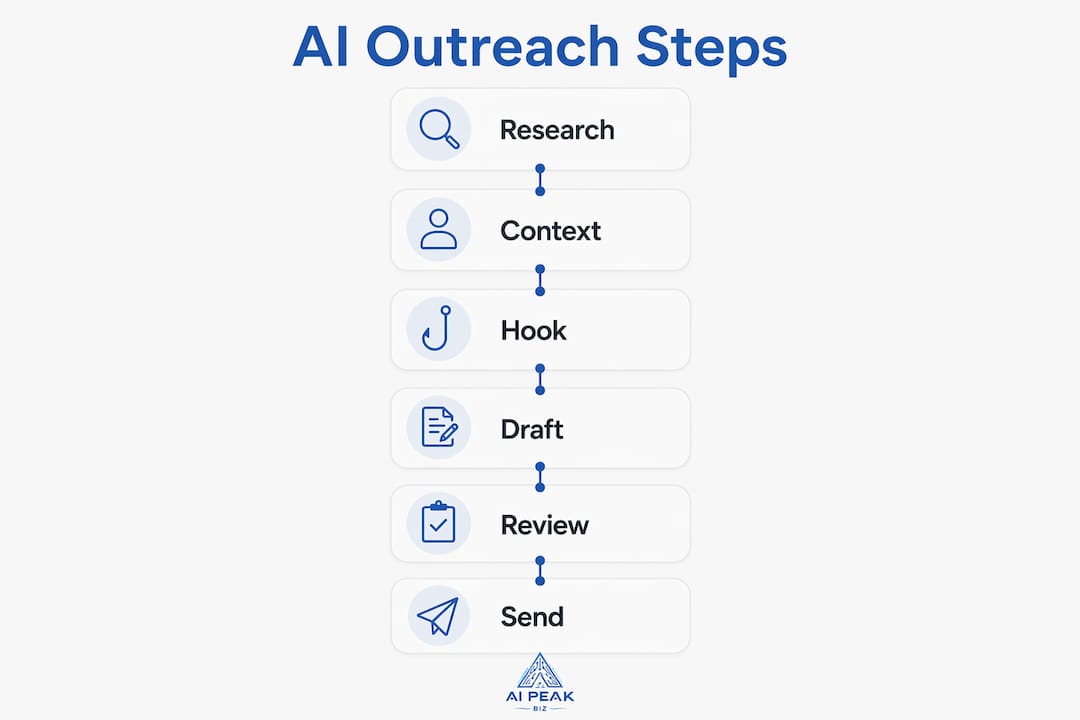
How personalized AI outreach works: the six-step system
Personalized AI outreach follows a defined workflow, not a single prompt typed into a chatbot. Each step builds on the previous one, and skipping any step weakens the entire chain.
-
Gather verified account intelligence. Start with confirmed data: company size, industry, recent funding rounds, leadership changes, and current tech stack. Generic contact lists produce generic results. The quality of your research directly determines the quality of every message that follows.
-
Identify the relevant business context. Find the specific reason your outreach is timely right now. A company that just hired a new VP of Sales has different priorities than one that just closed a Series B. Timing your message to a real business event makes it feel relevant rather than random.
-
Craft a personalized hook. Write a one or two sentence opening that references the specific context you found. This hook is the most important part of the message. It signals to the prospect that you did real research, not a database lookup.
-
Use AI to generate the draft. Feed your hook, the account intelligence, and a clear prompt into your AI tool. The AI writes the full message draft based on your specific inputs. This is where speed and scale enter the process.
-
Mandatory human review. A person reads every AI-generated draft before it sends. Human review catches errors, adjusts tone, and adds personal touches that AI misses. Skipping this step is the single fastest way to destroy trust with a prospect.
-
Optimize from response data. Track reply rates, positive responses, and meeting bookings by message variant. Feed that data back into your prompts and research criteria. The system improves with every campaign cycle.
Pro Tip: Write your personalized hook before you open any AI tool. The research that produces a strong hook is the real work. The AI handles the drafting once you give it something specific to work with.
How does AI integrate data sources for personalization at scale?

AI personalization at scale requires unifying multiple data types into a single system. Effective AI personalization platforms combine marketing data, service history, and behavioral analytics into AI-first CRMs that enable genuine 1:1 messaging across thousands of contacts simultaneously. That capability scales nearly 60 years of direct marketing principles without sacrificing the human-like quality of each interaction.
The data sources that matter most include:
- Firmographic data: Company size, industry, revenue range, and geographic location. This data segments your audience into groups with shared business realities.
- Behavioral signals: Website visits, content downloads, email opens, and product usage patterns. These signals reveal where a prospect is in their decision process.
- Situational triggers: Funding announcements, executive hires, product launches, and job postings. Research depth on these signals is the real differentiator between AI outreach that converts and AI outreach that gets ignored.
- Relational history: Past conversations, support tickets, and previous purchases. This data prevents you from sending a cold pitch to someone who already bought from you.
- Intent data: Third-party signals showing a prospect is actively researching solutions in your category. Targeting prospects with active intent dramatically improves conversion rates.
AI customer segmentation works by feeding descriptive prompts into your CRM’s AI layer. Instead of building brittle branching logic, AI models classify intent mid-journey and determine the next best message dynamically. This approach produces cleaner campaigns and removes the maintenance burden of complex decision trees.
| Data type | What it reveals | Outreach application |
|---|---|---|
| Firmographic | Company size and industry | Segment by business model |
| Behavioral | Engagement patterns | Time messages to active interest |
| Situational | Recent business events | Reference timely context in the hook |
| Intent | Active category research | Prioritize high-readiness prospects |
What best practices ensure authentic AI outreach?
Authentic personalization requires more than pulling a job title from a database. Genuine relevance demands four context layers: role context (what this person’s job actually involves), relational context (your history with them or their company), situational context (what is happening in their business right now), and firmographic context (the structural realities of their organization). Messages that address all four layers prove real research. Messages that address only one feel like automation.
The most common mistake in AI outreach is letting the AI write everything. AI should write only the personalized variable, which is typically the opening hook. The core value proposition, social proof, and call to action stay human-written. This hybrid approach keeps your brand voice consistent while giving each prospect a message that feels written specifically for them.
- Balance AI drafting with human editing. Review every message before it sends. AI hallucinates facts, misreads context, and occasionally produces tone that is off-brand.
- Avoid over-relying on data enrichment tools alone. Tools that auto-populate contact fields give you surface-level data. Real personalization comes from reading a prospect’s recent LinkedIn posts, press releases, or published interviews.
- Match your offer to your audience’s preferences. Technical B2B audiences respond better to outreach that offers a sandbox URL or a useful resource than to a generic demo request. Value over interruption is the rule.
- Keep your core message human. Social proof, case studies, and your value statement carry more weight when they sound like a person wrote them, not a language model.
Pro Tip: Before sending any AI-drafted message, read it out loud. If it sounds like a press release or a chatbot, rewrite the opening sentence. Your prospect will make that judgment in under three seconds.
What tangible benefits can businesses expect from AI outreach?
The business case for personalized AI outreach is grounded in measurable outcomes, not theory. Proprietary research enables higher reply rates and greater category authority than template-driven messaging. Building an in-house research process, even a lightweight one, consistently outperforms buying a generic agency playbook.
The efficiency gains are equally significant. AI-powered personalization can reduce service costs by 20–30% by matching messages to predicted preferences rather than sending the same content to every contact. That cost reduction comes from better targeting, not from cutting corners on message quality.
Businesses that implement a structured AI outreach system report several consistent benefits:
- Reduced manual workload. AI handles the drafting step, freeing your team to focus on research and relationship-building rather than writing from scratch.
- Higher reply rates. Messages tied to real business context get opened and answered at higher rates than generic templates.
- Better pipeline forecasting. A repeatable six-step process produces consistent output volume, which makes revenue forecasting more reliable.
- Smarter resource allocation. Targeting prospects with active intent signals means your outreach budget goes toward contacts who are already looking for solutions like yours.
- Execution consistency. AI does not have bad days. Every message follows the same quality framework, regardless of how busy your team is.
You can explore how AI tools improve customer experience in practice to see how these benefits show up in real service business contexts.
Key takeaways
Personalized AI outreach works because it combines verified account research, AI-assisted drafting, and mandatory human review into a repeatable system that scales relevance without sacrificing authenticity.
| Point | Details |
|---|---|
| Six-step system | Gather intelligence, identify context, craft a hook, draft with AI, review as a human, then optimize. |
| Four context layers | Role, relational, situational, and firmographic data together produce genuinely relevant messages. |
| Hybrid construction | AI writes the personalized hook; humans write the core value proposition and social proof. |
| Human review is non-negotiable | Every AI-generated draft needs a human check to catch errors and preserve trust. |
| Cost and efficiency gains | AI-powered personalization can reduce service costs by 20–30% through better message targeting. |
Why research depth matters more than AI writing ability
I have worked with enough AI outreach implementations to say this plainly: the writing is the easy part. Every marketer I know can get a decent draft out of a language model in under two minutes. The hard part, and the part that actually determines whether your outreach converts, is the research that happens before you open any AI tool.
The businesses that see real results from personalized AI outreach are the ones that invest in understanding their prospects at a level most teams never bother with. They know about the leadership change that happened six weeks ago. They read the earnings call transcript. They noticed the job posting that signals a new initiative. That depth of context is what makes an AI-drafted message feel like it came from someone who genuinely understands your business.
I also want to push back on the idea that AI outreach is a set-it-and-forget-it system. The optimization step in the six-step process is where most teams quit too early. Reply data tells you exactly what is working and what is not. Ignoring that feedback loop is like running ads without checking your click-through rate. The system only gets better if you feed it.
My advice for any business owner or marketer planning to adopt these methods: start with one segment, one message type, and one clear research process. Get that working before you scale. Aipeakbiz’s AI consulting approach reflects this same philosophy. Build the foundation right, and the scale follows naturally.
— Wylie
Aipeakbiz’s AI solutions for personalized outreach
Missed calls and slow follow-up are the two most common ways service businesses lose revenue. Aipeakbiz addresses both with AI systems that answer, qualify, and respond to leads around the clock, without making prospects feel like they are talking to a machine.
Aipeakbiz’s AI chatbot for service businesses applies the same personalization principles covered in this article to every inbound conversation. It pulls context from the prospect’s inquiry, matches the response to their specific situation, and books appointments without human intervention. For businesses that want to put personalized outreach on autopilot, the AI appointment setter integrates directly with your calendar and outreach campaigns to convert more leads into confirmed bookings. No lead slips through because the system was too busy.
FAQ
What is personalized AI outreach?
Personalized AI outreach is the use of artificial intelligence to generate messages tailored to each prospect’s verified account data, business context, and behavioral signals. It differs from generic automation by incorporating real research into every message rather than substituting a contact’s name into a template.
How does AI personalization differ from a mail merge?
A mail merge swaps static fields like name and company into a fixed template. AI personalization uses live research signals, behavioral data, and contextual prompts to generate a unique message for each prospect. The result is a message that reflects the prospect’s current business reality, not just their job title.
Why is human review required in AI outreach?
AI models can hallucinate facts, misread context, and produce off-brand tone. Mandatory human review catches these errors before they reach a prospect and preserves the trust that makes outreach effective.
What data sources power effective AI outreach?
Effective AI outreach draws from firmographic data, behavioral signals, situational triggers like funding or leadership changes, relational history, and third-party intent data. Combining these sources gives AI enough context to generate messages that feel genuinely relevant.
How quickly can a business see results from personalized AI outreach?
Results depend on the quality of the research process and the consistency of human review. Businesses that follow a structured six-step system typically see improved reply rates within the first few campaign cycles, with forecasting accuracy improving as response data accumulates over time.
Recommended
Want to see what your business is losing?
Take our free revenue assessment and find out how much missed calls, slow follow-up, and dormant leads are costing you every month.
Take the Free Assessment