The Role of AI in Service Business Retention

The Role of AI in Service Business Retention
The role of AI in service business retention is to automate repetitive tasks, personalize customer experiences, and proactively reduce churn to grow loyalty and revenue. Customer retention, the industry term for keeping existing clients engaged and spending, has become the defining competitive advantage in the service sector. 82% of small business leaders plan to continue investing in AI-driven engagement tools over the next year. That number reflects a clear market signal: service businesses that adopt AI now will outpace those that wait. AI expands capacity, speeds response, and catches at-risk customers before they walk out the door.
How does AI in service business retention work?
AI improves retention by removing the friction that causes customers to leave. Slow responses, missed calls, and repeated explanations are the top mechanical reasons clients cancel or stop returning. AI addresses each of these directly, in real time, without adding headcount.
The first function is speed. AI answers inquiries, qualifies leads, and books appointments around the clock. A customer who calls at 9:00 PM and gets a response immediately is far less likely to call a competitor the next morning. The second function is consistency. AI applies the same process every time, so no lead falls through the cracks due to a busy day or a distracted staff member.

First-year churn sits at 55%, making the first 12 months of a customer relationship the highest-risk window. AI enables proactive intervention during that window by flagging behavioral signals before a customer disengages. That is the core value proposition: AI does not just react to problems, it prevents them.
How does AI automate routine customer service tasks to enhance retention?
AI handles the repetitive work that consumes staff time and slows response rates. AI chatbots manage 60–80% of routine inquiries around the clock, deflecting common questions without human involvement. That deflection translates directly to cost savings and faster service for every customer.
Beyond chat, AI automates CRM data entry, call summarization, and appointment scheduling. These are tasks that staff often delay or skip under pressure, creating gaps in customer records that lead to poor follow-up. When AI handles them automatically, your team always has accurate context before every customer interaction.
AI digital assistants save small business owners 10–15 hours per week in administrative work. Those recovered hours go directly into higher-value activities like relationship-building and complex problem-solving.
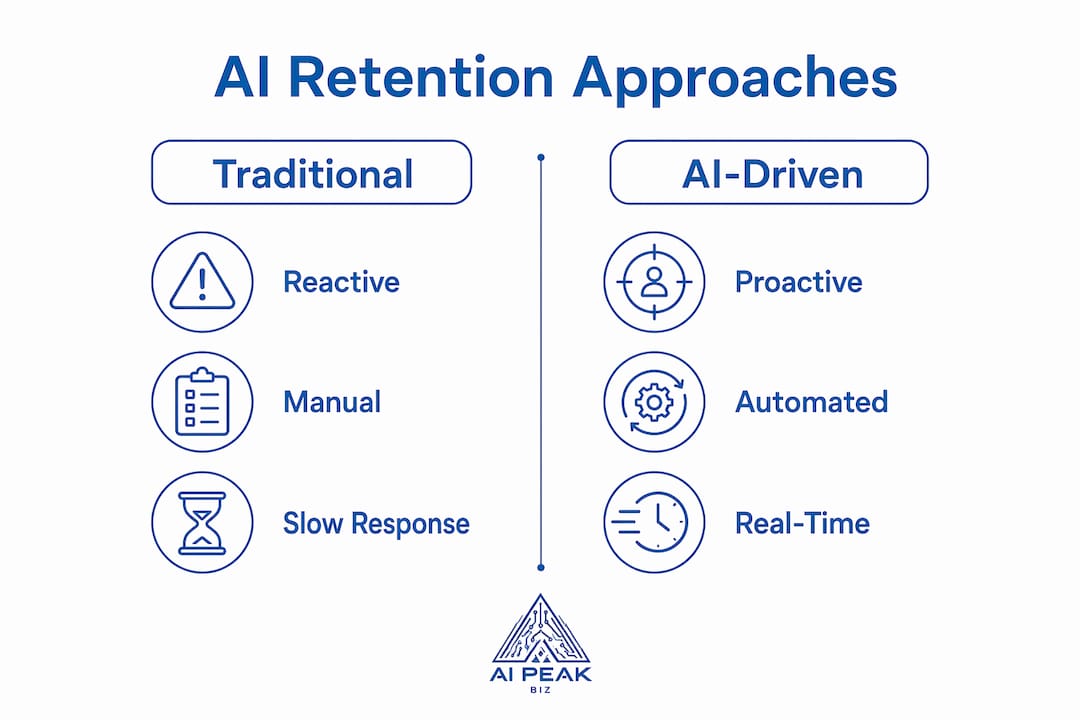
The most effective model for service businesses is a hybrid approach. AI handles volume and admin; humans handle judgment and empathy. A hybrid AI-human model consistently produces the best retention results in small and mid-sized businesses. Replacing human contact entirely with AI is a retention risk, not a gain.
Pro Tip: Start your AI deployment at the two highest-friction points in your customer journey: missed calls and slow follow-up. Fixing those two issues alone produces measurable retention gains before you add any other tools.
- AI chatbots answer FAQs, pricing questions, and booking requests 24/7
- Automated CRM updates keep customer records accurate without staff input
- Call summarization tools log key details after every conversation
- Appointment scheduling AI confirms, reschedules, and sends reminders automatically
- Missed call text-back systems recover leads that would otherwise go cold
In what ways does AI personalize customer engagement to build loyalty?
Personalization is the most direct path from satisfied customer to loyal customer. AI analyzes purchase history, service frequency, and communication preferences to tailor every touchpoint. A customer who receives a message that reflects their actual history with your business feels recognized, not processed.
AI-powered next best experience capabilities enhance customer satisfaction by 15–20% and increase revenue by 5–8%. That satisfaction gain compounds over time because loyal customers spend more, refer others, and cost less to retain than new customers cost to acquire.
Sentiment analysis is one of the most underused personalization tools available to service businesses. AI reads tone and language in customer messages to flag frustration before it becomes a cancellation. A human agent can then reach out proactively, turning a near-churn into a recovered relationship.
Context continuity is equally important. Customers stay longer when AI maintains their history across every channel, eliminating the need to repeat themselves. Nothing erodes loyalty faster than explaining the same problem to three different agents. AI solves that by carrying full context from one interaction to the next.
Key AI personalization techniques that drive retention:
- Behavioral segmentation based on service history and engagement frequency
- Automated follow-up messages timed to each customer’s activity patterns
- Sentiment analysis to flag at-risk customers for human outreach
- Personalized re-engagement campaigns triggered by inactivity
- Context-aware responses that reference previous interactions by name and detail
What is the role of AI in proactive churn prediction and intervention?
Proactive churn prevention is where AI creates the clearest competitive advantage for service businesses. Traditional retention is reactive: a customer cancels, and then you try to win them back. AI flips that sequence by identifying warning signs days or weeks before a customer disengages.
The behavioral signals AI monitors include declining contact frequency, unresolved service tickets, slower response times from the customer, and negative sentiment in recent communications. Each signal alone may seem minor. Together, they form a reliable pattern that predicts departure.
AI improves speed and consistency to reduce service-related churn by fixing the mechanical causes of attrition rather than guessing who will leave. That distinction matters. Most churn is not caused by price or competition. It is caused by slow responses, unresolved issues, and the feeling that a business does not care.
The table below shows how traditional reactive retention compares to AI-driven proactive retention.
| Workflow stage | Traditional reactive approach | AI-driven proactive approach |
|---|---|---|
| Churn detection | Customer cancels or goes silent | AI flags behavioral signals in real time |
| Response timing | After the customer leaves | Before disengagement occurs |
| Outreach trigger | Manual review of lost accounts | Automated alert to human agent |
| Resolution method | Win-back offer after cancellation | Service recovery before departure |
| Data used | Historical billing records | Live sentiment, ticket status, contact frequency |
Service recovery models work best when AI triggers the outreach and a human closes the conversation. AI identifies the problem and creates the alert. Your team delivers the personal touch that rebuilds trust. That combination is more effective than either approach alone.
How can service leaders integrate AI while preserving human relationships?
AI expands your team’s capacity. It does not replace the relationships your team builds. Service businesses that treat AI as a replacement for human judgment consistently see quality drop and retention suffer. The ones that treat AI as a capacity tool see both metrics improve.
AI accelerates existing workflows but will not fix broken ones. If your lead capture process is inconsistent or your follow-up cadence is unclear, adding AI scales those problems rather than solving them. Stabilize your core processes first, then deploy AI to run them faster and more consistently.
The right build sequence matters. Master one core AI assistant first by building prompt templates for your specific pain points before adding specialized tools. A business that uses one AI tool well outperforms a business running five tools poorly. Complexity without mastery creates confusion, not results.
Pro Tip: Before adding a new AI tool, ask one question: does this fix a specific, measurable problem in my customer journey? If you cannot name the problem it solves, the tool is not ready to deploy.
Practical steps for balanced AI integration:
- Audit your customer journey for friction points before selecting any tool
- Assign AI to high-volume, low-judgment tasks first
- Keep humans responsible for all complex service decisions and relationship conversations
- Review AI performance monthly against retention and response-time metrics
- Add specialized AI tools only after your core assistant is running consistently
You can also explore how AI tools improve customer experience in real service business settings to see these principles applied in practice. For businesses hiring to support AI-assisted growth, hiring software for small businesses has also advanced significantly in 2026, making it easier to build the right team alongside the right tools.
Key Takeaways
AI improves service business retention by automating friction points, personalizing every interaction, and catching at-risk customers before they leave.
| Point | Details |
|---|---|
| First-year churn is the critical window | 55% of customers churn in year one; AI intervention during this period has the highest ROI. |
| Automation frees capacity for relationships | AI handles 60–80% of routine inquiries, giving your team time for high-value human engagement. |
| Personalization drives measurable loyalty | AI-powered personalization increases customer satisfaction by 15–20% and revenue by 5–8%. |
| Fix processes before deploying AI | AI scales what exists; broken workflows become bigger problems, not smaller ones. |
| Hybrid models outperform full automation | AI handles volume and admin; humans handle judgment and trust-building for best retention results. |
Why I think most service businesses are using AI backwards
Most service leaders I speak with deploy AI to impress prospects. They build chatbots for their website homepage and automate their social media posts. Those are visibility tools, not retention tools. The businesses that actually grow their customer base with AI focus it inward, on the moments after the sale.
The first 12 months of a customer relationship are where revenue is won or lost. A client who books once and never hears from you again is not a retained customer. They are a one-time transaction waiting to be claimed by whoever follows up first. AI gives you the ability to follow up consistently, personally, and at scale. That is the real advantage.
I have also seen businesses stall by waiting for the perfect AI setup before deploying anything. The businesses gaining ground right now started with one tool, one pain point, and one measurable outcome. They fixed missed calls. They automated appointment reminders. They built from there. The role of AI in service call management is a good starting point for leaders who want to see what that looks like in practice.
The competitive window for early adoption in service businesses is still open. It will not stay open much longer.
— Wylie
How Aipeakbiz helps service businesses retain more customers
Service businesses lose revenue quietly. A missed call at 7:00 PM, a lead that waited two days for a reply, an appointment that never got confirmed. These are not dramatic failures. They are small gaps that compound into significant churn.
Aipeakbiz closes those gaps with an AI system built specifically for service businesses. The AI appointment setter books clients around the clock without staff involvement. The AI chatbot handles routine inquiries instantly, so no customer waits for a response during off-hours. The AI voice assistant answers calls, qualifies leads, and routes conversations to the right person every time. Every tool is set up and managed with hands-on support, so you get consistent results without the learning curve. If you want to see what your missed calls are actually costing you, the missed call revenue calculator gives you a clear number in under two minutes.
FAQ
What is the role of AI in service business retention?
AI retains customers by automating fast responses, personalizing follow-up, and flagging at-risk clients before they disengage. It removes the friction points, slow replies, missed calls, and repeated explanations, that cause most service business churn.
How does AI reduce churn in the first year of a customer relationship?
First-year churn reaches 55% in service businesses, and AI addresses this by monitoring behavioral signals and triggering proactive outreach before a customer goes silent. Automated follow-ups and consistent communication keep new clients engaged during the highest-risk period.
Can small service businesses afford AI retention tools?
AI tools are accessible at every budget level, and the cost savings are immediate. AI chatbots alone save small businesses up to $1,750 monthly by deflecting routine inquiries that would otherwise require paid staff time.
Should AI replace human staff in customer service?
No. The most effective model keeps humans responsible for complex decisions and relationship conversations while AI handles volume and admin. A hybrid approach consistently outperforms full automation for retention in small and mid-sized service businesses.
How do I start integrating AI into my service business?
Start with your highest-friction customer touchpoint, typically missed calls or slow follow-up, and deploy one AI tool to fix it. Master that core assistant first before adding specialized tools, and measure retention and response-time outcomes monthly to track progress.
Recommended
Want to see what your business is losing?
Take our free revenue assessment and find out how much missed calls, slow follow-up, and dormant leads are costing you every month.
Take the Free Assessment